
Audi AG, a Bavaria (Germany) based luxury automotive manufacturer is a wholly owned subsidiary of Volkswagen AG (Volkswagen Group), the Germany automotive group. Audi manufacturers across nine production facilities globally. In Germany, the company’s manufacturing facilities are based in Ingolstadt and Neckarsulm. The Audi e-tron family is series of electric and hybrid cars introduced since 2009. The first e-tron concept car was introduced at the 2009 International Motor Show (Germany). The Audi all-electric e-tron portfolio of battery-electric vehicles (BEVs) includes:
For those of you new to zero-emission electric driving, we recommend a read of the following articles:
Overview Audi AG, a Bavaria (Germany) based luxury automotive manufacturer is a wholly owned subsidiary of Volkswagen AG (Volkswagen Group), the Germany automotive group. Audi manufacturers across nine production facilities…
Read More
The all-electric Audi Q8 e-tron Sportback is the range-topping EV, replacing the first-generation Audi e-tron Sportback. The Q8 e-tron is also available in a more traditional SUV body style. Both EVs are being manufactured at the Audi Brussels factory.
The Audi Sportback body style was first shown in 2009. For those seeking a sportier exterior styling, the coupé-SUV roofline of the Q8 e-tron Sportback will appeal. According to Audi, “the Sportback e-tron has the unmistakable dimensions of an SUV – with the dynamic silhouette of a sporty coupé“. Indeed, this is correct, in that, the length, wheelbase and width of the Q8 SUV and Q8 Sportback are similar. However the key differences are in the height and the boot space.
The Q8 SUV height is 1633mm, while the height for the Sportback is 1619mm. The Sportback has a smaller boot (528 L) compared to the SUV (569 L). Both body styles have a frunk (62 L). Also, given the sleeker roof, headroom is compromised in the cabin and rear-view visibility impacted.
However, in return, the aerodynamics and efficiency of the electric vehicle is improved, compared to a more traditional SUV body style. The Q8 Sportback has an improved aerodynamic efficiency (0.24 Cd), compared to the traditional SUV (0.27 Cd). Moreover, for the latest generation e-tron Sportback, the drag coefficient has been reduced from 0.26 to 0.24 Cd.
The Q8 pure electric Sportback is available in two EV battery sizes: 95 kWh and 114 kWh. An increase in size from the original Audi e-tron Sportback, which was also available in two battery sizes (71.2 kWh/ 95 kWh). Audi claims that the Q8 e-tron Sportback can achieve an electric range up to 292 miles (WLTP) for the 95 kWh EV battery, and an e-range up to 345 miles (WLTP) for the larger 114 kWh EV battery. Both options offer marginally more zero-emission range, compared to the traditional SUV body style.
Of course, the real-world zero-emission electric range will differ from the manufacturer quoted range. Expect a real-world e-range closer to 250 miles for the 95 kWh EV battery and up to 290 miles for the 114 kWh EV battery. Certainly, a useful and practical range for short and long distance travel.
Audi has marginally improved the high-speed DC charging capability of the latest e-tron Sportback. The EV offers rapid DC charging up to 170 kW, but only for the 55 e-tron variant. The 50 e-tron variant is available with 150 kW DC.
The 95 kWh EV battery will take 28 minutes to achieve up to 80% charge at 150 kW DC, and will take up to 1 hour and 16 minutes to achieve 80% charge at 50 kW DC. The 114 kWh EV battery can be charged up to 80% in 31 minutes at 170 kW DC and 1 hour and 18 minutes at 50 kW DC.
The Q8 e-tron Sportback has a three-phase 11 kW AC onboard charger as standard, with the option to upgrade to a 22 kW AC onboard charger. If you expect the majority of the charging to be done at home, upgrading to a 22 kW AC onboard charger will not be required, as most homes in the UK are powered by single-phase power supply i.e. in reality you will be charging at 7.4 kW AC.
For those fortunate enough to have access to 11 kW three-phase EV charging at the workplace or any other public charging points, the 95 kWh EV battery can be fully charged in 9 hours and 15 minutes for 11kW AC charging. At 22 kW AC charging, it will take up to 4 hours and 45 minutes.
For the larger EV battery (114 kWh), at 11 kW AC charging, it will take 11 hours and 30 minutes, and for 22 kW AC charging, it will take up to 6 hours. Of course, charging at single-phase (7.4 kW AC) will take longer compared to three-phase EV charging.
At 7.4 kW AC, the 95 kWh EV battery will take 14 hours and 30 minutes to fully charge, while 114 kWh will take up to 18 hours. We at e-zoomed recommend a ‘topping up’ approach to charging an electric car, this way, charging times are always shorter!
The improvements for the latest generation e-tron continues: as an example, the Q8 e-tron Sportback has an improved asynchronous motor concept. It has upgraded the previous generation 12 coils to 14, further improving the delivery of torque for the Q8 and also reducing the energy required.
The pure electric Q8 e-tron Sportback is available in two drivetrain options, the 50 e-tron and the 55 e-tron. Despite the weight of the four-wheel drive electric SUV (2,585 kg), the performance is impressive. The higher specification, 55 e-tron can achieve 0-62 mph in 5.6 seconds (maximum power: 408 PS/ torque: 664 Nm). The 50 e-tron can achieve 0-62 mph in 6 seconds (maximum power: 340 PS/ torque: 664 Nm). The top speed of the EV is 124 mph.
In terms of interior quality, equipment and technology, it reflects the premium price tag. The Q8 Sportback EV has 40 driver assistance systems, supported by five radar sensors, five cameras and 12 ultrasonic sensors. The EV also incorporates remote paring assist plus, which is perfect for those tight parking spaces. The Q8 also uses the MMI touchscreen operating system, as is the case with the other Audi electric cars. The Q8 has two high-resolution displays, 8.6 inch and 10.1 inch.
As is the trend now with global automotive manufacturers, Audi is also keen to demonstrate its commitment to sustainability, in particular, in regards to materials used for production. Audi has used recycled materials for insulation, damping and carpeting.
The EV also incorporates recycled automotive plastic waste. The Q8 e-tron is expected to be certified as net-carbon-neutral for customers in Europe and the USA. The Q8 e-tron is available to order in the UK, with deliveries commencing in 2023.
Company-car drivers can take advantage of the lower Benefit-in-Kind (BiK-2%) tax charge for pure electric cars. Bottom-line, electric driving is good for the environment and the wallet. You can lease electric vehicles (EVs) via e-zoomed at very competitive prices!
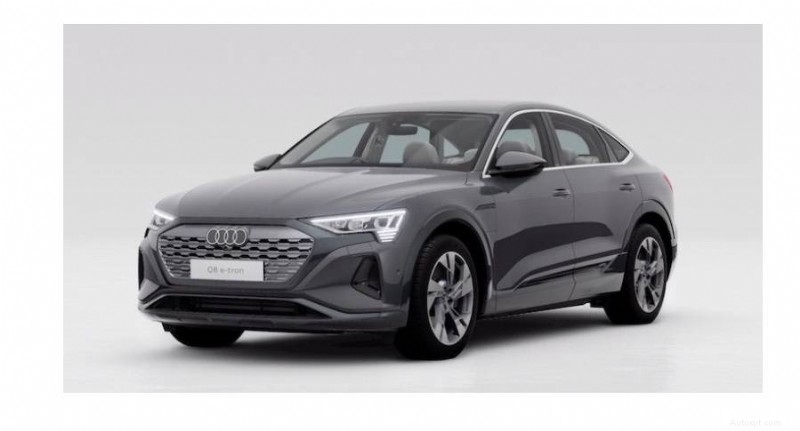
The All-Electric Audi Q8 e-tron Sportback (credit: Audi)
While e-zoomed uses reasonable efforts to provide accurate and up-to-date information, some of the information provided is gathered from third parties and has not been independently verified by e-zoomed. While the information from the third party sources is believed to be reliable, no warranty, express or implied, is made by e-zoomed regarding the accuracy, adequacy, completeness, legality, reliability or usefulness of any information. This disclaimer applies to both isolated and aggregate uses of this information.
