
SEAT CUPRA, S.A.U, simply known as CUPRA, is the high-performance motorsport subsidiary of SEAT S.A., Spain’s first family car manufacturer. The automotive company was founded in 1950 and is headquartered in Martorell, Spain.
In 1986, SEAT was sold to the German automotive group, Volkswagen A.G. CUPRA was previously known as SEAT Sport. The high-performance CUPRA brand was created in 2018. The manufacturer is committed to becoming a fully-electric brand by 2030. CUPRA is expected to introduce the all-electric CUPRA Terramar and the all-electric CUPRA UrbanRebel in due course. The company has the following portfolio of plug-in hybrid electric vehicles (PHEVs) and battery-electric vehicles (BEVs):
For those of you new to zero-emission electric driving, we recommend a read of the following articles:

Overview SEAT CUPRA, S.A.U, simply known as CUPRA, is the high-performance motorsport subsidiary of SEAT S.A., Spain’s first family car manufacturer. The automotive company was founded in 1950 and is headquartered in…
Read More
The Cupra Leon compact hatchback is the high-performance version of the Seat Leon hatchback. The Leon has been sold since 1999, and is now in its fourth generation.
The vehicle is built on the Volkswagen Group MQB platform. The Cupra Leon (formerly Seat Leon Cupra) plug-in hybrid electric vehicle (PHEV) is a good option for those seeking high-performance, but in an environmentally-friendly electric vehicle (EV).
In the Cupra electric hatchback, the automotive manufacturer has successfully combined a ‘hot hatch’ performance, along with an environmentally-friendly plug-in hybrid engine. The electric vehicle (EV) has a 12.8 kWh onboard EV battery, with a WLTP certified zero-emission electric range up to 32 miles.
The real-world EV range will be lower, impacted by a number of factors, to include: driving profile, speed, passenger load, weather, road condition, wheel size, etc. Assuming a 27 mile emission-free electric range is more realistic. However, that should be just fine for most shorter commutes.
Do keep in mind that the average commute is a mere 10 miles. Hardly surprising, given that the majority of our day-to-day trips include going to the grocery store, school-runs, high street, gym, to work etc.
Driving on e-mode is not only beneficial to the local air quality (zero-tailpipe emissions), but also saves money. Driving a PHEV on electric mode can cost as little as 10 pence per mile, substantially cheaper than using the internal combustion engine (ICE).
In fact, the more the EV is driven on the pure electric mode, the better is the overall fuel economy of the vehicle. The manufacturer claims that the Cupra PHEV has a fuel economy up to 221.8 mpg. To achieve anywhere close to the claimed MPG, driving the plug-in electric car on EV mode will be imperative. If the PHEV is driven primarily using the petrol engine, the fuel economy will be closer to 40 mpg.
Another advantage of the Cupra PHEV, compared to the conventional petrol variant (172g CO2/km), is the reduced tailpipe emissions from the PHEV (29g CO2/km). Given the lower tailpipe emissions, a company-car driver can save further on driving the PHEV, as the Benefit-in-Kind (BiK-12%) tax charge is far lower for the PHEV, than the conventional internal combustion engine variant!
The EV has a 3.6 kW onboard charger, and using a dedicated home EV charging station, can be fully charged in under four hours. Of course, EV owners ‘top-up’ the battery charge on a regular basis. This way, one does not need to wait fours hours for a full charge! Moreover, topping up on a regular basis is also better for the long-term maintenance of the onboard EV battery. Cupra offers a 8 years or 100,000 miles warranty.
Yes, a 3-PIN domestic socket can be used for charging the EV, however, we at e-zoomed discourage the use a domestic socket for charging an EV. It is faster and safer to use a dedicated EV charging station. The EV does not offer DC charging compatibility.
As would be expected from a Cupra badge, the exterior styling does not disappoint. The copper badged plug-in electric hatchback has a distinctive styling, placing it among the best looking electric hatchbacks in the market. The interior is also high quality and more importantly, practical. Adults seated on the rear seats have amply headroom and legroom. However, due to the placement of the EV battery, the boot space is not as large (270 L).
A number of intelligent safety features are available to include: emergency assist, rain/ light sensor, exit warning, rear traffic alert, front assist, side assist and the Cupra eCall emergency service.
The Cupra Leon plug-in hybrid pairs the 1.4 e-HYBRID petrol engine with an electric motor. In terms of performance, the front-wheel drive PHEV delivers up to 245 PS and 250 Nm torque. The top speed is 140 mph, and the EV can achieve 0-62 mph in 6.4 seconds. Of course, the EV benefits from instant torque.
The EV does not qualify for the UK government plug-in car grant (PiCG). Bottom-line, electric driving is good for the environment and the wallet. You can lease electric vehicles at very competitive prices via e-zoomed!
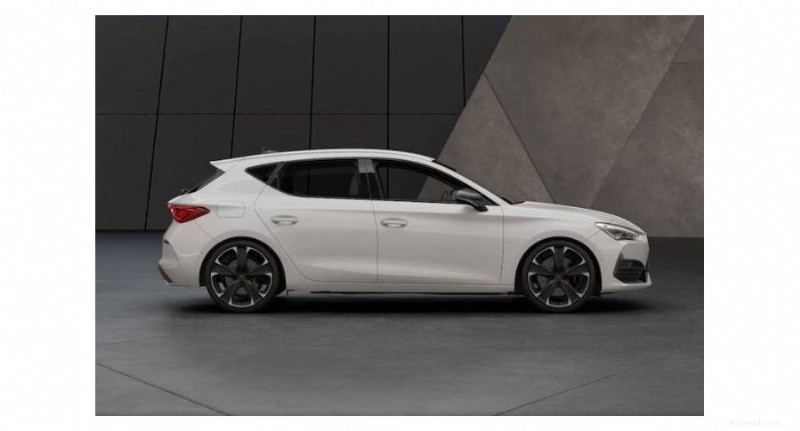
The Cupra Leon PHEV Hatchback (credit: Cupra)
While e-zoomed uses reasonable efforts to provide accurate and up-to-date information, some of the information provided is gathered from third parties and has not been independently verified by e-zoomed. While the information from the third party sources is believed to be reliable, no warranty, express or implied, is made by e-zoomed regarding the accuracy, adequacy, completeness, legality, reliability or usefulness of any information. This disclaimer applies to both isolated and aggregate uses of this information.
