
Audi AG, a Bavaria (Germany) based luxury automotive manufacturer is a wholly owned subsidiary of Volkswagen AG (Volkswagen Group), the Germany automotive group. Audi manufacturers across nine production facilities globally. In Germany, the company’s manufacturing facilities are based in Ingolstadt and Neckarsulm. The Audi e-tron family is series of electric and hybrid cars introduced since 2009. The first e-tron concept car was introduced at the 2009 International Motor Show (Germany). The Audi plug-in hybrid electric vehicle (PHEV) portfolio includes:
For those of you new to zero-emission electric driving, we recommend a read of the following articles:

Overview Audi AG, a Bavaria (Germany) based luxury automotive manufacturer is a wholly owned subsidiary of Volkswagen AG (Volkswagen Group), the Germany automotive group. Audi manufacturers across nine production…
Read More
The Audi Q3 is a compact premium crossover SUV. The Q3 has been manufactured since 2011. The SUV is now in its second generation and uses the Volkswagen Group MQB platform. The Audi Q3 is available as a standard SUV or Sportback body style. The Q3 Sportback is available as a plug-in hybrid electric vehicle (PHEV).
Its compact, stylish, high quality and can save you money while driving on e-mode. The front-wheel drive Audi Q3 PHEV is a good entry-level option to consider in the higher-priced upmarket segment. For those seeking a sportier looking, but environmentally-friendly premium-badged compact EV, the Q3 plug-in hybrid should be on the list.
For company-car drivers there is the added benefit of the lower Benefit-in-Kind (BiK-11%) tax rate from driving the plug-in electric car due to the lower tailpipe emissions. The Audi Q3 Sportback TFSIe Plug-In Hybrid has claimed emissions up to 45g (CO2/km).
The Audi plug-in hybrid electric vehicle has a 13 kWh onboard EV battery, with a quoted WLTP pure electric range up to 28 miles. Though the emission-free electric range is not as impressive as some alternative PHEVs, for shorter distances, in particular, in towns and cities, an emission-free electric range over 25 miles is more than sufficient. In fact, 2/3rds of motorist drive only 30 miles per day.
Despite the quoted manufacturers electric range, expect the real world range to be lower, impacted by a number of factors, to include: the way the electric vehicle (EV) is driven, the conditions of the road, the passenger load, the regenerative braking profile in use, weather condition, wheel size, etc. A real-world range will be closer to 23 miles.
We at e-zoomed recommend (when appropriate), to always choose the maximum available regen braking profile in the EV. This will help recuperate more energy and increase the overall fuel-economy of the electric car. Audi claims a fuel economy up to 141.2 mpg. The real-world fuel economy will vary based on the amount the EV is driven on electric mode.
We also suggest to keep the EV battery ‘topped up’, as the more the EV can be driven on electric mode, the more improved the efficiency of the vehicle and higher the financial savings. Keep in mind that driving an EV per mile is less than 10 pence i.e. much cheaper than driving on petrol or diesel.
The Q3 EV has a 7.2 kW onboard charger, sufficient for charging the 13 kWh EV battery relatively quickly at home or at public AC charging. The EV can be fully charged in 3 hours and 45 minutes. Though an EV can be charged using a 3-PIN domestic socket, we would encourage EV drivers to charge using a dedicated residential EV charger like Easee: faster and safer in charging operation, compared to a domestic 3-PIN plug! The EV does not offer DC charging compatibility.
The Audi Q3 PHEV pairs the electric motor, with the 1.4-litre petrol internal combustion engine (ICE), offering a combined system power of 245 PS and 400 Nm torque. The PHEV can accelerate from 0 to 62 mph in 7.3 seconds. Of course, a plug-in hybrid electric vehicle will be a little heavier than the internal combustion engine variant, given the additional weight of the onboard EV battery. However, a PHEV does gain from the availability of instant torque.
In terms of practicality, the rear seats are impacted by the sloping roofline i.e. lower headroom for rear seat passengers. However, the front seats have ample headroom and legroom. Also impacted by the roofline, is the rear visibility. Despite the boot reduced in size due to the placement of the EV battery, the EV still offers 380 L.
As for interior quality, the Audi plug-in hybrid does not disappoint. The interior is completed to a high finish and is technology-filled, to include: hill descent control, pre-Sense front with pedestrian and cyclist detection, camera-based traffic sign recognition, lane departure warning, Audi virtual cockpit, MMI navigation plus with MMI touch display, Audi Smartphone Interface and a lot more.
The EV does not qualify for the UK government plug-in car grant (PiCG). Bottom-line, electric driving is good for the environment and the wallet. You can lease electric vehicles (EVs) via e-zoomed at very competitive prices!
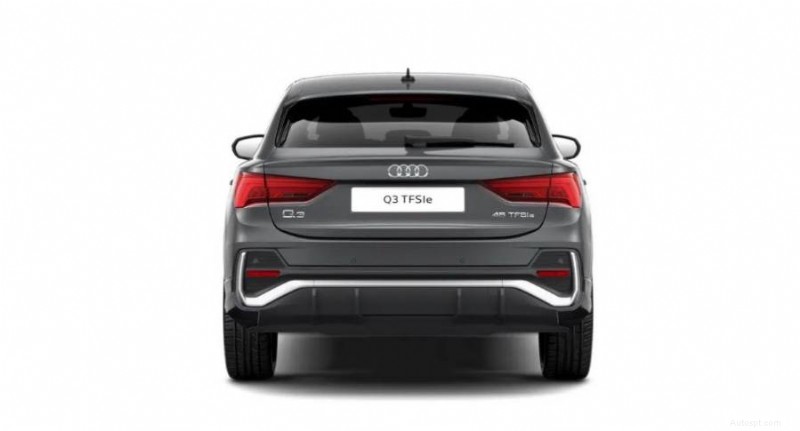
The Audi Q3 Sportback TFSIe PHEV (credit: Audi)
While e-zoomed uses reasonable efforts to provide accurate and up-to-date information, some of the information provided is gathered from third parties and has not been independently verified by e-zoomed. While the information from the third party sources is believed to be reliable, no warranty, express or implied, is made by e-zoomed regarding the accuracy, adequacy, completeness, legality, reliability or usefulness of any information. This disclaimer applies to both isolated and aggregate uses of this information.
