
Stuttgart based Porsche is known for high-performance cars and is currently owned by the Volkswagen Group. Porsche has always had a close relationship with the Volkswagen Group, because the iconic VW Beetle was designed by Ferdinand Porsche, the founder of Porsche.
Apart from this, both VW and Porsche have collaborated on a number of platforms, to include, the Porsche Cayenne SUV. In 2010, Porsche launched the Cayenne S Hybrid and also developed an electric prototype of the Porsche Boxster, called the Boxster E (2011). The luxury automotive manufacturer currently has the following electric vehicles (EVs) in its portfolio:
For those of you new to zero-emission electric driving, we recommend a read of the following articles:
The Porsche Panamera luxury saloon was unveiled in 2009 at the Auto Shanghai International Automobile Show. Production began the same year in Germany and the Panamera continues to be manufactured in the country. The hybrid variant was launched in 2011, and the plug-in hybrid electric vehicle (PHEV) variant released in 2013.
The PHEV was unveiled at the 2013 Shanghai Auto Show. The luxurious Panamera is available as a saloon and estate (Sport Turismo) body style plug-in hybrid. This article covers the saloon PHEV.
Porsche cars do not come cheap, however, with the incorporation of an electric motor and an onboard EV charger, the cost of motoring can be reduced by leveraging the benefits of zero-tailpipe emission electric driving. Driving an EV, costs between 5 pence and 10 pence per mile i.e. substantially lower, compared to using the internal combustion engine (ICE).
The Panamera saloon plug-in hybrid has a 17.9 kWh onboard EV battery with an electric range up to 35 miles (WLTP certified). However, the real-world EV range will be lower, impacted by a number of factors, to include: driving profile, speed, passenger load, weather and road condition etc. Assuming a 28 – 30 miles emission-free electric range is more realistic, which will be sufficient for most shorter commutes. The EV also has regenerative braking to increase the electric range.
If your driving is predominantly motorway and long-distances, it would be a challenge to leverage the benefits of zero-tailpipe emission electric driving with this PHEV. However, if the majority of your travel is shorter distances (work, school-runs, grocery store, high street etc), then the e-mode will certainly prove to be useful in saving money.
Porsche claims a fuel economy up to 141.2 mpg, but achieving this will require using the onboard electric motor, powered by the EV battery, on a regular basis. As is the case with the real-world pure electric range, expect the real-world fuel economy to be lower than the manufacturer claimed figures.
The Panamera saloon PHEV is not capable of DC charging, which given the price tag is a pity. Of course, not all plug-in hybrid electric vehicles are DC charging compatible, but a number of PHEVs do offer DC charging capability. Also surprisingly, not all Panamera PHEVs come with a 7.2 kW onboard charger as standard i.e. only the more expensive trims. Again, this is disappointing given the price tag.
The entry-level models have a 3.6 kW onboard charger (0% – 100%: 4 hours). For the upgraded 7.2 kW onboard charger, a full charge will take 2 hours. We at e-zoomed discourage the use of a domestic 3-PIN socket for charging an electric car. The best way to charge an EV at home, is via a dedicated home EV charging station like easee, faster and safer for EV charging! Porsche offers a warranty up to 8 years or 100,000 miles.
In terms of driving performance, the Panamera PHEV is what you would expect from a high-end premium automotive brand like Porsche. It simply does not disappoint. The Panamera electric car combines a 2.9-litre twin-turbo V6 engine with an electric motor (100 kW), delivering a 462 PS combined output and 700 Nm maximum torque. The all-wheel drive Panamera PHEV can achieve 0-60 mph in 4.2 seconds, with a 174 mph top speed (pure electric mode: 87 mph).
Company-car drivers can save further given the lower Benefit-in-Kind (BiK-12%) tax rate for the PHEV, due to the lower tailpipe emissions of the Panamera PHEV (45 – 57g CO2/km), compared to the conventional internal combustion engine (ICE) variant (302g CO2/km ). Bottom-line, a plug-in hybrid electric vehicle is good for the environment (air quality) and wallet.
The electric vehicle (EV) is without an iota of doubt, stunning in design, style and interior quality. The PHEV offers a high level of driver assist features (park assist, lane keeping assist etc) and is technology-laden. Though a conventional saloon has more space to offer, despite the placement of the onboard EV battery, practicality is reasonable. The PHEV offers a boot space up to 403 L.
The plug-in electric vehicle (PHEV) does not qualify for the UK government plug-in car grant (PiCG). Bottom-line, electric driving is good for the environment and the wallet. You can lease electric vehicles (EVs) via e-zoomed at very competitive prices!
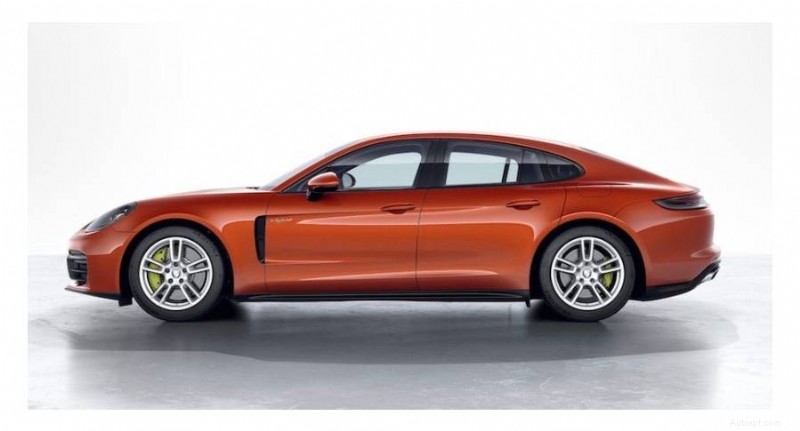
The Porsche Panamera PHEV Saloon (credit:Porsche)
While e-zoomed uses reasonable efforts to provide accurate and up-to-date information, some of the information provided is gathered from third parties and has not been independently verified by e-zoomed. While the information from the third party sources is believed to be reliable, no warranty, express or implied, is made by e-zoomed regarding the accuracy, adequacy, completeness, legality, reliability or usefulness of any information. This disclaimer applies to both isolated and aggregate uses of this information.
