
Mercedes-Benz, simply known as Mercedes, is a leading global luxury automative manufacturer based in Germany. The company is headquartered in Stuttgart and is famed for its high quality passenger vehicles, to include the Mercedes-Maybach. However, the company is also a leader in manufacturing commercial vehicles, to include the plug-in Mercedes eSprinter commercial EV and the plug-in Mercedes eVito electric van.
Mercedes-Benz EQ is the sub-brand used by the company for its portfolio of battery-electric vehicles (BEVs), plug-in hybrid electric vehicles (PHEVs) and mild hybrids. The pure electric cars are branded as EQ, while the PHEVs are branded as EQ Power. The mild hybrid vehicles are branded as EQ Boost. The PHEV portfolio includes:
For those of you new to zero-emission electric driving, we recommend a read of the following articles:
The Mercedes-Benz A Class premium vehicle is currently in its fourth generation. It was first introduced in 1997. The fourth generation model was launched in 2018 and also included the saloon body style. The A Class also includes the A250e plug-in hybrid electric vehicle (PHEV) variant.
The A250e saloon PHEV is a cheaper option, compared to the Mercedes C-Class, E-Class and S-Class plug-in hybrid models. For those seeking luxury, lower motoring costs and lower tailpipe emissions, the A Class saloon PHEV is certainly a good entry-level option to consider. It is a very efficient medium-sized plug-in electric car.
The Mercedes-Benz A250e PHEV has a 15.6 kWh onboard EV battery, which is an average EV battery size for PHEVs. The real-world electric range will be lower than the claimed range (44 miles/ WLTP certified), and will depend on a number of factors, to include: driving profile, onboard services used, speed, weather, road conditions and more.
Expect a real-world zero-tailpipe emission electric range closer to 38 miles. However, for most urban commutes, this range is more than sufficient and the EV can help save money and improve local air quality. Driving on the pure electric mode will cost between 5 pence to 10 pence per mile, significantly lower than driving using the combustion engine. The EV also incorporates regenerative braking, which further improves the efficiency of the vehicle.
Moreover, an EV range between 38 miles and 44 miles is also very useful for shorter motorway trips. The more the electric car is driven on e-mode, the higher the efficiency of the vehicle i.e. the lower the cost of motoring. Mercedes claims a fuel economy up to 282.5 mpg for the PHEV.
Achieving anything close to this fuel economy will require using the electric mode on a very regular basis. Of course, if the majority of the driving is done using the combustion engine, the fuel economy will be far lower (44.8 mpg).
The Mercedes electric saloon has a 7.4 kW onboard charger, capable of single phase AC charging. Though the EV can be charged using a domestic 3-PIN socket, we at e-zoomed encourage using a dedicated home EV charger like Easee. A 7 kW EV charger will charge the EV from 10% to 100% in 3 hrs and 15 minutes.
Do keep in mind that most homes in the UK are supplied a single-phase power supply and most EVs are charged overnight. Moreover, from a practical point of view, we recommend a ‘topping-up’ approach to EV charging. This way the EV battery is never fully depleted and charging times are shorter. The PHEV does not have DC charging capability.
The front-wheel drive Mercedes A250e plug-in hybrid combines a 1.3-litre (4-cylinder) petrol engine with a 75 kW electric motor. The performance of the electric car is appropriate for both city and highway driving. Given the electric motor, the EV also benefits from instant torque. The PHEV can achieve 0-62 mph in 6.7 seconds. The EV delivers a maximum system power up to 218 HP and 450 Nm torque. The top speed is 149 mph. In electric mode, the top speed of the EV is 87 mph.
The electric vehicle is technology-laden and incorporates the standard Mercedes features, to include: Mercedes-Benz User Experience (MBUX) infotainment system, 10.25in touchscreen display, keyless-entry, ambient lighting in 64 colours and a lot more. The top variant of the EV also features a panoramic glass sunroof. The EV incorporates numerous safety features. The EV is practical, despite a slightly smaller boot space (345 l), compared to the conventional internal combustion engine (ICE) variant.
The Mercedes plug-in electric car is suitable for both private and company-car drivers. Company-car drivers can take advantage of the lower Benefit-in-Kind (BiK-8%) tax rate, given the lower tailpipe emissions of the PHEV (22g CO2/km). The EV does not qualify for the UK government plug-in car grant (PiCG).
Bottom-line, electric driving is good for the environment and the wallet. You can lease electric vehicles (EVs) via e-zoomed at very competitive prices!
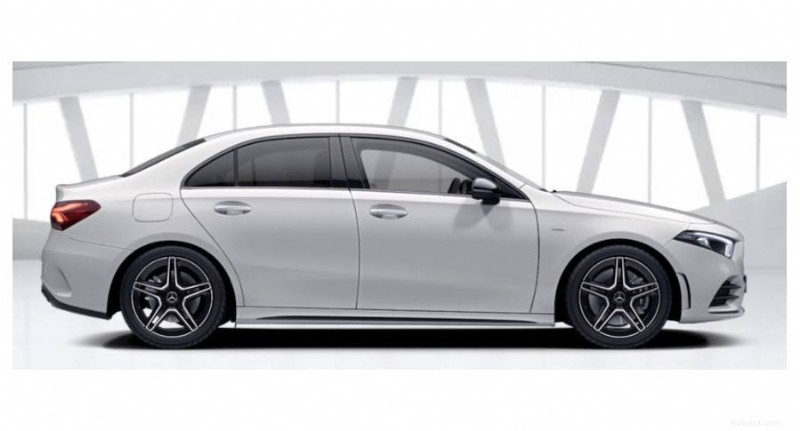
The Mercedes-Benz A250e Saloon PHEV (credit: Mercedes)
While e-zoomed uses reasonable efforts to provide accurate and up-to-date information, some of the information provided is gathered from third parties and has not been independently verified by e-zoomed. While the information from the third party sources is believed to be reliable, no warranty, express or implied, is made by e-zoomed regarding the accuracy, adequacy, completeness, legality, reliability or usefulness of any information. This disclaimer applies to both isolated and aggregate uses of this information.
