
Kia Corporation, the South Korean automotive manufacturer is fast developing a portfolio of lower-emission ‘eco’ vehicles, to include, zero-tailpipe emission battery-electric vehicles (BEVs), plug-in hybrid electric vehicles (PHEVs) and mild hybrids. The Korean automotive company is headquartered in Seoul, and it is South Korea’s second largest automotive manufacturer after the Hyundai Motor Company (Hyundai owns a 33.88% stake in Kia Corporation). At one point, the US automotive manufacturer, Ford Motor Company, also owned a stake in Kia.
Kia was found in June 1944, and was formerly known as Kyungsung Precision Industry. It has also been previously known as Kia Motors Corporation. The Kia name has been derived from the Sino-Korean characters, ‘ki’ (arise) & ‘a’ (Asia) to suggest ‘Rising from Asia’. The Kia Corporation has been active in the European markets since 1991. The Kia electric vehicle (EV) portfolio includes both, battery-electric vehicle (BEV) and plug-in hybrid electric vehicle (PHEV) models:
For those of you new to zero-emission electric driving, we recommend a read of the following articles:

Overview Kia Corporation, the South Korean automotive manufacturer is fast developing a portfolio of lower-emission ‘eco’ vehicles, to include, zero-tailpipe emission battery-electric vehicles (BEVs), plug-in hybrid electric vehicles (PHEVs) and mild hybrids….
Read More
The Kia XCeed compact crossover SUV has been manufactured since 2006. The XCeed was designed specifically for the European market. The model is currently in its third generation. The hybrid variant concept was unveiled at the 2008 Paris Auto Show. The Kia XCeed is available as a plug-in hybrid electric vehicle (PHEV).
It is compact, stylish and is environmentally-friendly. Though the Kia XCeed electric vehicle (EV) does not qualify for the UK government plug-in car grant (PiCG), it is still a relatively affordable PHEV for families, and as a company car. The XCeed PHEV crossover is not the only PHEV that does not qualify for the electric car incentive, in fact, all PHEVs are disqualified from the UK electric car grant.
The Kia PHEV pairs a 1.6-litre GDi petrol engine (6-speed DCT transmission) with an electric motor (44.5 kW), powered by an onboard EV battery. The automotive manufacturer claims a fuel economy up to 201.8 mpg for the electric vehicle (EV).
Of course the real-world fuel economy will depend on a number of factors, but none as influential as using the e-mode. Bottom-line, to increase the fuel economy of the electric vehicle and lower the driving costs, the PHEV should be driven as much as possible on the pure electric mode.
It is also far cheaper to drive on electric mode, compared to using the combustion engine. Depending on when and where an electric car is charged, the cost per mile for electric driving is between 5 pence and 10 pence.
Given the WLTP certified emission-free electric range is 29.8 miles, and most commutes are short, there is much scope for taking advantage of electric driving to save money. The PHEV has a 8.9 kWh onboard EV battery, which is reasonably standard for a PHEV of this size.
However, expect the real-world electric range to be closer to 25 miles. The EV range is impacted by a number of factors, to include: driving profile, speed, load, regenerative braking, road condition, weather and a lot more. It is worth noting that Kia claims an emission-free electric range up to 36.6 miles for the 16″ wheel ‘3’ grade.
Taking advantage of the EV range will also require inculcating a habit of charging the EV on a regular basis, which again is as easy as charging a smartphone. We at e-zoomed recommend the use of a dedicated EV charging station, like easee to charge the EV.
We do not encourage the use of a domestic 3-PIN plug. Charging the EV using a single-phase EV charger will take up to 2 hours 15 minutes (0% → 100%). Of course, if you top up on a regular basis, the charging time will be faster. The EV incorporates a 3.3 kW AC onboard charger and is not capable of DC charging.
In terms of practicality, the EV has its limitation, given both the body style and the placement of the onboard EV battery. For adults, the rear seats are not as comfortable and the headroom is impacted by the roofline. Moreover, the boot size is small (291 L). If the rear seats are folded, the available cargo volume increases up to 1,243 L. However, the plug-in electric car is easy to drive and park, perfect for city and town centres.
The performance of the electric SUV will not exhilarate, but it does the job! The front-wheel drive XCeed Plug-In Hybrid can achieve 0-60 mph in 10.6 seconds, also benefiting from instant torque. The hybrid drivetrain delivers a maximum power of 139 bhp (torque 265 Nm), sufficient for city and motorway driving. The top speed is 99 mph. Do keep in mind that the additional weight of the onboard EV battery (117 kg) does impact the overall performance of the electric vehicle.
The Kia electric car has a decent level of standard specifications and safety features, to include: 10.25″ touchscreen satellite navigation, Android Auto, Apple CarPlay, reversing camera system, driver attention warning, hill-start assist control, intelligent stop & go, lane keep assist, blind-spot collision warning, forward collision-avoidance assist and more. Interior quality is decent and reflects the price tag of the EV.
The Kia plug-in hybrid is also an option for company-car drivers, given the reduced tailpipe emissions (38g CO2/km) of the hybrid and lower Benefit-in-Kind (BiK-11%) tax charge, compared to the conventional petrol variant. Bottom-line, electric driving is good for the environment and the wallet.
You can lease electric vehicles (EVs) via e-zoomed at very competitive prices!
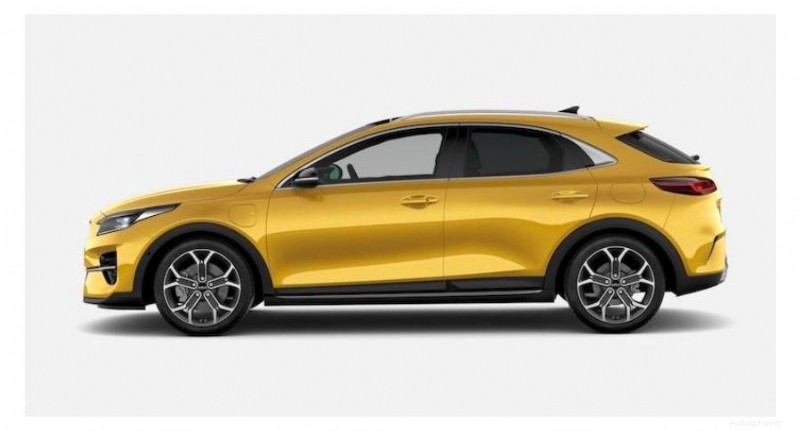
The Kia XCeed PHEV SUV (credit: Kia)
While e-zoomed uses reasonable efforts to provide accurate and up-to-date information, some of the information provided is gathered from third parties and has not been independently verified by e-zoomed. While the information from the third party sources is believed to be reliable, no warranty, express or implied, is made by e-zoomed regarding the accuracy, adequacy, completeness, legality, reliability or usefulness of any information. This disclaimer applies to both isolated and aggregate uses of this information.
