
Sweden has created its fair share of global brands, but none with a reputation as good as Volvo Cars, when it comes to passenger safety. Volvo cars is an automotive manufacturer based in Gothenburg, Sweden. The Volvo Group has a long history of success and was established in 1927. Since then the company has had multiple owners, to include the US based, Ford Motor Company. Its current owner is a Chinese automotive behemoth, Geely Automobile, which acquired Volvo Cars in 2010. Geely also owns the automotive brands Lotus Cars and Polestar.
Volvo Cars was one of the first mainstream OEM’s to commit to a push towards zero-tailpipe emission road transportation. In 2017, the company announced its intention to ‘electrify every car in our range’. Volvo is not new to ‘electric propulsion’ and had already deployed a test fleet of battery-electric vehicles (BEVs) in 2010 and had launched the first plug-in hybrid diesel car in 2012. In March 2021, the company announced its ambition to be a fully electric brand by 2030. The company is also committed to becoming ‘climate neutral’ across the value chain by 2040. The name Volvo is derived from Latin. It means “I roll’. The logo is an ancient chemistry sign for iron, signifying Volvo’s commitment to using high quality iron.
The company currently has the following battery-electric vehicles (BEVs) and plug-in hybrid electric vehicles (PHEVs):
For those of you new to zero-emission electric driving, we recommend a read of the following articles:
The Volvo V60 conventional petrol and diesel variants have been available since 2010. The second generation V60 estate was launched in 2016. As with other Volvo models, the company has also introduced the V60 as a lower emission plug-in hybrid electric vehicle (PHEV).
The updated Volvo V60 Recharge PHEV has much to offer families and company-car drivers seeking a practical and spacious electric vehicle (EV). The upgrade of the onboard EV battery to 18.8 kWh has positioned this estate electric car, as one of the few EVs capable of delivering a real-world emission-free electric range close to 50 miles.
Volvo claims a pure electric range up to 54.7 miles (WLTP certified), however, the real-world EV range will be closer to 48 miles. Nevertheless, it is an impressive and certainly very useful EV range to reduce the cost of motoring.
Do keep in mind that driving an electric car is far cheaper than driving a conventional petrol or engine car. A plug-in hybrid driven on zero-emission e-mode can cost as little as 5 pence to 10 pence per mile. There are real financial savings to be gained in electric driving. The EV also benefits from regenerative braking to improve range and vehicle efficiency.
Moreover, using the electric mode, also improves the overall efficiency of the vehicle. Volvo claims a fuel economy up to 353.1 mpg for the estate PHEV. Of course, the real-world fuel economy will be lower, but far improved compared to the fuel economy of the conventional petrol variant (44.8 mpg).
Despite the updates, it is disappointing to note that the PHEV does not offer DC charging. The EV has a 3.6 kW onboard charger. The Volvo electric vehicle can be charged 0% to 100% via a dedicated EV charging station in 5 hours.
We at e-zoomed recommend a ‘topping up’ approach to EV charging. This way, EV range is available to use and regular charging also improves the long-term maintenance of the onboard EV battery. Volvo offers a 8 years or 100,000 miles warranty.
Despite the placement of the onboard EV battery, practicality has not been compromised, in comparison to the conventional petrol variant. The V60 plug-in offers a 519 L boot and ample space for passengers. The interior has been finished to a high standard and offers leather free upholstery and recycled carpets.
It also offers a generous level of standard equipment, safety features and technology. These include: google built in, 360° camera, BLIS and cross traffic alert, keyless entry and keyless start, advanced air purifier, intelligent safety assistance and more.
Also improved are the tailpipe emissions for the plug-in hybrid electric vehicle. The V60 PHEV has tailpipe emission up to 18g CO2/km, benefiting the local air quality. The conventional petrol variant has tailpipe emissions up to 142g CO2/km.
The all-wheel drive V60 plug-in electric estate car combines the T6 2.0-litre powertrain with an electric motor. The EV can achieve 0-62 mph in 5.2 seconds (350 hp). The top speed of the EV is 112 mph. The plug-in hybrid does not qualify for the UK government plug-in car grant (PiCG).
The EV is suitable for both families and company-car drivers. Company-car drivers can take advantage of the lower Benefit-in-Kind (BiK) tax rate for electric cars. Bottom-line, electric driving is good for the environment and the wallet.
You can lease electric vehicles (EVs) via e-zoomed at very competitive prices!
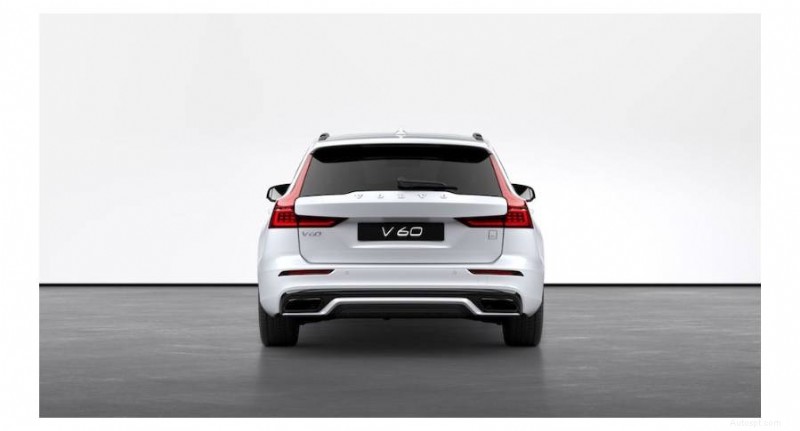
The Volvo V60 Recharge Plug-In Hybrid Estate (credit: Volvo)
While e-zoomed uses reasonable efforts to provide accurate and up-to-date information, some of the information provided is gathered from third parties and has not been independently verified by e-zoomed. While the information from the third party sources is believed to be reliable, no warranty, express or implied, is made by e-zoomed regarding the accuracy, adequacy, completeness, legality, reliability or usefulness of any information. This disclaimer applies to both isolated and aggregate uses of this information.
