
One of the most frequent questions you see these days in electric vehicle forums, blog comments and Facebook groups is some variation of the following:
“I reserved my Tesla Model 3 on (fill the date), will I still be eligible for the$7,500 Federal tax credit when my car becomes available?
There are several variables that go into answering this question, including:
How The Federal Tax Credit Works
Battery electric and plug-in hybrid vehicles purchased in or after 2010 may be eligible for the federal income tax credit of up to $7,500. The credit amount varies based on the capacity of the battery used to power the vehicle. All current Tesla models are (and the Model 3 will be) eligible for the initial full $7,500 credit. The Chevrolet Volt PHEV also qualifies for the full $7,500, for example, whereas the Ford Fusion Energi, is only eligible for a $4,007 credit.The federal tax credit is phased out over time beginning the second quarter AFTER the quarter in which a manufacturer reaches a total of 200,000 BEV or PHEV vehicles sold since 2010. Here is how the phase out works:
So What’s The Big Deal?
So why is the question of availability of the federal tax credit such a hot topic? One reason is simply the perceived impact the credit might have on someone making a purchase decision on a Model 3 at around $40,000 versus a buyer of a $75,000 to $100,000+ Model S or Model X.
While I’m not aware of any data or surveys to support this, the theory is that some potential Model 3 buyers may change their mind if the tax credit expires (at the full $7,500 or one of the reduced levels) before their turn comes up to make the purchase.
The second reason for so much interest is that the question simply begs speculation on what future sales will be like for the Model S and X and when Model 3 production will begin?4 Possible Scenarios to Predict the End of the Federal EV Tax Credit for Tesla Buyers
Since no one knows how many cars Tesla will sell in the US in 2017 or when the Model 3 will begin production at scale, I’ve created 4 sample scenarios showing combinations of sales for the Models S, X and 3.
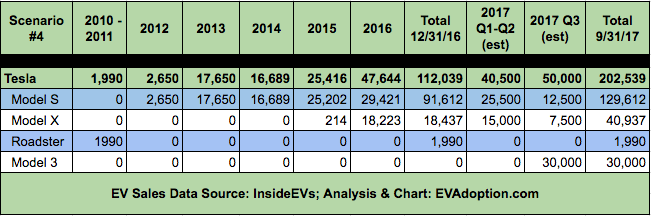
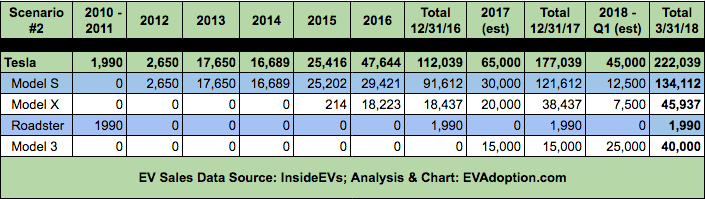
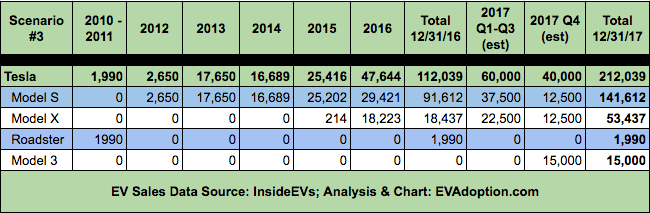
While readers can argue with my assumptions and come up with another dozen variations, I’ve structured the scenarios so that regardless of the individual model sales numbers, Tesla would reach the 200,000 units sold milestone in 3 different and consecutive quarters, beginning in Q3 of 2017.
Scenario 1: This scenario is the least optimistic on the Model 3 production timing, with manufacturing not starting until Q1 of 2018. It does assume solid growth in sales of the Model S and X in 2017, but not enough to reach the 200,000 total historical sales milestone.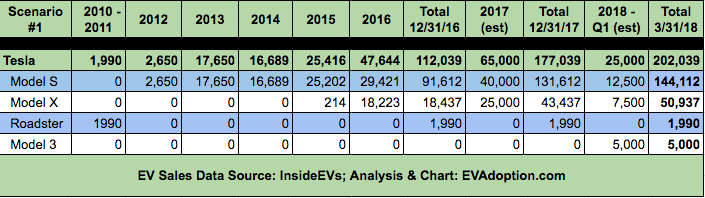 Scenario 2: This scenario is a bit of a mixed bag with sales of the Model S and X basically flat over 2016 (probably not likely, but these are scenarios after all). However, it is modestly optimistic on the Model 3 with production starting the second half of 2017, but with production still light and only beginning to ramp in Q1 of 2018. The 200,000 milestone is also not reached until Q1 2018.
 Scenario 3: This scenario is reasonably optimistic and assumes significant growth in sales of the Model S and X in 2017, but that the Model 3 would not begin production until Q4 of 2017. Total Tesla historical sales would reach the 200,000 milestone in that Q4 of 2017.
 Scenario 4: This scenario is the most optimistic, which I decided to add after reading several comments on various forums where commenters were confident that Tesla would start production of the Model 3 in July 2017. It assumes significant growth in sales of the Model S and X in 2017 and the Model 3 scaling production at an average of 10,000 units per month in Q3 of 2017. Total Tesla historical sales would reach the 200,000 milestone in Q3 of 2017.
Production Delay Theories Debunked
I’ve read a variety of theories that suggest Tesla would delay production of the Model 3 (or perhaps the S and/or X as well) or shift production to non-US orders as a means to delay the phase out of the tax credit so more US buyers can take advantage of it.
While this is certainly a possibility, I think Tesla taking this approach is extremely unlikely for a few reasons:
Tax Credit Phase Out
These scenarios then provide a useful model for the phase out period of the tax credit. As you can see from the chart below, the earliest that the tax credit would end entirely is at the end of Q4 of 2018 and the latest is Q2 of 2019. So if you are a US citizen and are a current reservation holder for a Model 3, there is a good chance that either the full $7,500 or partial credit will still be available for your purchase.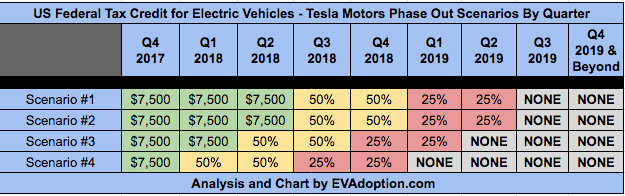 Additional Resources on the Tax Credit:
