
Not only the new Kia Soul EV gets more range, it’s also more efficient, even with a heavier battery.
Kia-world.net did a nice roundup of the battery’s changes. Let’s see:
Current battery
New battery
Considering that most DC fast charges are capped by the Amps, the battery voltage increase will probably make the new Kia Soul EV charge at a higher rate.
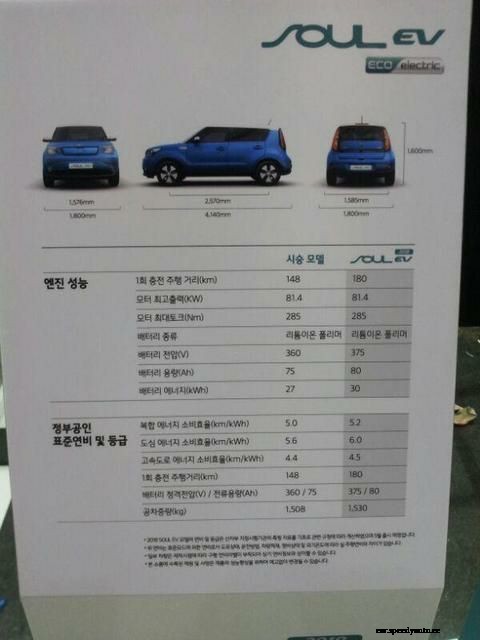
Kia Soul EV – 2017 vs 2018
While the battery capacity increases 11 % from 27 to 30 kWh, the range increases by a higher margin. Let’s see:
Current battery
New battery
Both South Korean and the EPA test cycles are very similar, this is why I estimate that the EPA range will increase by the same margin.
Now let’s compare the range and efficiency figures in the South Korean test cycle.
|
Electric car |
Range |
Efficiency |
||||
|
Combined |
City |
Highway |
Combined |
City |
Highway |
|
|
2017 Kia Soul EV |
148 km |
166 km |
130 km |
20 kWh/100 km |
17,86 kWh/100 km |
22,73 kWh/100 km |
|
2018 Kia Soul EV |
180 km |
208 km |
156 km |
19,23 kWh/100 km |
16,67 kWh/100 km |
22,22 kWh/100 km |
It’s amazing how much efficient are Kia’s and Hyundai’s electric powertrains, this is especially surprising considering that the Kia Soul has the aerodynamics of a brick.
If the EPA range is confirmed to be 113 miles (182 km), the new 2018 Kia Soul EV finally surpasses the – now outdated – 2017 Nissan Leaf with the 30 kWh battery and gets a much similar range to some other electric cars.
All the electric cars listed above have an EPA range less than 200 miles and need price drops to become more appealing. This is exactly what will happen when more higher range electric cars start to appear and it’s another reason why the Chevrolet Bolt EV, Nissan Leaf 2 and Tesla Model 3 are very important, even to the ones that will not buy them.
Despite the very un-aerodynamic shape, this is an EV that I really like – as most of Kia/Hyundai cars. What about you?
