
Usually when Samsung SDI goes to auto shows and advertise its battery cells, good information is unveiled. Previously, some of this information has helped to predict future battery upgrades for BMW and Volkswagen plug-in cars.
However, at the ongoing Frankfurt Motor Show 2017, Samsung SDI didn’t let any information slide about battery capacity. Yet, it doesn’t mean that nothing has changed.
Samsung SDI’s current biggest customers are BMW and Volkswagen that use its prismatic battery cells, and for this reason, the focus of this battery cell maker has been to improve and advertise this type of cells. However, you should never put all the eggs in the same basket…
To diversify its offer, Samsung SDI is trying to attract new customers for its cylindrical 21700 battery cells, as the press release below reveals:
“Samsung SDI also displayed cells and modules based on the new 21700 standard of cylindrical battery. A ‘21700’ battery is 21 millimeters in diameter and 70 millimeters in height. Its capacity is 50 percent bigger than the existing 18650 battery (18 millimeters in diameter and 65 millimeters in height). Its size is optimal for maximizing capacity, life and output simultaneously. The new battery beats batteries of any other size in light of cost competitiveness. A 21700 battery draws attention from major global manufacturers as the next-generation standard which can be applied to all sorts of products including electric vehicles, ESS and electric tools.”
It’s no secret that no one uses more 21700 cylindrical battery cells than Tesla, which is exactly the most desired customer for any serious battery cell maker. So let’s see what Tesla could accomplish with what Samsung SDI has to offer…
Currently Samsung SDI has the Samsung INR21700-48G battery cell. The “INR” code means that the cathode is NMC (nickel, manganese and cobalt), the “21700” code refers to the dimensions and shape (21 mm in diameter, 70 mm long and the final “0” means it’s cylindrical), finally the “48” part tells the maximum capacity (4,8 Ah, but consider 4,75 Ah to be nominal). By the way, Tesla dropped the “0” and just calls these cells 2170.
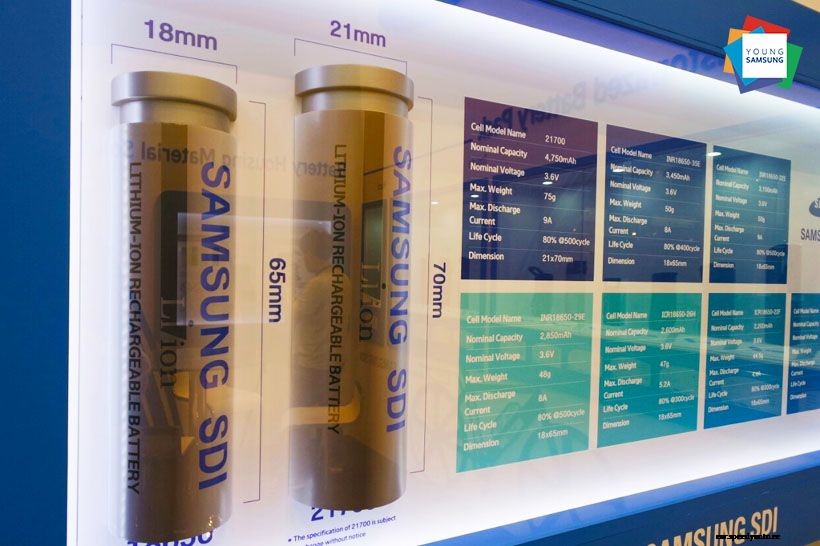
Samsung SDI 21700 battery cell specs
Fred Lambert from Electrek already provided great information about the Tesla Model 3 battery packs. The battery pack of the standard version has 2.976 cells, while the longer range version has 4.416 cells.
Let’s see what we get with 4,75 Ah battery cells from Samsung SDI.
Standard range version battery pack
Capacity: 2.976 x 3,6 V x 4,75 Ah = 50,89 kWh
Max. discharge power: 2.976 x 3,6 V x 9 A = 96,42 kW
Weight (cells only): 2.976 x 0,075 kg = 223,2 kg
Long range version battery pack
Capacity: 4.416 x 3,6 V x 4,75 Ah = 75,51 kWh
Max. discharge power: 4.416 x 3,6 V x 9 A = 143,08 kW
Weight (cells only): 4.416 x 0,075 kg = 331,2 kg
As you can see these Samsung INR21700-48G battery cells would fit perfectly in a Tesla Model 3, the only part that doesn’t look great it’s the maximum discharge power, but that can be easily improved with the TMS (Thermal Management System) that is already used in Tesla cars.
Furthermore, these 21700 cylindrical battery cells from Samsung SDI can also be used for ESS (Energy Storage Systems), therefore great candidates for Tesla Powerwall.
To sum up, while Tesla chose Panasonic as its partner for the Gigafactory 1 in the USA, I wouldn’t be surprised if Tesla adds to its list of partners the South Korean cell makers – LG Chem, Samsung SDI and SK innovation – to build more Gigafactories around the world… In fact, I don’t think that Tesla can rely in its partnership with Panasonic alone to build all the Gigafactories that it needs to mass produce the Model 3, Model Y and Powerwall.
With LG Chem and Samsung SDI already present in Europe, USA, South Korea and China, they are great candidates to help Tesla build more Gigafactories. Relying only in Panasonic is exactly what putting all eggs in one basket means, I hope that Tesla understands it and expands its partners list.
What do you think? Can Tesla rely in Panasonic alone, or are future partnerships with other battery cell makers inevitable?!
