
Norway shows us that it’s very easy to make electric cars successful. It’s not rocket science!
I always find interesting how some some well-intentioned public policies are actually counterproductive. In this regard, public policies aimed to electric cars are great examples.
A competent policy maker knows that to increase the consumption of healthy food, we shouldn’t subsidize it, instead we should tax the unhealthy food. The same principle applies to electric cars. We shouldn’t subsidize them, instead we should heavily tax products that increase pollution and decrease the well-being of the whole community.
Let’s compare some consequences of two different approaches:
Strategy 1 (subsidize electric cars):
Strategy 2 (tax polluting cars and fuels):
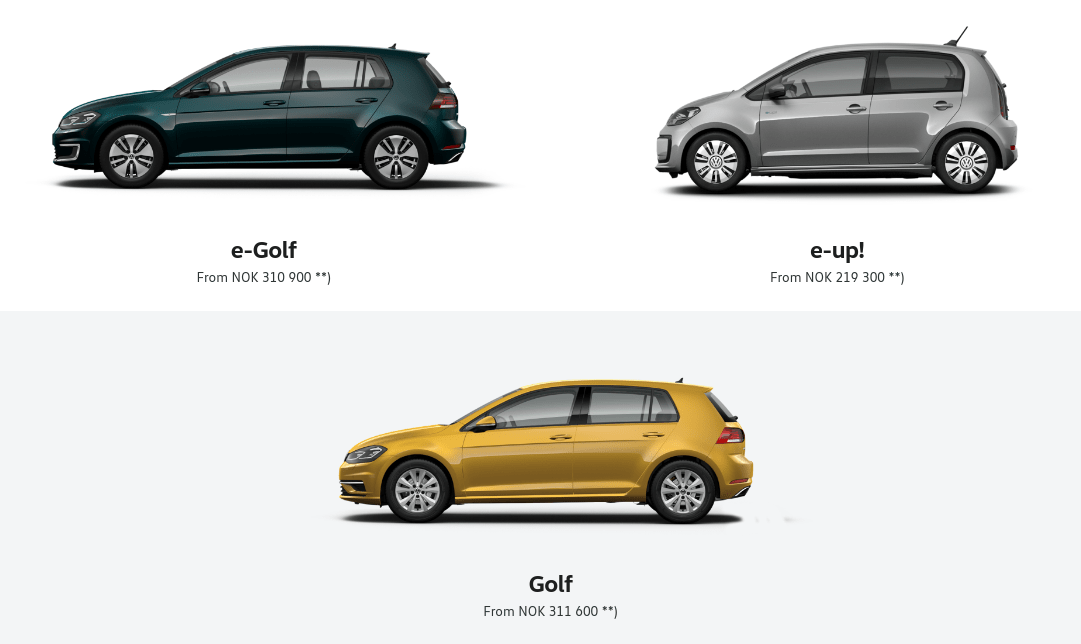
Volkswagen prices in Norway
As you can see above, resorting to efficient tax policies, in Norway the electric Volkswagen Golf is cheaper than the ICE (Internal Combustion Engine) counterpart. This is an example of a public policy that actually works.
I’m always amazed to see some electric car supporters and associations think that the subsidies are actually good. To me it’s obvious that they are very counterproductive to our cause.
To sum up, while Norway’s example is very positive, this car market isn’t big enough to spark the electric car revolution. It takes much bigger markets such as China or the European Union to make automakers actually adapt to change.
What about you? Do you agree that governments should drop the subsidies to buy electric cars and instead they should heavily tax polluting cars? Which strategy do you support, 1 or 2?
