
While this isn’t exactly a surprise, it’s nice to finally have a public confirmation from a Nissan employee.
Brian Maragno, Nissan’s director of EV Marketing and Sales Strategy told AutoGuide that the 2019 Nissan Leaf will have a longer range and more powerful version called e-Plus.
Maragno said that the bigger battery allowed Nissan to increase the motor power from 147 hp (110 kW) to 200 hp (150 kW).
This suggests that the 2019 Nissan Leaf will get the same powertrain made by LG Chem for the Hyundai Kona Electric.
Anyway, last year, I made a comparison table with what I expected to see in the Nissan Leaf e-Plus based on what Nissan employees have been saying behind closed doors.
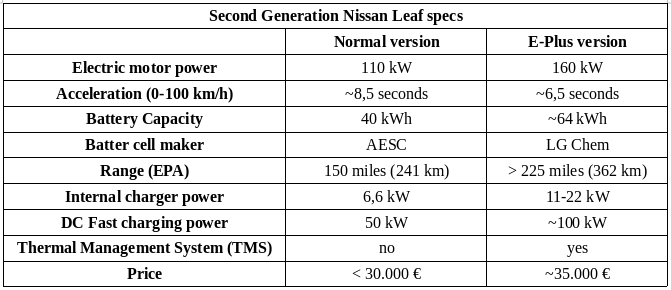
Second Generation Nissan Leaf specs
Now let’s see what’s almost confirmed and what’s not.
Now some general considerations.
Since the longer range version will finally get a TMS, I hope that Nissan changes its mind and implement it also in the standard version. Why is it so hard to admit that launching an electric car without a TMS was an error?! Without the above average battery degradation problems the Nissan Leaf is almost technically perfect – for its purposes -, it’s probably the most reliable car on market. Wasting time and money replacing all those degraded batteries on warranty doesn’t seem very sustainable. Furthermore, it creates the myth that all electric cars have battery problems.
I was glad that Nissan failed to sell the battery business to GSR Capital. GSR Capital is a Chinese private investment fund and I prefer that Nissan sells AESC to an already established battery cell maker, that can immediately use the facilities and start producing batteries. An investment fund will probably gamble the facilities in the stock market without the intent to produce anything.
In my opinion, buying AESC facilities in Zama (Japan), Sunderland (UK) and Smyrna (USA) would be a great way for a Chinese battery cell maker, such as BYD or CATL to expand the battery production outside China.
One thing is certain, an automaker without its own battery cell production, that wants to mass produce electric cars shouldn’t rely on a single battery supplier.
We saw that EVTEC charged the Nissan Leaf e-Plus via CHAdeMO but it would be great if the European version moved to CCS, especially since Nissan Leaf and Renault Zoe will share a common platform in the future. Nissan Leaf should keep CHAdeMO only in Japan.
Lastly, the 2018 Nissan Leaf was first launched in Japan, then Europe and finally USA. However it would make sense if Nissan does the opposite with the 2019 Nissan Leaf, for three main reasons.
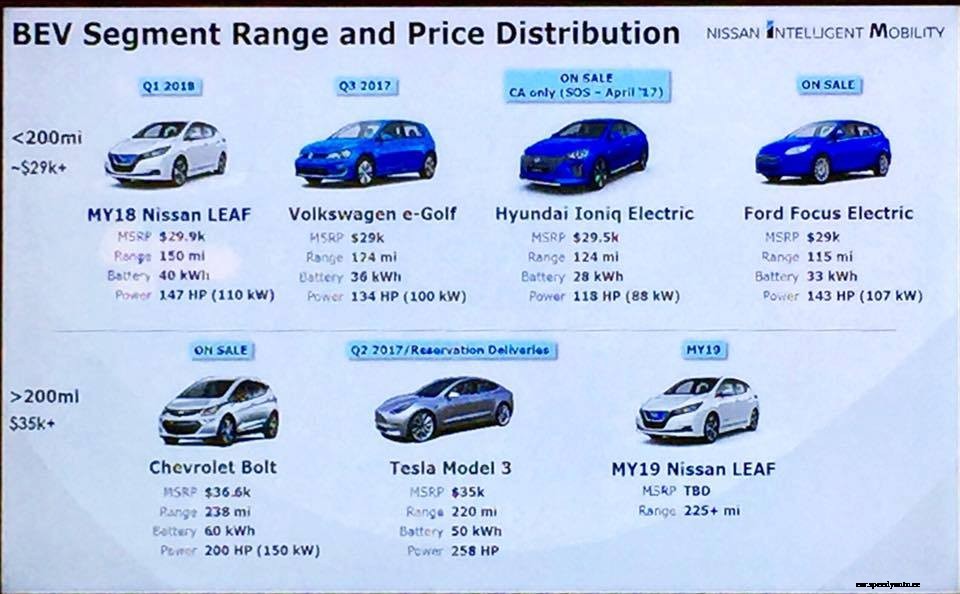
BEV Segment Range and Price Distribution by Nissan
What do you think about the 2019 Nissan Leaf e-Plus? Is this finally a mainstream electric car without compromises (decent price, range, charging and availability)?
