
In the newest Renault’s secret calendar, we can see the already announced arrival of the Renault ZOE 2 scheduled for September, but also two new BEVs (Battery Electric Vehicles) for the coming years.
The first comes in 2021 and it’s a compact SUV. I imagine it as an electric version of the Renault CAPTUR II, aiming to become an alternative to the Hyundai Kona Electric, Kia e-Soul and DS 3 CROSSBACK E-Tense.
The second comes in 2022 and it’s the long-awaited electric city car Renault Twingo ZE. Hooray! The fourth generation of the Renault Twingo will only be available as electric. The current third generation of the Twingo was already developed to have an electric variant, but Renault never released it, afraid that it would cannibalize ZOE’s sales.
The most direct alternative to the Renault Twingo IV ZE will definitely be the new generation Fiat 500e, which will arrive next year. Furthermore, the Volkswagen triplets will also be great alternatives as electric city cars and we shouldn’t forget the upcoming new generation smart EQ forfour.
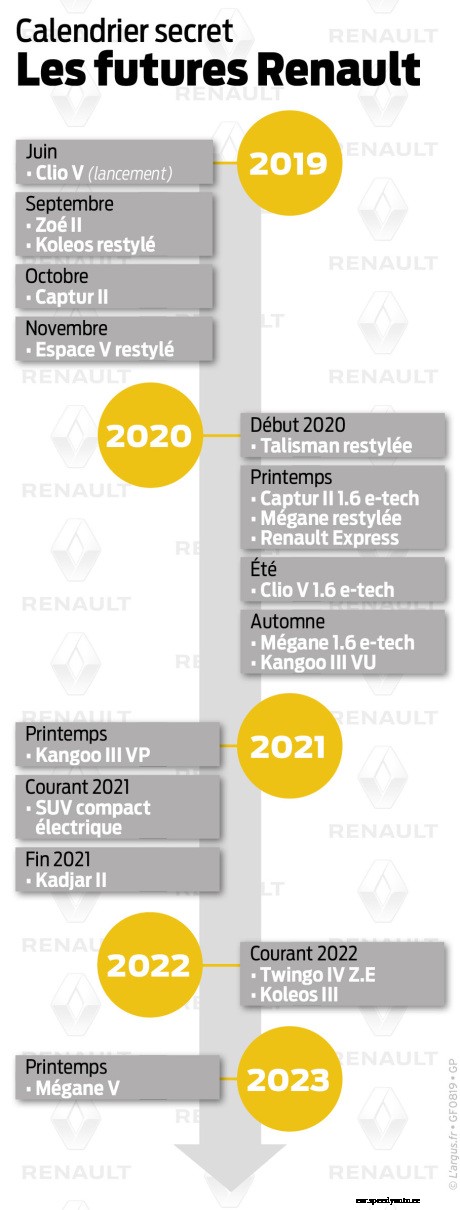
Renault’s secret calendar reveals two new BEVs
The upcoming BEVs from Renault will be built on the new CMF-EV platform shared with other Alliance’s partners, such as Nissan and Mitsubishi. Meaning that we’ll see similar electric cars from other Alliance’s members. For example, Nissan is considering to have an electric version of the upcoming Nissan Juke 2.
I’m very curious to see what Mitsubishi will have to offer. Since the pioneer i-MiEV this automaker has been absent from the electric revolution.
The use of a shared platform will further reduce costs.
By 2020, when CMF is fully deployed in plants worldwide, 70% of all Alliance vehicles with fall within the CMF scope. The approach is expected to cut purchasing costs by as much as 30% and engineering costs by up to 40%. The savings enables product planners to add more in-demand content to vehicles.
Using shared platforms is a step in the right direction to make electric cars more affordable. The other is the use of cobalt-free batteries.
