
The Toyota C+pod is a small electric car with two seats that will be available to individual customers by 2022. Initially, it will be used mostly by car-sharing services.
Let’s see the details.
Toyota City, Japan, December 25, 2020―Toyota Motor Corporation (Toyota) announced today a limited launch of the “C+pod” ultra-compact battery electric vehicle (BEV), from December 25, to corporate users, local governments and other organizations that have been exploring new options to drive the popularization of BEVs. Toyota plans to further promote the establishment of systems for popularizing BEVs, including development of new business models, and to conduct a full-scale launch including to individual customers by 2022. Today’s launch will also demonstrate new services that can only be provided by BEVs.
The new C+pod is an environmentally-friendly two-seater BEV designed as a mobility option that improves per-person energy efficiency. In addition to short-distance daily use, the C+pod is also aimed at corporate users visiting customers on a regular basis, and at users in urban or mountainous communities needing safe, unrestricted, and environmentally-friendly transportation options.
To drive further popularization of BEVs, Toyota is expanding its product lineup and forming open collaborations as it works to build new business models. In Japan, it is focusing initially on the C+pod, Walking Area BEVs*1, and Toyota i-Road*2, with more than 200 corporate and local government partners*3 currently involved in exploring new transportation models.
As one of these collaborative efforts, today’s launch of the C+pod will also demonstrate new services specific to BEVs. One of those services is Toyota Green Charge, a joint project developed with Chubu Electric Power Miraiz Co., Inc. to offer a single point of contact for corporations seeking support when constructing optimal charging facilities or developing electricity plans for BEVs, such as CO2-free power. The service will be jointly implemented in collaboration with Chubu Electric Power Miraiz, Kansai Electric Power Co., Inc., and TEPCO Energy Partner, Inc. Other services in planning include the Electric-vehicle sharing service that combines tourist information with the “Toyota Share*4” car-sharing service to promote sightseeing and excursions.
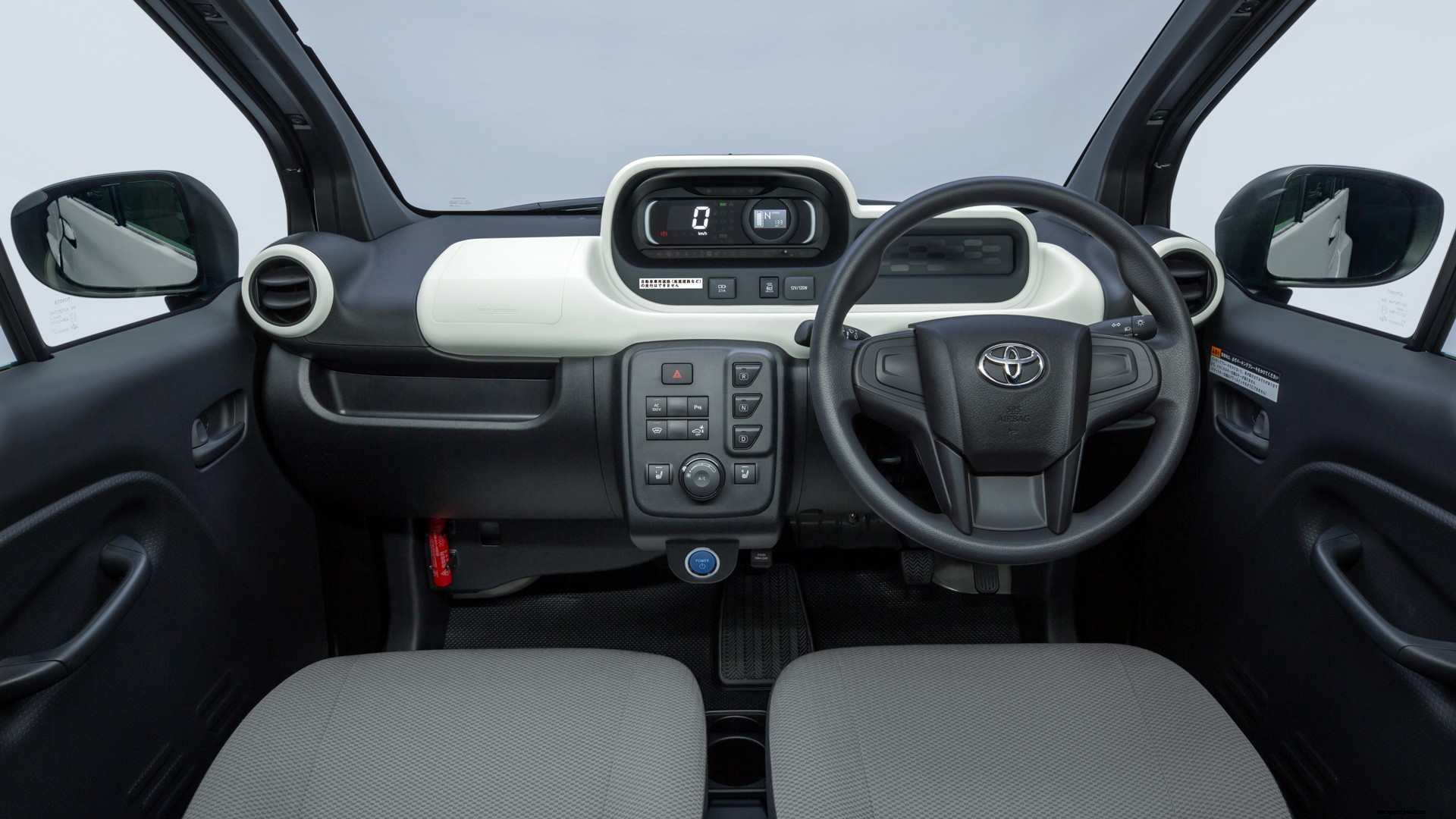
Toyota C+pod interior
Specs
Prices
The Toyota C+pod gets a 9 kWh battery made with 48 prismatic 51 Ah battery cells from Panasonic and the realistic range should be around 100 km (62 miles).
The Pre-collision Safety System and the Panasonic battery are nice features, but the price, range and maximum speed are very disappointing. This small electric car from Toyota is the definition of too little, too late and has no chances against a SGMW Baojun E300. By 2022, some Chinese automakers will already be selling much more compelling small electric cars in Europe and North America.
Sadly, Toyota made clear multiple times that doesn’t want its all-electric cars to compete with its hybrids. Therefore, we can only expect Toyota to produce extremely underwhelming electric cars in the near future.
I remember one occasion when a Toyota’s executive claimed that producing electric cars was extremely easy and anyone could do it, Toyota was proud to be able to produce reliable hybrid cars that are also very complex and hard to make. That’s its competitive advantage and the main reason for Toyota to fear the arrival of electric cars, it’ll bring a lot more competition, not only from legacy automakers but also startups.
On the opposite side, the Chinese automakers see electric cars as an unique opportunity to grow and compete with already established automakers.
