
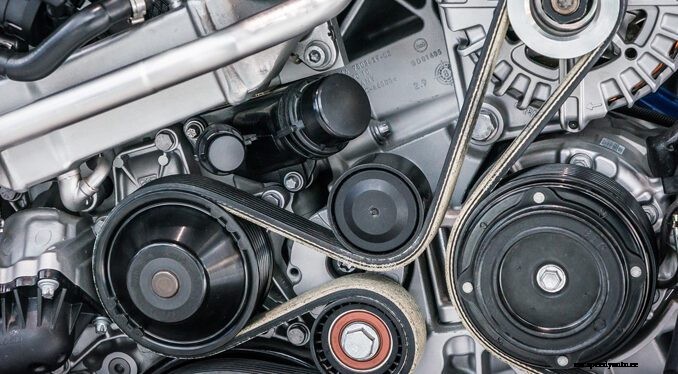
Consequently, an automatic belt tensioner is a relatively inexpensive part to replace. So, every time you replace a belt; be sure to replace the automatic belt tensioner at the same time.
The automatic belt tensioner also provides a little “give”; so it can absorb and cushion shock loads. An example would be, like when the A/C compressor clutch cycles on and off.
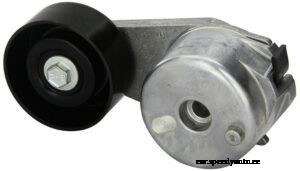
What’s more, the tensioner automatically compensates for wear; and keeps the belt under constant tension.
Because, the tensioner drives the belt, wear on both will happen at some point. So, having either one fail could cause a multitude of problems. Finally, nothing automotive lasts forever, not belts and not automatic belt tensioners.
The typical service life of a serpentine belt, is about 60,000 miles or five years. When the belt nears the end of its life, it may become cracked, glazed and noisy. Cracks on the underside of a serpentine belt are normal.
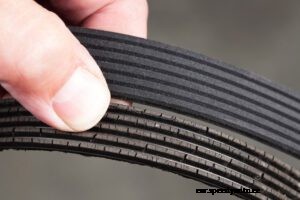
However, if you see more than three cracks in a three inch section on any one rib; the belt has already used up 80% of its intended life.
Broken belt consequences:
So, the automatic tensioner prevents the belt from slipping. A weak tensioner can also allow, the belt to slip and squeal.
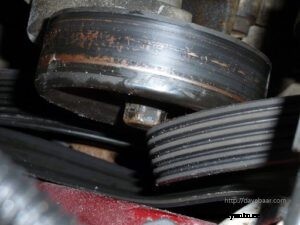
Inspect the tensioner for:
There should be a gentle arm motion as accessories turn on and off; (such as the A/C compressor clutch engaging and disengaging). If the tensioner pulley does not move at all, the tensioner may be stuck. Also, watch for excessive chattering or tensioner arm oscillation while the engine is idling.
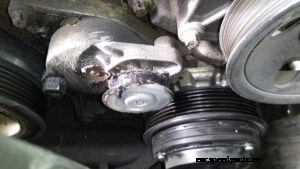
Excessive arm oscillation is a warning sign; that the damper has possibly failed or is failing and the tensioner needs to be replaced now.
The tensioner should be quiet when the engine is running. Any squealing, rumbling, growling or chirping noises, should be investigated. Use a mechanic’s stethoscope to pinpoint the source of the noise. The same goes for all the engine-driven accessories (water pump, alternator, PS pump and A/C compressor).
Physical damage of any kind on the tensioner pulley; may indicate excessive tension or physical interference. Always replace both, the pulley and the tensioner.
Check the movement of the tensioner arm with the engine off. Use a socket with a long handle ratchet or breaker bar; on the tensioner pulley center bolt, to rotate the tensioner. Consequently, you should be able to feel tension pulling it back. So, if it does not move, it may be jammed or seized.
Also, note the position of the arm on the automatic tensioner. Many units have marks on the housing that show the normal range the arm can pivot. If the position of the arm is outside these marks; it indicates a problem (the belt may be too long or too short, or the tensioner may be jammed).
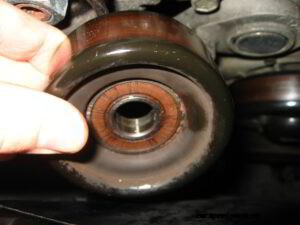
Also, with the belt removed try spinning the pulleys by hand. All pulleys should turn freely with no binding, roughness or wobble. Any binding, roughness or wobble; means these parts are bad and need to be replaced.
So, the problem with the automatic belt tensioner is that, once it goes; it usually means replacing the pulleys and sometimes, the drive belt itself. Finally, it’s not usually a one-part replacement job.
