
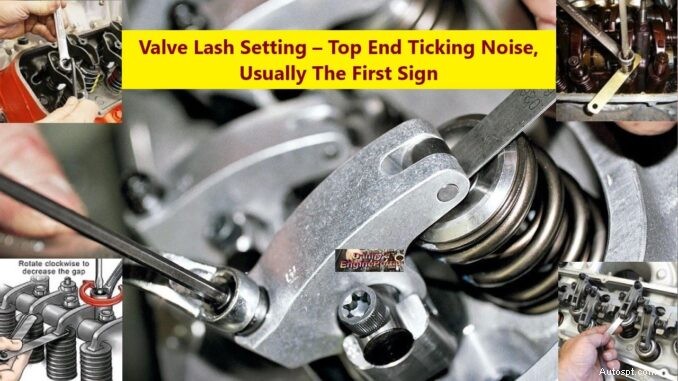
 Valve Lash Setting – Top End Ticking Noise, Usually The First Sign
However, others don’t even mention valve lash setting clearances in their maintenance schedules. So, either check your owner’s manual or call your dealer to find out for sure.
Usually the need for a valve adjustment, is determined by their sound. More accurately, the louder the ticking noise made in the valve train, the greater the need for adjustment.
Properly adjusted valve lash will be quiet. Some engines will always have a light tapping noise. But, they should never be so loud as to mask all the other noises the engine makes.
Note: Knowing when the valves are too loud is a matter of experience. Not to mention, they very gradually become louder and we are often oblivious to this fact. If you’re not sure, find someone with experience to help you determine the need for adjustment.
So, over time the original clearances (valve lash) between the valve stems, become bigger. (with exhaust valves, the clearance can become tighter). That often leads to a clattering noise that a driver might not notice over time, because it increases gradually.
Intake valves open and close to let the air/fuel mixture, (or just air in modern engines) enter the combustion chambers. And, the exhaust valves allow exhaust gases to escape. But, too much or too little valve clearance can result in poor performance or a rough idle. This is because, the engine can’t “breathe” normally and operate at peak efficiency.
If your engine generates a loud clatter, it could be time for a valve lash setting adjustment. Though on some engines the valves don’t generate noise, when there’s too much clearance.
So, a clearance adjustment may not be all that’s needed. As a result, the mechanic won’t know for sure, without inspecting the valves. Adjusting valve clearance (or “lash”) requires, removing the valve cover (or covers on V-type engines).
It could take a fair amount of time to checking both intake and exhaust valves. It’s not a quick job, like an oil change, especially on engines that have three or four valves per cylinder. So, plan on at least a few hours at the shop for a mechanical adjustment.
As the camshaft rotates, it pushes on the valve stem. Either directly or by using a rocker arm, to open the valves inside the combustion chambers at the proper time. Finally, the valve springs will automatically close the valves.
If the valve clearance is too small, the valves will never fully close when they should. As a result, this will eventually burn part of the valve surface off, causing a constantly misfiring engine. But, if the valves are too tight, the engine may run rough, either cold, hot or all the time.
If the valve clearances get too loose, this will lead to a noisy running engine. Consequently, this will eventually damage the camshaft lobes, rocker arms and the tips of the valves themselves.
So, setting the valve lash for the first time, can seem like a scary task. But, as often as it’s over looked, it’s extremely important to get the best performance out of your engine.
Thank You!
