
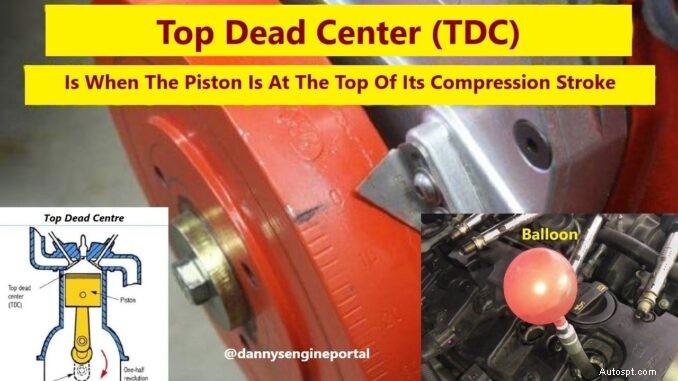
 Top Dead Center - Is When the Piston Is at the Top of Its Stroke
So, Top Dead Center (TDC), can usually be found, by looking at timing marks. But, on some engines, these marks may be lost or hidden. Fortunately, there’s an easy way to discover Top Dead Center (TDC), without the use of any timing marks.
Above all, being able to accurately find Top Dead Center (TDC) is a critical step, when working on any engine. It won’t find a misfire but it will keep your engine in the proper sequence. Consequently, there are actually many ways to do it. But, in this article we wanted to show you a simple, quick and practically foolproof method for finding it.
So, if you’re relatively new to engine work and have never, pulled the distributor or damper from your engine. Then, finding Top Dead Center (TDC) on piston #1, becomes an instant priority.
Finding Top Dead Center (TDC), is an essential skill, for assembling and tuning engines. And, is even a necessity for performing some engine diagnostic tests, such as a cylinder leak down test.
So, top dead centre is the position of an engine’s piston, when it is at the top of its stroke.
Depending On Whether You Need To Be On The Compression Stroke Or Not, There Are Many Methods:
So, the first thing you would want to do is, remove all the spark plugs. Consequently, the reason for this is you are going to be turning the engine over by hand. Well, most likely with a wrench, on the harmonic balancer nut. This will make it a lot easier to turn.
I like to use the hose from my compression tester gauge. ( Make sure to remove the schrader valve from the hose, before you start ). Start, by screwing the hose into the number one cylinder.
To Determine The Location Of The, Number One Cylinder:
At this point, there are a few ways to confirm the compression stroke:
Most old school mechanics would just use the finger method. Place one finger over the end of the hose, then rotate the crankshaft. During transition between exhaust and intake strokes, when one or both valves are open. There will be no pressure.
During approach to Top Dead Center (TDC), between compression and power strokes, there will be pressure. Consequently, it will push your thumb off of the hose, to allow air to escape. When air stops blowing out, it is fairly near Top Dead Centre (TDC) on the compression stroke. Move on to STEP FOUR.
Use a vacuum/pressure gauge. Hook up the gauge to your hose. Again turn the engine over by hand until you see pressure. Keep going until you see the pressure change to vacuum. Move on to STEP FOUR.
Use a compression tester. Again turn the engine over by hand, until you see pressure starting to build ( it won’t be much ). Move on to STEP FOUR.
Other things I have seen are, putting a balloon or a finger from a latex glove over the hose. The balloon or finger will fill up, till it gets to Top Dead Centre (TDC). Then, it will suck back in.
At that point rock back and forth a little, till your zeroed in between suck and blow. And, there you have it, Top Dead Center (TDC) on the compression stroke. Move on to STEP FOUR.
Now, remove the hose and place a long screwdriver, coat hanger or straw into the spark plug hole. Next, feel for the height of the piston.
Now there are times where you have to be dead on, but this covers most cases.
A more accurate way to locate (TDC) is by using a Piston Stop Tool. Screw the tool into the number one spark plug hole by hand. Next, slowly rotate the crankshaft by hand, until the piston comes up against the stop.
Mark your Harmonic Balancer with a marker, and then slowly rotate the crankshaft by hand, in the opposite direction. Continue, until you come up against the stop again. Mark your Harmonic Balancer again. Measure the distance between the two marks, and divide by two. As a result, this is your Top Dead Centre (TDC).
All things considered, setting an engine to Top Dead Center (TDC), is a relatively simple procedure.
