
I’ve mentioned this before, but I grew up in a Ford SUV and truck family. If it wasn’t Ford, it was Chevy—but I was the first of my family to own something Japanese when I bought my Subaru Forester at 24, and boy did that cause a stir. Having a set of very pro-American parents who loved camping, hiking, and fishing meant I was subject to Prius Slander every time we got stuck behind one on those windy, two-lane mountain roads. My sister and I regularly heard things like, “It’s always some a***ole in a Prius,” or, “Are they here just to hold up the line, or what?”
Kristen Brown
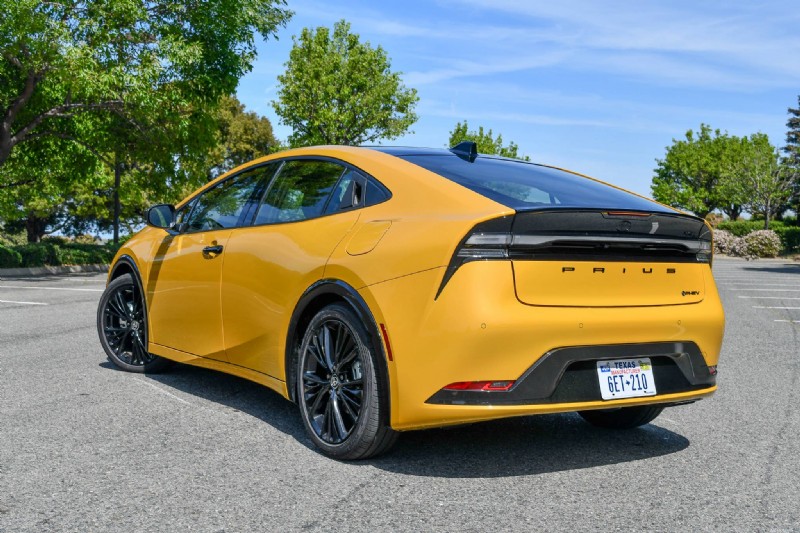
If it wasn’t hogging the mountain roads and refusing to pull over, it was lagging in the fast lane on the highways. Going slow and holding up traffic became a stereotype for Prius owners. That, paired with the fact that I’ve never met anyone who’s said they bought one because they loved the way they looked, drove, or had decent power. They always bought it for mileage. But, I think for 2026, Toyota’s finally flipped the script for the Prius. The interior is much nicer, the exterior design is interesting this time, and of course, the yellow Karashi color. Let me explain.
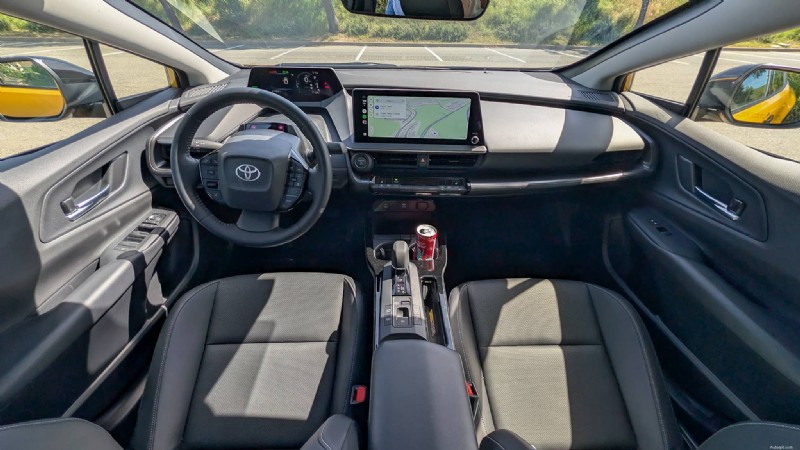
The only Toyota interior I can say I actually enjoyed was in the new 4Runner and Tacoma. The Sequoia is up there, too. Most other interiors are very lackluster for me. Even for the Prius, there’s lots of cheap-feeling black plastic; the dashboard and driver controls feel like they have acres of space between the driver and the firewall. I have a love-hate relationship with the 10.2-inch driver information display, because it’s so far away from the driver, it’s low-res, and it’s in an awkward place—it feels impossible to position the steering wheel in such a way that you can see the entire screen.
Kristen Brown
The Prius Nightshade PHEV I drove, though, had a touch of faux carbon fibre on the dashboard, the optional longer 12.3-inch main touchscreen was an excellent morale booster, and there’s an LED strip between the glovebox and the dashboard, which helped make it more attractive, especially at night. Because the cupholders, wireless phone charger, and center compartment are so high up, I felt a little boxed in at first—but I adjusted pretty quickly. If anything, it felt like I was piloting some kind of spaceship, and that made it fun. The carbon fibre accents and the lighting helped make it more fun, which is something the Prius could have used a few generations ago.
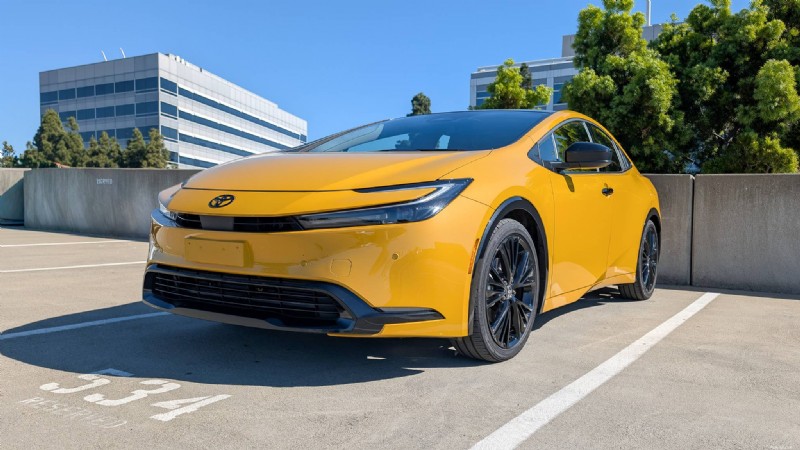
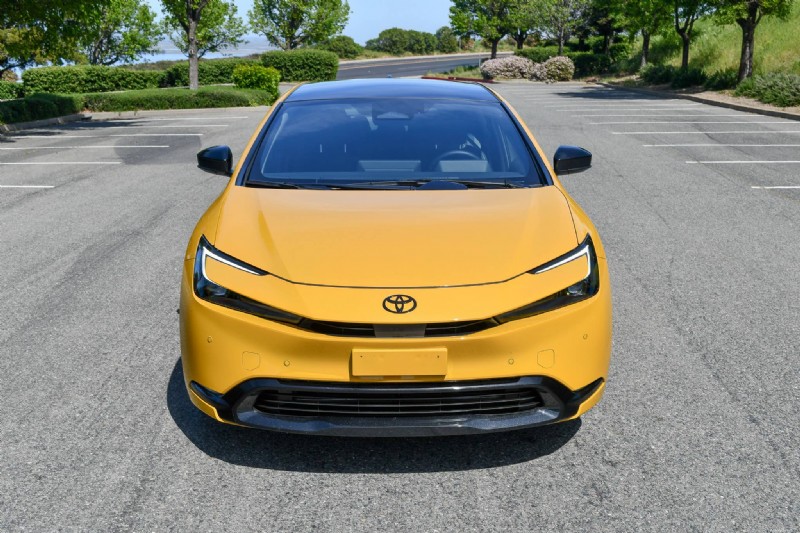
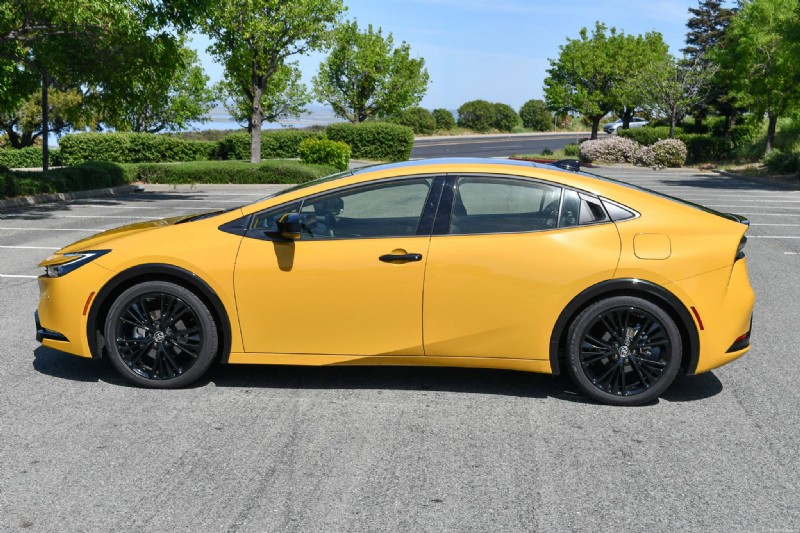
I was amongst the many who said the Prius looked like a door wedge. It wasn’t meant to have much personality when it came to design—the design was just to prioritize mileage. Not to inspire or provoke any emotions. The exterior for the 2026 Prius is much, much better. It’s still very wedge-shaped to help it minimize wind resistance and maximize mileage, but it’s hidden behind sleeker lines, wider hips, Toyota’s hammerhead headlight design, handsome black wheels as part of the Nightshade package that also encompasses black badging, door handles, and a black roof. It looks like something a Millennial like me would feel proud and excited to drive, because it has more personality.
Kristen Brown
My daughter noticed it, too. The Karashi color (which, if you didn’t know, means “Mustard” in Japanese), to her, was the best part. The second she saw it, her eyes lit up as she told me, “Mama, it looks like a baby school bus!” So, if a three-year-old thinks it’s cool because of the color, then it’s gospel. Plus, as an underrated bonus, I liked being able to easily see it in a crowded parking lot. Yellow isn’t a common color these days, and it hans’t been for a while—so it makes it easier to spot it from a distance.
I feel like it’s impossible to avoid news about what’s going on in the Middle East right now, and how that’s impacting the price of gas. Especially in places like California, where filling up causes me physical and emotional pain. The closest gas station to me, a Chevron, is charging $6.29 per gallon for regular. So, my condolences to those who are driving premium or diesel-only vehicles. Diesel was $7.69 per gallon. I wish I was joking.
The Prius I reviewed was the Nightshade PHEV, which is rated for 48 mpg combined. If you keep it charged, you get up to 44 miles of electric range, so when you’re doing your around-town driving, you can do it in EV mode and not burn a drop of gas. Then, when you’re done, plug it in, and do it again the next day. If you’re commuting, that’s a 44-mile head start before you have to dig into your fuel tank, which will absolutely help you save on fuel for the month. You’ll still cringe when you see how much you’re paying, but because you may only have to do it once per month—or even less if you work somewhere with employee charging—it won’t be nearly as bad as your coworker driving their Subaru.
Kristen Brown
A majority of my driving with it has been around town with short trips on the freeway, but even then, I averaged about 45.2 mpg. After 200-plus miles on the clock, I barely used up half of a tank of gas. That makes a huge difference to whoever’s buying one, especially commuters. I don’t have a place to charge a plug-in, so once my 44 miles were used up, I used the HEV settings, and both are excellent. If I were to buy one (and I seriously want one if I ever have to commute), I’d buy the standard Nightshade hybrid edition, which, ironically, is rated for a maximum of 52 mpg. Can I get a “hell yeah”?
Analysts at Cox Automotive reported that the average price of a brand-new car was between $49,000 and $50,300. I don’t know about you, but as a journalist, those are prices that would just about run me dry when you factor in the cost of rent, utilities, a phone bill, and everything else I’m bleeding myself dry to pay for. The Prius, true to its mission since its debut, is still incredibly affordable. The HEV’s base model, the LE (which is rated for 57 mpg), starts at $28,550. The top-tier Limited starts at $35,565. The PHEV’s base model, the SE, has a base MSRP of $33,775, while the XSE Premium starts at $40,470.
Kristen Brown
My tester, which was the Nightshade PHEV, had a sticker price of $41,304—but that’s because it had a few options, like the larger touchscreen ($610), the dealer’s add-on floor mats ($319), a 50-state emissions charge ($275), and then the fixed glass roof ($1,000). I’d argue that all of those upgrades, aside from the floor mats, which you can buy for much less aftermarket, are worthy upgrades. And if you stuck with the smaller touchscreen and didn’t go with the fixed glass roof, the sticker would be $37,795. Which, for the mileage and the styling, is excellent. Especially since you can lease one for $383 per month when you put $3,000 down. That’s something someone in my position could afford.
Back in the day, the Prius was looked at and treated like it was an appliance. There’s no soul, personality, style, or whimsy to it. For 2026, it finally feels like there is. While it’s still very much built for mileage and everything else took a back seat in a sense, it’s not nearly as bad as it used to be. The interior’s been updated, the exterior has vastly improved, and fun colors make it so much easier to love. The fact that it’s affordable and efficient on top of everything else makes it an excellent choice for just about anyone, but especially commuters.

Kristen Brown is an Oregon-based automotive writer and photographer who has been covering the industry since 2018. She specializes in a wide range of topics, including industry news, off-road vehicles, and Subaru culture, with a particular focus on testing new family cars from the practical perspective of a parent. Her writing has been featured in outlets such as U.S. News & World Report, The US Sun, and HotCars, while her photography has been published in Autoweek and Vintage Motorsports.
