
The most important safety feature on your car: the brakes. Surely you can survive if your ride won’t go from zero to sixty in less than six seconds. But if you can’t stop… well now, that’s a problem. Most likely, your car is equipped with highly efficient two- or four-wheel disc brakes. But your braking system needs attention – periodic maintenance to remain in good working order. Under the best circumstances, your brakes will wear out eventually. Unfortunately, brake systems sometimes (wait for it…) break down. Other times, they are just plain abused and neglected. Brake pads are worn too thin. Brake rotors become grooved or warped. And dirt, grime, salt, and sand can cause your calipers to seize up.
You might already know that your brake pads need to be replaced regularly. You might suspect that your rotors will eventually wear too thin to be of use and will need replacement. But did you know that your brake calipers can go bad? Let’s take a look at what a brake caliper is and how you might detect that is has gone bad.
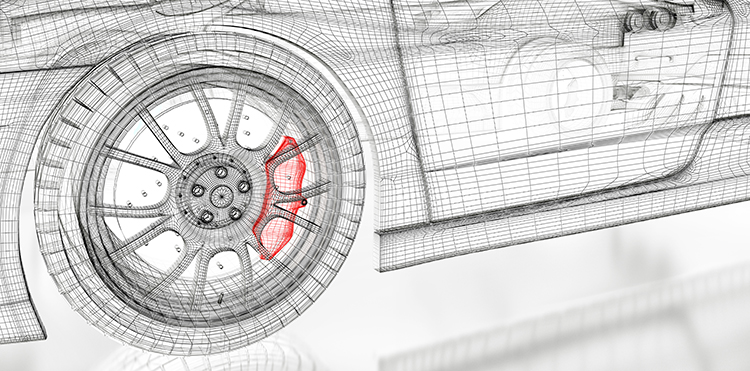
A disc brake system is made up of several components. Attached to each wheel are a brake rotor (the disc part), a pair of brake pads, and a brake caliper. The caliper is a clamp of sorts. It suspends the brake pads in a sandwich configuration on each side of the flat, round rotor (disc). When the wheel spins, the rotor spins with it. When you press on the brake pedal, hydraulic pressure is exerted (by way of a pump – the master cylinder – and through metal tubes called “brake lines”) to the caliper. The caliper squeezes, or clamps down, on the rotor and stops it from spinning.
The process is similar to when you apply the brakes on a bicycle. The brake caliper on the bike holds the rubber brake pads just outside the edge of the wheel. When you squeeze the brake lever, the caliper squeezes the pads against the wheel, bringing it to a stop. Now, the caliper needs to hold the brake pads next to the rotor at all times without creating drag until the brake pedal is pushed. It is able to do this because of one or more small pistons inside the caliper that extend and retract as the hydraulic pressure increases or decreases. In other words, when you press the brake pedal, the piston extends and pushes the brake pads against the rotor. When you let go, the piston retracts and the brake pads move away from the rotor.
If the caliper ceases to function properly, one of two problems will occur. Either the pads will fail to grab the rotor, or they will fail to release it. Both cases will negatively affect performance of the brake system and need to be addressed as soon as possible. The most common brake caliper problems are hydraulic fluid leaks and seizing. Consider the following results of these problems and the effects they have on performance:
If you experience any of these problems with your brake system, make sure to make an appointment with – or have your vehicle towed to – a trusted repair shop.
