
Whether your ATV has been in use all year long or you’re just taking it out of the garage, it’s probably a good time to look at your tires. But how do you choose the best tires to for your ATV and maintain the right ATV tire pressure? There are a few things to keep in mind.
The optimal tires for your ATV depend on what you’re planning to do with it. For instance, all-terrain or all-purpose tires are just like all-season ones on your car. They’re fine for driving on sand, grass, mud or pavement, but they don’t really shine on any one surface.
Mud tires are built to dominate in the muck. They feature deeper aggressive tread to dig through mud and get a grip. While they excel on muddy trails and gravel, and do well on hard snowpack and hard sand, they may not give you much traction on soft sand or pavement.
Off-road tires are really a balance between all-purpose and mud tires. They feature more-aggressive tread than all-purpose tires, yet not as aggressive as mud tires. Off-road tire construction and durability strikes a similar balance.
Turf-saver tires offer the best traction on pavement and other hard surfaces. Their flat non-aggressive tread keeps them from ruining turf and helps them last longer on hard surfaces. Sand tires, on the other hand, are made for soft sand. Rear sand tires are wide for better flotation, and flat ribs cross the entire width of the tire for traction, and it’s easy to see why they’re typically called “paddle tires.” Front sand tires typically feature no tread at all, with a single or double rib for steering.
Snow tires can be found in designs similar to both mud tires and sand tires, another balance of traction and flotation. Some even feature holes for studding.
Motocross tires are similar to all-purpose tires, but optimized for closed dirt tracks, whose surfaces are usually pretty uniform and loose. Stiff lugs and wide spacing makes for better cornering, traction and cleanout.
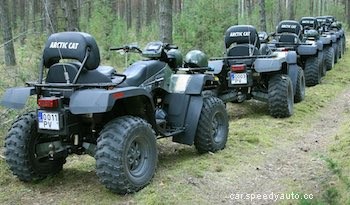 The right ATV tire pressure is based on manufacturer recommendation, terrain and load. Starting from the ATV and tire manufacturer recommendations, which generally range from 5 to 15 psi, take the following into consideration:
When you measure tire pressure, use a low-pressure ATV tire pressure gauge. Automotive tire pressure gauges are not accurate enough at such low pressures. Keep in mind the pressure on the sidewall is not operating pressure. This is the maximum safe tire pressure while mounting the tire and setting the beads.
Now that you’ve got your tires mounted and tire pressure set, go out and have some fun!
