
Fernando the electronics guy is an electronics engineer. He earned his Bachelor of Science in Electronics Engineering from UC Riverside.
Is jump starting another vehicle damaging to your own battery or electronics? Are sparking jumper cables a bad sight? Should I charge a super dead battery? Should I charge a battery that died overnight? Explanations to those questions, safety tips, and how to properly start jump starting another person's car battery.
The short answer here is maybe. Let's explain why.
Twelve-volt batteries simply lack the power to cause significant damage to electronic components – not to mention one can usually find integrated anti-surge protection when charging. As a result, expensive car battery damage happens when you do not connect the ends of a jumper cable properly to both your car and the recipient’s car. Unless you are touching one of the leads to something else and as a result shorting one or more components of the vehicle’s delicate systems, there should not be electronic damage.
How you proceed to crank the car with the dead battery makes a difference. The safest way is to charge the dead battery using the good battery, and after the dead battery has sufficient charge to start, disconnect the cables and then crank the car with the bad battery.
The less safe way is to crank the car with the bad battery while the car with the good battery is running and both batteries continue to be wired to each other. This method creates a heavier load on the battery, requiring higher currents. Just the act of removing this load from the good battery can create a load dump – a moment where current falls drastically and voltage spikes momentarily due to the inductance of the field winding inside the alternator. This may or may not cause electrical problems.
The safer method is preferred, but make such a decisive action at your own risk.
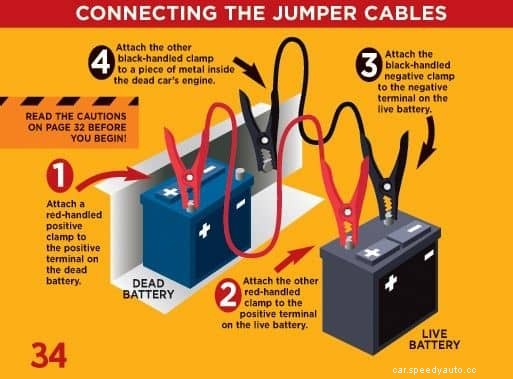
Sparking is dangerous as there is always a small probability the battery may explode, ejecting battery acid in your face. Avoiding this problem is exactly why it is recommended to connect the negative jumper cable to the vehicle body and not the negative post of the battery. Always place the jumper cables in the correct order and way.
In normal cases charging a too dead battery for a few minutes before attempting to start the bad battery’s vessel will work. But, in the case that said process does not work, the terminals of the battery may be corroded or the battery itself may be very old and beyond repair. In either case there is also the possibility the problem is found elsewhere – the alternator, a blown starter, etc.
If you want to be the best at jump starting, you need to own the best.
For years I have paid for countless sets of jumper cables that were below $100. Nearly all have failed me up to this day. The following are the most common problems you'll face with a cheap set:
I personally learned my lesson years ago. I bought the following product -- a product I recommend to all my friends and family. It has paid for itself and I've never had the same problem again.
It really does pay for itself. You won't regret it.
Admin (2016). Will I damage my car if I give someone a jump start? Serra Hyundai,
Alsop, Rory. (2012). Is it possible to harm your car by giving someone a boost. Stack Exchange: Mechanics.
Azuma, Tsukasa. (2019). Is sparking while jump starting a car safe or not? Car From Japan.
How to jump start a car. (August 22, 2016). Firestone.
Lim, John. n.d. 8 things you should never ever do when you start your car. Says.
How long should you charge a dead car battery? (April 10, 2018). Meineke.
Connecting the jumper cables. (October 27, 2010). [Photograph]. My Techie Guy.
Vallet, Mark. (December 3, 2015). The do’s and don’ts of jumpstarting a car. Your Mechanic.
McMahon, Russell. (January 10, 2012). Why is there risk of overvoltage when jump-starting a vehicle? Stack Exchange: Electronics.
How to jump start a car. (February 8, 2018). Holts Auto.
Electrical, electronics, batteries, and automotive. electrofern.com
This article is accurate and true to the best of the author’s knowledge. Content is for informational or entertainment purposes only and does not substitute for personal counsel or professional advice in business, financial, legal, or technical matters.
