
Windshield wiper problems are seldom noticed until you’ve got somewhere important to be, and wipers are struggling to keep the rain away from the windshield. Without functioning wipers, driving in rain or snow is incredibly dangerous and next to impossible. In this guide, we’ll take a closer look at 6 windshield wiper problems that can be fixed easily on the road with basic or no tools required.
This is by far the most common, but also the easiest problem to fix. Wipers are an expendable component, and just like tire treads, the rubber slowly rubs away under friction. Step outside the vehicle, lift the wiper arm into an upward position, then rotate the blade to closely inspect the rubber. If you’re seeing signs of wear, chipping, and serious twisting, the wiper blades are ready to be replaced.
Chattering or juddering are terms used to describe a wiper blade that jumps across the windshield and can’t cycle smoothly. This happens when there’s too much friction between the rubber and glass. Since rain or wiper fluid acts like a lubricant too, there has to be an outside source of stickiness that causes additional friction.
The solution is very simple – take a sponge, a bucket of water with some cleaning solution, and scrub the entire windshield and wiper blades. Your windshield might already appear clean, but there could be a coating of pollen or other substance you can’t quite see, but it’s causing increased friction. The same goes for the wipers, so clean the surfaces as best as you can, then try the wipers with the windshield cleaner.
If you wash your vehicle regularly at a self-service station, the cause might also be the wax-water option. I’ve experienced wiper chatter myself when I didn’t rinse the wax water properly after applying it to the vehicle. Make sure to spend a few extra seconds on hosing down the windshield whenever you’re washing the vehicle to ensure no excess residue remains.
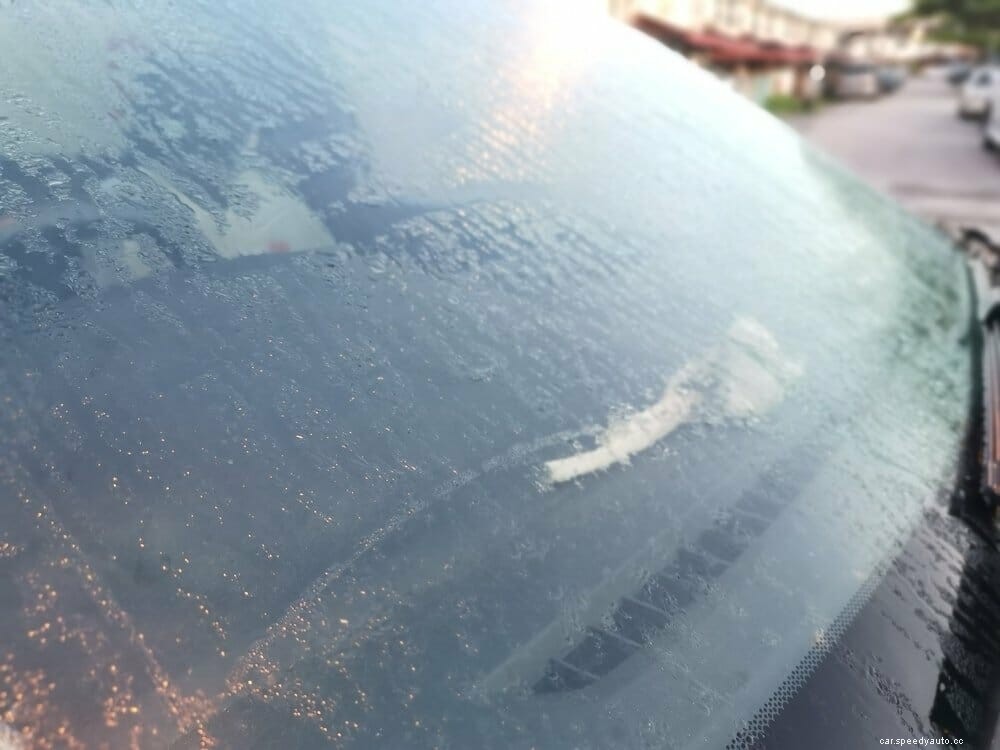
Hazing windshield is one of the most annoying occurrences when driving in the rain. Visibility conditions are bad, to begin with, and the last thing you want is a hazy view, especially at night.
There are several reasons why windshield hazes:
Without getting into the technical terminology, wiper haze appears because the moisture doesn’t get effectively removed. This can be caused by the dirty windshield or worn wiper blades, but also by a chemical agent.
Some windshield cleaning fluids or wax solutions actually hurt your visibility more than they help. They leave a thin coating that should keep the windscreen clean and haze-free but only succeed in the first part. Change your cleaning and wax fluids and see whether the problem persists.
Hazing could also be the regular fogging up of glass due to a temperature difference. When the outside temperature is much colder than the passenger cabin, the windshield will fog up and make it difficult to see the road. The solutions are very simple – turn on the windshield heating vents, and blow either cold or hot air, either will result in defogging. Leaving one window slightly open will get enough cold air inside to prevent fogging without significantly affecting the interior temperature.
When wipers are not touching the windshield and wiper blades are in good condition, then the problem is the wiper arm. You can tell by lightly raising the wiper blade, and comparing the tension to the one working properly. To get the best and access to the wiper arm, let your wipers run slowly, then turn off the ignition when they’re at their peak of the movement.
I was personally very skeptical of the method I’m about to share with you, but having tried it myself, I can tell you it’s not dangerous if performed correctly. You’ll need a cardboard roll as you’d get from the toilet paper, only thicker. You can alternatively use a plastic tube, or a deodorant can, but place a piece of paper on the windshield and work carefully to avoid scratching it.
The wiper arm is made out of thin, spring steel that can be bent slightly without damage, which is what we’ll do. By using the tube as a lever point, gently apply pressure on the wiper blade to bend it into shape. Check the tension, and if it feels better, try the wipers with some windshield cleaning fluid. Make sure not to overdo it, as that will cause the wiper to jitter over the windshield and make a scratching noise.
Here’s a useful guide that illustrates this method well:
This happens when wipers of incorrect size are installed on the vehicle. It happens more often than you think, as people generally don’t think too much about wipers they’re buying, and get whatever the shop clerk thinks is the best. Check the owner’s manual or manufacturer’s website for the exact measurement of wipers.
Some cars use wipers of different lengths, so you might have to get two sets at the same time, which is great since you can put the spare set in the trunk. If you can’t find the official specifications, you can measure the wiper blade length yourself.
Spray some water on the windshield, then use the wipers to wipe it off. The blades will leave an outline that you can use to measure how much longer they can get without going out of bounds. Remember that wiper blades don’t have a symmetrical area to cover, so don’t try to achieve maximum coverage.
Pulling the wiper stick towards yourself only to see wipers pointlessly scrape over a dry windshield can be very frustrating. There are a few reasons why the windshield nozzles are not spraying cleaning solution on the windshield, so let’s review them.
The most obvious problem is the lack of cleaning fluid, so lift the hood up and check the fluid levels on the cleaning bottle. It’s made out of plastic and can be found on the sides of the vehicle, typically above the front left wheel. In freezing temperatures, cleaning liquid without anti-freeze properties will freeze and cause a number of problems. Always use an all-weather cleaning solution as it’s not more expensive, but is much more convenient.
If the cleaning fluid is not lacking, inspect the tubes running across the hood towards the nozzles. Look for rupture or leak signs, and mend with waterproof tape or replace a part of the tube. When everything appears to be in order, but the nozzles aren’t ejecting enough liquid, they might be affected by calcium scaling.
The most likely cause for nozzle scaling isn’t the cleaning liquid, as it uses distilled water. The more likely cause is the mineral-rich rain that falls on the car. Use a basic bathroom scale cleaner on the nozzles, then rinse them from outside, and test them out. Repeat the process until they’re back to a fully functional state.
This video guide will help you if you can’t get the nozzles to work:
When windshield wipers don’t respond to commands, rather than suspecting their electromotor, you should check the fuse box. A blown fuse is a far more likely cause, and you should always have a set of spares in your vehicle, just in case.
Unfortunately, wiper motors are not expensive. They cost between $200 and $300, while the cost of labor to replace them can go up to $100. If you’re suspecting a failed wiper motor, make sure to rule out all other suspects before proceeding with a replacement.
You’d be surprised to hear that this is actually a frequently asked question, but some do bring up the viability of driving without wipers. Someone attributed it to “swimming without goggles” and I couldn’t agree more. Driving without wipers is one of the most irresponsible actions and should never be done, even if you’re headed to the nearest shop for a new set of wiper blades.
Because it’s petroleum-based, WD40 shouldn’t be used on wiper blades. The chemical reaction dissolves rubber, and while other components can endure it, wiper blades are too delicate.
Wiper motors are made to last a lifetime, never to be replaced. Realistically, the weather conditions, outdoor parking, heat, and moisture all contribute to wiper motor failure. There’s no mileage or time range in which it can happen – it’s completely up to chance.
The conventional wiper blade design has been used for decades and was invented in a time when windshields were mostly flat. Modern windshields are convex, so a premium wiper blade does provide some benefit over budget options.
Surprisingly, almost all of the wiper problems can be solved with a proper cleaning and wiper blade replacement. When it comes to lack of tension, use the fourth method to get them back in order. Overall, wiper problems are very easy to solve and should never be left unchecked until the rainy days come. I hope I’ve helped you solve your issue, and if you’ve liked this guide, browse our website for more simple and inexpensive maintenance tips!
Check out some of our windshield-related articles for more knowledge:
Why Is My Windshield Wiper Fluid Not Coming Out?
How To Adjust Windshield Wiper Arm Tension And Park Position
Do Car Warranties Cover Windshields?
