
It’s normal for the internal combustion engine to consume a small amount of oil over time. When the oil levels fall below the required amount, you’ll need to add more, but the question is – can you do it when the engine is hot?
You can add oil to a hot engine, but the problem is that you won’t be able to accurately read the dipstick and know how much oil to add. Because of that, it’s better to let the engine cool off until it’s warm, which should only take 5-15 minutes.
Yes, you can safely add oil to a hot engine without the risk of damage. The oil will heat up much faster than a temperature difference can be created, especially if you’re only topping up. Opening the oil cap will not cause any vapors or oil to burst out, as there’s no vapor pressure in the crankcase or heads.
While adding oil to the engine is safe, keep in mind that everything inside the engine bay is very hot. If you cannot wait for the engine to cool off even slightly, be very careful where you place your hands, and consider wearing a pair of gloves.
Neither option is ideal as you’ll face the problem of not being able to accurately read the dipstick. In a cold engine, all of the oil will accumulate in the oil sump at the bottom of the engine, while the hot engine will circulate it through the entire system.
The ideal conditions are reached more quickly with a hot engine – simply let it cool for 5 to 15 minutes. During that time, the oil will drip down and settle in the sump, allowing you to get an accurate reading with the dipstick. In case of a cold engine, you should warm it up first, then check the levels after 2-5 minutes.
Oil can be added to the engine even when it’s running, but the whole process doesn’t rely on when, but rather how much oil should be added. That’s why the best results are achieved with a warm engine.
If the amount of oil missing goes beyond what is considered normal, you may have a leak in the system. In the Rear Main Seal Leak Symptoms And Repair Cost article, we explore the main causes for engine leaks, so be sure to check it out.
Adding motor oil involves a very simple process:

It may seem like there are a lot of steps to adding motor oil, but I’ve just made it more detailed to help you better understand the process. In reality, it’s just a series of checks and refills until you get to the right amount. Usually, this is achieved with only a couple hundred milliliters of oil.
The one thing you need to remember is what type of oil is your engine using. It’s best to use the same type, and even brand as the one added during regular service. For that reason, it’s good practice to buy an extra quart of oil to keep inside your trunk.
If a mechanic changed your oil and you’re not sure what type was used, look around the engine bay for maintenance tags. Mechanics attach a tag stating the mileage when the service was performed, as well as the oil type used.
Overfilling the engine with oil can be a serious problem. With the increase in oil levels inside the pan, the crankshaft will come in contact with the oil and mix it with air. This will create a foamy liquid that won’t lubricate the engine as well. In some regard, it’s just as bad as not having enough oil.
It’s a good idea to give your car 5-15 minutes to cool down, as this will allow you to get a more accurate reading with the dipstick. As we’ve discussed in the article, an engine that is too hot or too cold will prevent you from getting an accurate estimate as to how much oil is missing.
Yes, it should be safe to open the engine oil cap even when the engine is hot, as there is no pressure in the crankcase.
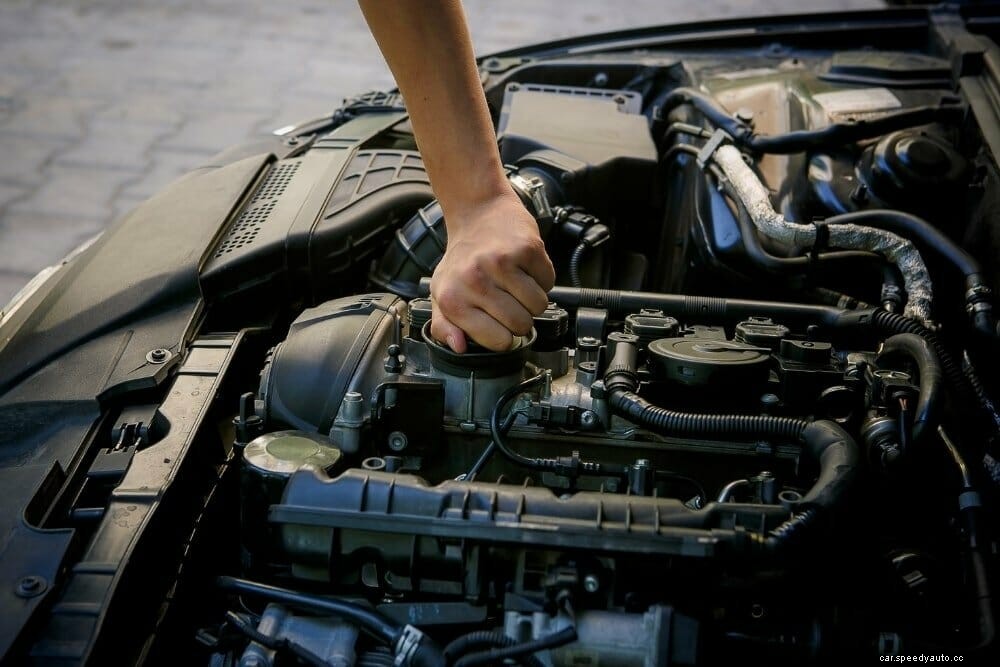
If the oil inside the engine hasn’t exceeded its mileage limit, it’s completely fine to add oil in between regular service. Some engines consume up to 1 liter of oil between the intervals, so you’ll have to add oil a few times before the next change.
This largely depends on the ambient temperature, as cold weather has a significant effect on how quickly oil heats up. In general, 10-20 minutes is enough for oil to reach optimal running temperature.
Every dipstick has a clear way of telling how much oil is in the system. It’s either marked with a MIN and MAX gauge, or there’s a grooved section in the middle of an indent. Once you’ve cleaned and reinserted the dipstick, pull it out and hold it flat to see how far the oil has reached on the dipstick gauge.
If it’s beyond the grooves or the MAX marking, there’s too much oil in the system, and some should be immediately let out through the drainage pug.
Motor oil can be added to the engine at any point, but the best time to fill up is when the engine is warm. Check the oil levels with the dipstick and add more oil in stages, rather than all at once. Overfilling the engine with oil is a serious problem, and will have a negative effect on the lubrication, but as long as you’re working patiently, the chances of adding too much oil are minimal.
Check out some of these related topics:
Is Engine or Motor Oil Flammable?
Oil In Intake Manifold: What Causes It And How Do You Fix It?
Oil In The Spark Plug Well: Symptoms, Causes, and Fixes
