
The check engine warning lights up on the dashboard, and your OBD2 scanner tells you there’s a problem with sensor 2 of bank 1. You might be confused as to what this means, but the terminology is quite simple.
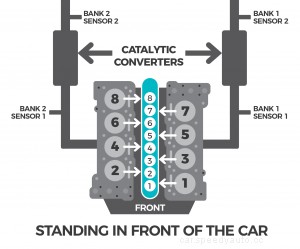
The engine banks represent two halves of the engine. Bank 1 is closer to the radiator and serpentine belt, while bank two is the other side. Sensor 1 is located between the engine and the catalytic converter, while sensor 2 is located behind the catalytic converter.
This might seem confusing at first, but in this guide, I’ll go into more detail on how to identify banks and sensor positions, so you can easily figure out where the faulty sensor is, no matter the displacement, the number of cylinders, or the layout of the engine.
The engine of your vehicle acts as a single unit, but it’s divided into banks and cylinder numbers to help you identify problems more easily.
To identify banks 1 and 2, we need to find the first cylinder of the engine. In a longitudinally mounted engine, the transmission faces the back of the vehicle, so cylinder 1 is going to be the one closest to the radiator and the serpentine belt.
In the transverse-mounted engine, the layout is shifted so the first cylinder faces either the left or right wheel. As the radiator is in the front, you can only identify the first cylinder by looking at the position of the serpentine belt.
Bank represents a row of cylinders. A V engine will have two banks, a boxer engine will also have two banks, while an inline engine will only have one bank (with one exception).
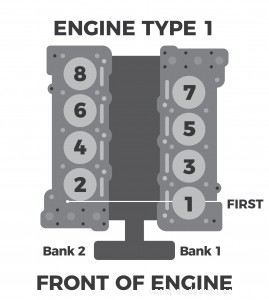
The inline-6 engine is somewhat of an exception. It has one physical bank, as it only has one row of cylinders, but also has two exhaust manifolds. Manifolds split into two exhaust pipes that have a catalytic converter and two o2 sensors each.
Because banks help you identify which side of the engine and the exhaust system has a problem, inline-6 engines are split into virtual banks. The first three cylinders form bank one, while the rest make bank 2.
If you’re having trouble identifying bank 1, there’s a couple of things you can do. The first is to check whether the owner’s manual has the information. Alternatively, you can disconnect the O2 sensor and read the error to figure out what bank you disconnected.
One of the reasons why we need banks is to identify which O2 sensor has a problem. The number of O2 sensors is determined by the number of catalytic converters – 2 sensors per cat.
The first sensor is placed between the engine and the catalytic converter, while the second is located behind it. If you know this, it’s very easy to locate the faulty O2 sensor.
The Bank 1 sensor 2 is located behind the catalytic converter, on the side of the engine that has cylinder 1.
We all know that oxygen sensors are important, but why is that the case?
O2 sensors provide an additional set of information to the car’s computer unit so it can better adjust the air-fuel ratio. Their primary purpose is to reduce emissions, but they also improve fuel economy and keep the engine running at optimal power.
If the oxygen sensor goes bad, the computer will not get the data necessary to make adjustments and can run either too lean or too rich. Neither is good for your engine, with common symptoms being poor gas mileage, rough idle, misfire, loss of power, and smoke coming out of the exhaust.
The first symptom will always be the check engine light, making it very easy to identify the problem. Simply attach the OBD2 scanner to the connection port, and read the error codes.
Testing and replacing the oxygen sensor is not very difficult if you can reach it. The trouble is that on some vehicles, getting to the sensor can be a challenge, so before you get the tools, check the location and instructions for your exact vehicle. In this guide, I’ll take you through the general process, so you can see it’s not that difficult of a job.
| Image | Title | Price | Buy |
|---|---|---|---|
 Top
Top | ANCEL AD310 Classic Enhanced OBD II Scanner Car Engine Fault Code Reader CAN Diagnostic Scan Tool-Black | Buy Now | |
 Top
Top | AstroAI Multimeter 2000 Counts Digital Multimeter with DC AC Voltmeter and Ohm Volt Amp Tester ; Measures Voltage, Current, Resistance; Tests Live Wire, Continuity | Buy Now | |
 Top
Top | TEKTON 3/8 Inch Drive x 7/8 Inch 6-Point Oxygen Sensor Socket | 4929 | Buy Now | |
 Top
Top | Crescent 3/8" Drive 72 Tooth Quick Release Teardrop Ratchet 8.5" - CR38 | Buy Now | |
 Top
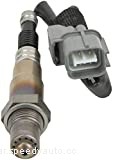
Top | Bosch 13539 Oxygen Sensor, OE Fitment (Acura, Honda, Isuzu) | Buy Now | |
 Top
Top | Permatex 80078 Anti-Seize Lubricant with Brush Top Bottle, 8 oz. | Buy Now |
There’s no way to say with certainty whether bank 1 is left or right side of the engine before taking a look at it. Use the instructions provided in this article to learn how to identify banks 1 & 2, as well as figure out the position of the sensor within the exhaust system.
Terms upstream and downstream relate to the position of the sensor in reference to the catalytic converter. Sensor 2 is located after the catalytic converter, meaning it’s downstream.
Unfortunately, O2 sensors cannot be cleaned and have to be replaced. Seafoam, gasoline, brake cleaner, and any other solution will not help the O2 sensor in any way. The only thing you can do before changing it is to check if it’s still working with the multimeter, and look for the problem elsewhere.
The first symptom of a bad oxygen sensor will be the check engine light, followed by rough idling and bad gas mileage. There will also be a smell of gasoline and excess smoke coming from the exhaust.
Driving without the O2 sensor is possible, but I wouldn’t advise driving for long distances once the sensor has failed. The improper air-fuel mixture can lead to a number of long-term problems for the engine, so try to replace the O2 sensors as soon as possible.
Dummy O2 sensor replaces the original and always sends the same signal to the ECU as if the air-fuel mixture was optimal. It’s basically just a step above not having the sensor at all, in the fact that the engine will not report an error in the system. Like driving without the O2 sensors, using dummy O2 sensors is not advised.
Identifying bank 1 sensor 2 might have been a challenge initially, but after reading this article you’ll be able to easily identify O2 sensor problems, no matter the engine layout, number of cylinders, or the number of O2 sensors. I hope you’ve learned something new and that you’ll frequently visit the VehicleFreak website!
Check out more similar posts:
How To Remove O2 Sensor Without Socket?
How To Bypass Reduced Engine Power?
5 Bad Knock Sensor Symptoms
