
As cars get more advanced and our roads become more streamlined, the tests that drivers take naturally change. You cannot rely on your parents’ knowledge of driving to get you through the exams today because the important factors they had to consider are no longer relevant for today’s exams.
Don’t worry though, as we will tell you exactly what you need to know for your driving test, so you can feel confident when the examiner sits next to you.
The most important advice that we can give you is to practice, practice, practice. Keep this page bookmarked, and test your knowledge continuously until the exam day. Eventually, this will all feel like second nature to you, but you have to put the effort in now to reach that level of confidence.
Table of contents
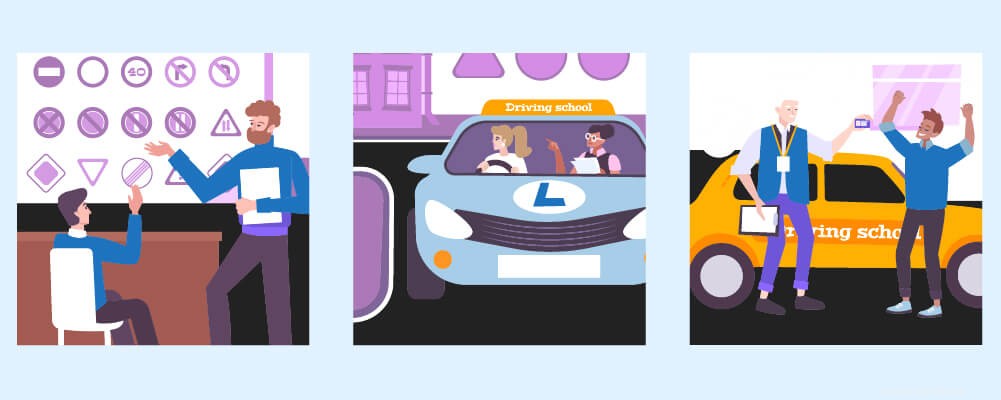
These four points are the minimum you need to pass your driving test. Ideally, you’ll be preparing everything, but if you’re struggling with where to start, this list will help you.
Every state has a different starting age for learning to drive. In some places, it is as young as 15, and in others, you need to be 18. Figure out which age is correct for your state, and then find an instructor or responsible adult to teach you. This person should have a driving license and should have at least 2 years of experience.
Once you know the laws and have someone responsible helping you out, it’s time to get comfortable in your new classroom.
The car you are driving should feel like an additional limb to you. You should know where your indicators are, understand how much pressure to apply on the brakes, and know how to adjust the seats to fit your body.
Feeling comfortable in your vehicle will help you stay focused when the exams come. If you are already stressed when you’re driving, having someone mark you in the seat next door won’t help you stay focused.
Every state has their own DMV department, and unfortunately, that means they also have their own driving manuals. Luckily, the Official Driver Handbook has collected every manual from every state and put it into one place. Their handbook is free too, so everyone can have access to this vital information.
Now you have your permit, a helping guide, and your state’s driving manual, you can start to study for your driving test. Ideally, you should learn the basics of the road in paper form before sitting behind the wheel. This means memorizing the pedals, understanding the gears (even if it’s just an automatic), and learning the different types of roads.
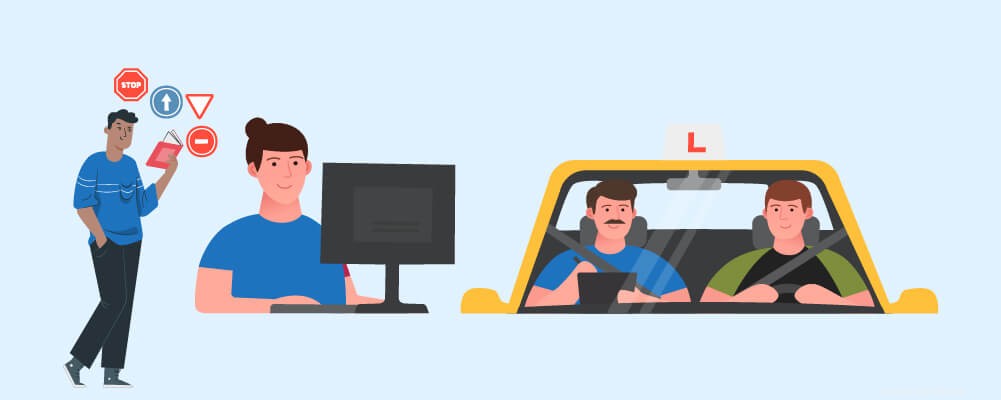
Just like with any test, you need to prepare for the exam and make yourself as knowledgeable as you can.
We have some suggestions to help you reach that level of proficiency.
Each state has its own grading system, however, using the driving manual we talked about earlier can help you learn the key steps in your area. Study the areas your examiner will be taking an interest in and prepare yourself for these types of questions and actions.
If you know your driver will ask you to parallel park, then you need to be prepared for the question.
Next, you need to learn what the passing rate is, so even if you don’t get 100%, you know what grade is still acceptable.
When it comes to practicing the physical element of driving, you should try and find an empty spot of land. Ideally, a vacant parking lot will be the best choice, as you will have a lot of room to make mistakes.
However, if the parking lot has cars inside, this will not be a good option. That’s because you could crash the car causing damage before even getting your license. Unfortunately, most parking lots are full in our generation, so finding a different open space might be the best bet.
Once you know the basics of driving and feel confident enough in your open space, you should start to tour around public roads. Again, if you feel confident on the road with other people, you should take the car to the site of your test.
The best way to pass the first time is to know your landscape and commit it to muscle memory. If you practice and practice in the area of your test, you will be more comfortable when the time comes for an examiner to join you.
If you don’t have access to the testing area, your next best bet is to practice on a quiet road that still has people moving around their daily life. The suburbs would be perfect as people living there aren’t often in a rush, the space tends to be large, but there are still enough people to give you a realistic sense of problem-solving.
As the saying goes, “if you stay ready, you don’t have to get ready,” and the same goes for your car. If you keep it in good condition, you don’t have to put extra effort on the day to make sure it’s in good condition.
As a little bit of a tick box exercise, here are some things to double-check.
This means ensuring your headlights have a level of approved brightness and work as functioned. The same goes for your brake lights and turn signals.
Be sure that your foot brakes are secured and not worn down. These two are the most likely to fail before a test as most drivers buy second-hand cars. Make sure you don’t fall into this trap and get your vehicle tested.
A cheap way to see if your tires are in good condition is to put a penny upside down in a tire’s tread. If you can see the top of Lincoln’s head, or even more of him, then your tires need to be replaced.
You should also check the tire pressure, condition, and oil. All of which you can find here, or alternatively, you can hire a mechanic.
Checking your wiper fluid is nothing like checking your oil. No dipstick is needed. All you need to do is fill up the liquid to the top. However, because this process is so easy, many new drivers forget this step. You need your wiper fluid, especially if you live near dirt paths or in harsh weather conditions.
Simply check how full the wiper fluid container is and top it up every now and then.
Your instructor will likely want to see you adjusting your mirrors, so keep this preparation skill in mind when you start your test. It is something you should be doing every time you drive, as your mirrors are an important part of your safety.
When you are sitting in your seat, you should slowly tilt the rearview mirror until you can see out the back of your windshield without moving your head.
Then you should tilt the side mirror until you can see the road behind you.
Hopefully, you should never need your hand signals, as your lights should be constantly checked before you set off on your journey. However, your instructor will likely want to make sure you know them anyway.
As part of your instinctive learning, practice the hand signals every time you enter your car and before you set off on your journey.
Your car’s paperwork will hold the critical information on how to fix any problem, where to get replacement parts, and how to use the technology inside. To make sure you don’t lose this information, you should keep it in the glove compartment.
Secondly, your information about licensing and tax should also be kept in your vehicle, this way, if an officer questions you, you’ll have all the information you need.
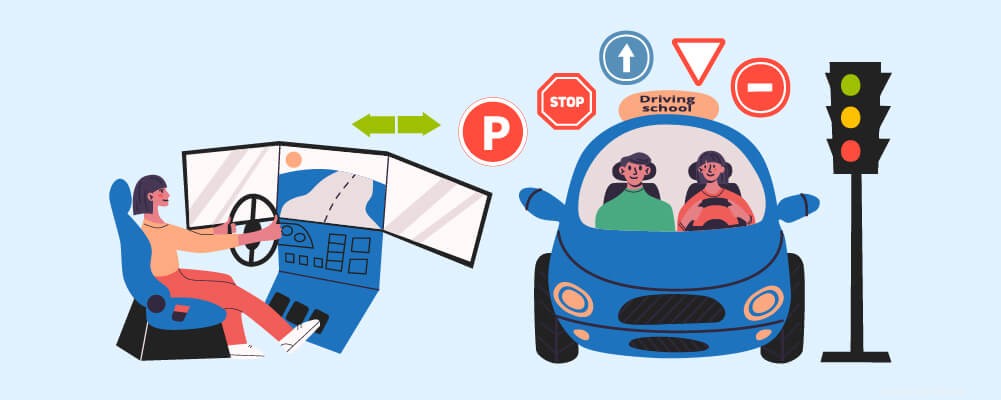
Typically there will be 7 sections in your road test, each of which we will go over now.
This is the section where the examiner will watch how you deal with your car before starting your journey.
There isn’t a proper guideline around testing your emergency braking, however, you should try and test it out before starting your car; that way, if something goes wrong, you know your brakes will protect you.
To give it a test, move the car just a little bit and then slam on the brakes. The vehicle should stop instantly.
We have already discussed arm singles briefly, but your examiner will want to see you carry out these steps.
If you want to slow down or stop, you should move your hand out of the window and extend it downwards. If you need to turn left, you should put your hand outside the window and keep it straight. And if you need to turn right, you should put your hand outside the window and raise it high in the air.
Your windshield wipers should be able to move freely without friction, and the liquid should spurt without faulting. If your wipers do not function properly, they will be considered a safety risk.
Leaving your car with snow on the windshield or on top of your vehicle could lead to an accident. This could happen from your obscured view or from a sudden stop throwing the snow at another driver.
However, if you defrost the vehicles incorrectly, it could break your windows.
To do it safely, you should use a spray to melt away the ice and then scrape the remains with a scraping tool. Dishwashing soap and alcohol can also do the trick, but hot water could break the glass.
Your emergency flashers, or hazard lights, are used to inform other drivers that something is wrong. To make sure that others know to slow down around you and treat you with caution, you need to make sure that they are working properly.
To do this, simply press the button and watch for a couple of seconds for them to flash as they should.
Different states have different rules around when to use headlights, as snowstorms, daylight, and rain act differently around the country. Make sure you know which rules apply to you.
You should also make sure that your lights are working properly and adhere to your state’s brightness ruling.
Again this should be a simple test of making sure the turn signals work. If you are using the examiner’s car and not your own, it is important to make yourself aware of where the turning signals are so you don’t panic or get confused when you need to use them.
Like the emergency brake test, you should press down the foot brake to see if you feel the expected force behind it and then move the car slightly to use the brake in action.
If the car stops as it should, from the test of your break, then you will be safe to drive the vehicle.
Lastly, the pre-drive checklist should include your horn. Horns are meant to be used when going around blind corners. This is so that any incoming traffic will become aware of your presence, and a crash can be avoided.
Again, each state will have its own specific rules, so check what is considered best practice for your area.
Before the examiner will allow you to drive on the road, they will first ask you to drive through a parking lot. This is so that the supervisor can assess your basic driving skills and see if you will be a danger to the public.
If the designated area is not at the same spot as the pick-up site, you might be expected to follow a private road to the open space or a public one. This will be up to the examiner and their business.
When you have been seen as safe enough to drive in public spaces, you will be taken through different spaces so the examiner can see how you fare in different situations.
A traffic check is when the driver scans the area for any obstacles or obstructions. This could be other cars, pedestrians or even bins. Anything that could become a hazard should be picked up in your traffic check. Failed checks often lead to collisions.
In the exam, you might be asked to name all of the hazards in your area. If that’s the case, you will be judged based on how many you picked up.
One of the main things the examiner will do is check your speed. A common misconception is that you can go over the speed limit by 5 mph and still be in the legal range, however, this isn’t true. The limit is the limit, you cannot go over it.
To be safe, you should try to keep your driving 5 mph under the speed limit, so you have a little buffer between you and the law.
Leaving space between you and the next driver will save you from a horrible collision. If that other driver stops suddenly, you need space to brake too; otherwise, you will go into their backside. Failing to give space is called “tailgating,” but how close is too close?
A safe distance is 3 seconds behind. This means that it will take you 3 seconds to reach the same spot as the previous car. However, this is considered a minimum requirement as most people will not react fast enough in 3 seconds.
Instead, you may want to use a visual representation instead and imagine two cars between you and the driver ahead. Leave enough space for these imaginary two cars, and you will have enough space to brake.
Lastly, you should be aware of your lane position as you are told to move left and right. There are 5 options in total, and they depend on the obstructions found in your traffic checks.
Depending on your state, you will be asked to turn around using a corner and to back up along one. The idea is to test your ability to control the car and use the proper vision techniques to do so.
The most important thing to remember, when reversing, is to turn around and view the back window through your own eyes. If you use a rearview mirror or your side mirrors to complete the task, you will lose points.
When you change lanes, you need to make sure you signal to the other drivers, so they can give you room. However, signaling doesn’t give you the right of way, so don’t expect to swerve into the next lane. Instead, you should look for someone to accept your request and only then move into the space.
When you are signaling, you should do a traffic check and be sure that you have enough space when you move into the next lane. If you instantly start tailgating someone, then you will lose points for an improper lane change.
In the exam, you can expect all if not most of the 7 types below to crop up. If you try to master these, you’ll be set when the day comes.
These turns should be basic and easy to follow. Some say that you will only be asked to do up to 4, but in reality, it depends on your location. If you take the test in an area that is basically filled with turns, then you will not be able to avoid the suggestion.
Because turns will be part of the test at some point, you should try your best to become comfortable and confident with this maneuver.
Unfortunately, many Americans refuse to use their signals after passing their test. This could be because a lot of our roads are one way, so the need to use them is often unnecessary, however you should not pick up on this habit.
It is better to overuse your signals than underuse them, as trying to turn a corner and move to a new lane without informing the drivers around you of your intent could cause an accident.
Navigating the right of way system at a full stop sign can be complicated. You will likely be asked to do this on your test, so be sure to follow the guidance in your manual and learn the 4 different ways to turn at a stop sign.
If there are limited or restricted lanes near you, you will be able to notice them from their double yellow strip markers. Knowing when to move into these lanes can be tricky, so practice them often in case they come up on your test.
When you make your turn, no matter which one it is, the examiners will be seeing how well you can control the steering. If your turn is too loose and you end up in an odd position in the lane, you will be penalized for your lack of control,
Always aim for the center of the lane when turning. This will show the examiner that you have a confident level of control over the car.
While you are turning, you should be able to maintain your speed. If you were turning at a Full Stop sign, you would need to completely stop before continuing on. After making the safe turn, you should be able to get back to your original speed without pushing the car too hard.
Understanding which lane to move into while you are driving can be overwhelming. This is why we suggest trying to take the examiner’s route before taking the test. This way, you can practice the turns they will likely give you.
Intersections can be tricky roads to maneuver through. They are junctions that have a large section where multiple vehicles can meet or cross at once.
To navigate through them, you and the other drivers on the road should be following the law and respecting each other’s path.
Depending on how busy the intersection is, you will need to match the speed of the vehicles around you. The intersection will have a designated speed limit, as with every road, however, with so many cars moving through this free space, you need to make sure that you don’t break the limit trying to reach the other side.
Yield signs mean you have to give the other vehicles or pedestrians the right of way. If you ignore a yield sign on your test, you will receive a heavy set of deductions.
Throughout this whole process, you should be completing traffic checks. It is even more important during an intersection, as many cars will become frustrated and will push through to their lane. This will cause an accident if other cars do not spot it. As a responsible driver, you should do your best to avoid all collisions.
Ideally, when you brake, you should be slowing your speed. Emergency brakes should only be used when necessary, as you will otherwise force the cars behind you to emergency brake too.
Again, if you do not obey the limited lines on an intersection, you will be heavily deducted points. We suggest practicing this maneuver on a less busy intersection or road before starting your test.
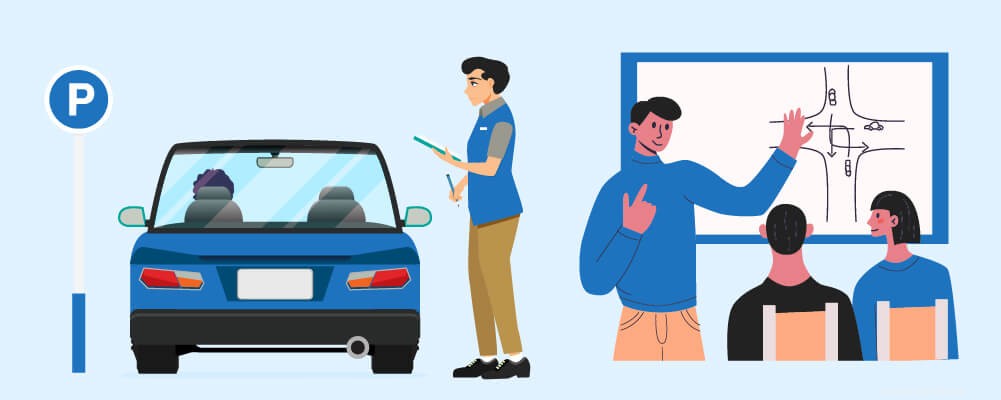
Here we have a couple of tips to help you out on the day of your road test. Ideally, you are reading this before the actual day, so you can make any preparations needed. If you are only reading this now, on your way to the test site, we should still be able to help you out.
Ideally, you should have been practicing driving in the same car you will be tested with. This
will allow you to become comfortable with the vehicle. Every car is different. Their indicators will be in different places, their breaks will have different levels, and the atmosphere will be different too.
If you can book the test with your own car, you will be able to use your muscle memory to find the switches you need, and you can hopefully tap into calming energy when the test begins. Just remind yourself that you have done this drive before so that you can do it again.
Automatic cars are easier to use than manual ones. If you are worried about gear changes and don’t want an extra problem added to your list of worries, opt for the automatic drive instead.
Although some people might tell you that driving a stick will give you more options in the future, think about the actual likelihood of driving those cars. In reality, the majority of Americans never touch a manual car, so allow yourself to take the easier test.
When you get into the car with the examiner, you should adjust the mirrors to the preferred state. We have already talked about adjusting your mirrors and knowing what you should be able to see, but it is prevalent that the examiner sees you doing this.
If you brought your own car, it could be tempting to leave the mirrors as they are, but the examiner will mark you down if you haven’t openly checked them.
Once you have put the mirrors in the right position, leave them. The examiner will mark you down if you move them during the drive, as you will be seen as distracted. It will also mean that you made a mistake before.
Getting to the DMV early is a personal choice that would benefit most people. This way, you can get the test out of the way and relax for the rest of the day. If you leave the test until a later slot, you could allow yourself to get overwhelmed or become filled with anxiety as the looming pressure will have all day to settle into your stomach.
“Ripping the band-aid off” will likely be the best mental attitude for this situation.
Lastly, you should make sure to pay attention to your surroundings, the examiner, and the car. Do not allow yourself to zone out or become complacent, as the examiner will note any signs of inattention.
If you are worried that the examiner hasn’t noticed all the checks you have made, you can always say them aloud. This way, you know they have recognized the actions you have taken.
Remember, this is not the time to slip up on your road etiquette or your knowledge. If you become too complacent, then you might miss the key details of the road.
Using all the information we have given you, you should start to feel confident behind the wheel. We have added resources in this article to help you find the right laws and rules in your state, so be sure to click on these links to take you to the correct place.
If you are still struggling, you should ask your local driving examination center where you can find the best rule book for you to follow. Ideally, you should have a professional instructor to guide you through the process.
For more tips, check out some of these articles:
How Many Times Can You Fail A Driving Test?
How Old Do You Have to Be to Test Drive a Car?
Why Is Driving So Hard – 10 Ways To Make It Easier
