
We all have heard the phrase where there is smoke there is fire. In this case, where there is smoke, there are problems. Smoke coming out of your tailpipe is never a good sign. But what could be the reason? Let us discuss 6 causes of white smoke coming from the exhaust.
Exhaust gasses are the byproducts of the combustion that happens inside the engine. These products exit the car in the form of exhaust gasses. When the fuel-air mixture is ignited inside the combustion chamber, it creates a lot of harmful gasses. These gasses are partially filtered by the catalytic filter. So seeing exhaust gasses or smoke coming out of the tailpipe is normal.
Unless you have a really old car or a diesel engine, the smoke that is emitted is not clearly visible. This is especially true in modern cars. Modern technology allows cars to burn the least amount of fuel, so it doesn’t produce a lot of exhaust gasses. The minimum amount that is produced is thoroughly filtered.
You might see slight whitish fumes. These are often caused by water vapor in the fumes. You should understand that there are no thick white fumes.
Thick white smoke coming out of the exhaust is not normal. This is an indicator that something is wrong with your car. But what could it be? There are several reasons why you might experience this strange problem. None of them are good. Let us look at a few common causes for white smoke to come out off the exhaust, and whether the issue can be fixed.
This is the most common reason that produces thick white smoke. This is often visible upon start-up. You will see a cloud of white smoke come out of the tailpipe. You will notice that this happens as your car heats up.
This is caused due to the water that is condensed in the exhaust system. As the exhaust system heats up, the water vaporizes and comes out as a cloud of smoke.
This is more common if your car has been sitting for a couple of days and the weather is chilly. The water molecules that were in the system from the last drive condenses inside.
If the white smoke doesn’t last long, the weather is chilly and you haven’t driven the car for about a couple of days, chances are the white smoke is due to condensation.
Is this bad? No, if this was the case, you have nothing to worry about. This doesn’t mean that your car is malfunctioning.
For the car to properly function the engine should work properly. The engine produces power by burning fuel inside the combustion chamber. To produce the greatest amount of energy, the best fuel efficiency, and to ensure complete combustion, the proper fuel-air ratio should be maintained.
If the fuel delivery system is malfunctioning, the combustion process is sabotaged. When the combustion inside the cylinders isn’t complete, they generate more impurities than usual.
The common culprit is the fuel injection system. If the system is worn out or damaged the proper amount of fuel is not delivered. If the fuel pump is clogged you’ll similar results. The fuel pump could get clogged because it filters the fuel before pumping it to the engine. If the fuel that you use is impure, the dirt and debris in them could clog the fuel pump.
If this was the issue you might encounter engine misfires and a reduced fuel economy along with the emission of white smoke.
The best solution is to remove and clean the fuel pump or replace the fuel injection kit if necessary.
The head gasket is the gasket that separates the engine block and the cylinder head. It separates whatever happens between these two components. It is the barrier between combustion, engine oil, and the coolant.
The head gasket could crack or wear off with time. When it is damaged coolant could jump the barrier and seep into the combustion chamber. When the coolant finds its way inside the cylinders, it is combusted.
Coolant has a high concentration of water. Some people might even use water as their coolant. As this water is heated, it evaporates. These would create water vapor in huge amounts that will look like thick white smoke when it exits through the tailpipes.
This is a problem that needs to be fixed immediately. The bad news is the repairs won’t be cheap. To replace the head gasket, the entire engine should be disassembled. This takes time. With time labor costs are going to add up.
The repairs are going to cost thousands of dollars. You might be better off replacing the entire engine.
This is another major issue that generates thick white smoke. The engine block and the cylinder head heat up a lot when the engine is working. To make sure that the engine block doesn’t overheat it is consistently cooled down using the coolant.
The coolant flows over the engine block and the cylinder head in multiple groves that act as channels. When the engine heats up it expands. And when the coolant flows over it cools back down. When the process of expansion on contraction for over a million times puts a lot of stress on the engine.
If you are unlucky this pressure turns into stress fractures. With time this could crack either the engine block or the cylinder head.
Since both these components are bathed with coolant when there is a crack coolant seeps through. Again coolant will seep through and find a way into the combustion chamber. Similar to a blown head gasket, the coolant evaporates to form white smoke. The smoke is actually water vapor.
Is this any better than a blown head gasket? No, this is just as bad. If this happens the engine block or the cylinder head needs to be replaced. This also will require the engine to be disassembled.
Again, you might be better off replacing the engine instead of spending a fortune and repairing your engine.
This is not a well-known component of the exhaust system. This is because you only find this in modern cars. Not all cars have them especially American-made cars. But a lot of European cars that are produced these days consist of an EGR cooler.
EGR stands for exhaust gas recirculation. The EGR cooler is a small metal device with a thin passage and fins to circulate and cool the exhaust gasses. Similar to hove radiators work, they use the cool air that passes through the fins to cool down the hot exhaust gasses that pass through the thin passage.
There aren’t a lot of ways to diagnose a bad EGR cooler. All symptoms are inside the engine or engine-related. If the EGR cooler is cracked or damaged, the only way to diagnose it is by taking it to a mechanic. He will be able to take it apart and inspect the unit for damage.
Once the unit fails it will drain a lot of coolant into the exhaust system. Again the heat from the exhaust turns the coolant to steam. This comes out of the exhaust pipes in the form of white smoke.
Coolant reservoir doesn’t suffer from any damage naturally. If it is damaged it is probably caused by human error. Maybe if you are someone else was working under the hood, an accident could have cracked the tank.
When the coolant starts leaking all over the engine it is just a matter of time before it finds its way inside the exhaust system. This coolant will evaporate in the form of steam, which would look like white smoke.
If this were the case you should be able to see coolant dripped on the ground below if you keep your car parked. There is a chance the coolant which is dripped over the engine block might evaporate and look like the engine is smoking. So if you notice any of these the coolant reservoir is probably damaged.
As mentioned earlier, this is extremely rare since this can only happen with the help of an external force. If you face this issue you need to get the reservoir replaced as soon as possible. If the reservoir runs out of coolant, the engine will overheat. This will cause major damage to the engine.
Replacing a coolant reservoir would cost about $300. The reservoir itself costs around $200 with labor you’d be paying more.
These are the most common causes that cause white fumes to come out of your exhaust. As you might have noticed, generally white fumes form as the coolant evaporates. More often than not the white fumes you see is steam.
The only occasion where white fumes are not a huge problem is when it is caused by condensation. If that is not the cause you might be staring at a huge bill for the repairs. In the best-case scenario, you would end up paying $300 to $500.
If you are unlucky, you would need to spend thousands on repairing the engine or replacing the engine.
After going through the worst damages that cause white smoke to come out of your exhaust, you might assume that white smoke is the worst. But is it? What are the types of smoke and what do they mean?
If you see black smoke coming out of your exhaust, your car is probably burning too much fuel. Carbon emissions cause the smoke that comes out of the exhaust to be black. When your car is burning ideal amounts of fuel, the carbon that is produced is low, so you will not see a plume of smoke through the exhaust.
If this is the case, there are some other indicators as well. You will suffer low fuel economies, the smoke will not be present on idle, heavy loads will cause more black smoke to come out of the exhaust, and whenever you are accelerating smoke emission will be high.
If you see at least a couple of these along with the black smoke, it means that your fuel to air ratio is off.
Any component in the fuel delivery system could be the cause. Usually, the prime suspects are fuel regulators, fuel injectors, or faulty sensors. It is hard to pinpoint which of the above is faulty, so you will have to take your car to a mechanic.
After a thorough inspection, he will be able to repair or replace damaged parts and tune your car so the fuel-air mixture that enters the combustion chamber is just right.
Sometimes it is hard to believe that blue smoke could come through the exhaust pipes. Actually, that is the most common type of smoke that you can see in a car. This happens when your engine is burning oil.
In older cars engine burning oil is not out of the ordinary. There was a time when if you can drive 2000 miles without running out of engine oil was considered great. In modern cars, it is a completely different story.
Today a car should at least be able to get 5000 to 7500 miles without running out of oil. Some cars can go up to 30,000 miles without needing an oil change.
Therefore, you do not see engines that burn oil in modern times. As long as nothing is wrong with your engine, it won’t burn oil. If so you will not see blue-tinted smoke.
There are a few common causes for blue smoke. Usually, it is the seals that let the engine oil into the combustion chamber. So you might have to look at the piston rings, valve seals, and also the head gasket. A bad PCV system could also lead to blue smoke.
Overall, the main reason for this is wear. As the engine becomes old the nuts and bolts of it start to wear off. So, engine oil finding its way into the combustion chamber is quite normal with older cars.
Depending on the volume of oil being burnt you have to make your decision. If you are noticing a lot of oil being burnt, you must get it checked and repaired. If it is just a little amount, and you see only a slight blue tint in the smoke, you should be fine.
Grey is a pretty wide range. It is rare to see grey smoke coming out of the exhaust. Usually, either white, blue, or black smoke is mistaken as grey smoke. So before concluding that the smoke emitted from your exhaust is grey, double-check to see if it is a different color.
Just because it is rare doesn’t mean there is no such thing as grey smoke. Grey smoke is developed when the transmission fluid is burnt in the engine.
Transmission fluid finding its way inside the combustion chamber is rare. But there are cases where this has happened. If you suspect that your car is burning transmission fluid, check the fluid levels. If that doesn’t clear your doubts take the car to a mechanic.
You do not want your transmission failing mid-drive.
Here are a few of the most common questions related to white smoke coming out of the exhaust.
Smoke coming out of the exhaust is directly connected to what is burning inside the engine. As long as your engine is getting the ideal fuel-air ratio, it will not produce any noticeable smoke.
When the fuel-air mix is not balanced, you’ll see black smoke. If your engine is burning something that is not supposed it will also result in smoke. Some of those substances are coolant, engine oil, and transmission oil. When these are burnt, the engine will emit, white blue, and grey smoke respectively.
Whenever smoke comes out of your exhaust, it would mean that you are going to face a major repair procedure soon. The only occasion where smoke coming out of the exhaust is okay is when it is caused by condensation.
If your engine block is cracked or the head gasket is blown, that would cause engine oil or coolant to drip into the combustion chamber. When this happens, you would need a complete engine rebuild or replacement.
Engine rebuilds can cost anywhere from $2500 to $4000 or more. Replacing the engine will also have similar costs. This is the worst possible reason for smoke coming out of the exhaust. When this happens you would see either white or blue smoke.
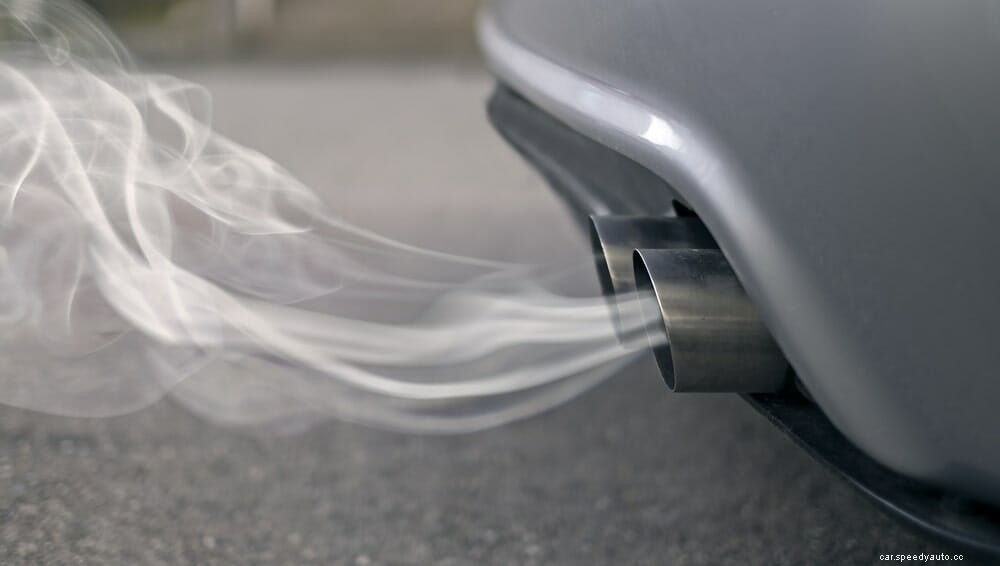
The engine produces a lot of exhaust gasses when it is operating. So it is normal to see a constant flow of exhaust gasses while driving. But these gasses are colorless, so you will not be able to see them.
If you see smoke coming out of the exhaust, it means that something is wrong with your engine.
Exhaust gasses are the direct outcome of combustion inside the engine. It contains carbon monoxide, carbon dioxide, sulfur dioxide, nitrogen oxides, and hydrocarbons. Water vapor is also present.
Carbon monoxide is poisonous, due to this the catalytic converter inside the exhaust system converts the carbon monoxide into carbon dioxide. In older vehicles and in deisel engines, soot is produced. This soot mixed with the gasses looks like black smoke. In modern vehicles, the fumes aren’t visible.
Exhaust gasses are produced by a combustion engine. An electric vehicle doesn’t have a combustion engine since it runs using a battery, it doesn’t produce any exhaust gasses. You wouldn’t see a tailpipe in electric vehicles.
This is a common issue that many of us face. You might see black smoke when your engine is working hard. This might happen when towing heavy loads, accelerating, or climbing hills.
Usually, the culprit is the carburetor. The carbureter sends more fuel than necessary when the engine is stressed. The system is called AFM or automatic fuel management. There is nothing to worry about.
In modern vehicles you rarely see smoke coming out of the exhausts. With the development of technology, we are seeing more efficient cars. So whenever you see white smoke coming out of your exhaust it is not a good sign.
While smoke can be really bad unless it is caused by condensation. If the reason for the white smoke is condensation, you need not worry about it. But if you see constant emission of white smoke, or white smoke while you are driving it could be due to major damage in the engine compartment.
Usually, it is caused by coolant entering the combustion chamber. Coolant is not supposed to be inside the cylinders, the longer it lingers the more damage it does to the engine.
Even though white smoke is pretty bad, that is not the only smoke you have to worry about. You might also see the black, grey, and blue smoke. Black smoke would indicate problems with the fuel delivery system This is relatively a less expensive problem.
Blue smoke is generated when engine oil is combusted. This is just as bad as white smoke if not more. Oil burns to give a blue shade to the smoke. Even though grey smoke might be rare, it still exists. Grey smoke comes out if transmission oil is burnt.
Smoke coming out of the exhaust is definitely something to be concerned about. By looking at the color of the smoke you should be able to diagnose the cause.
