
Motor oil is important in regards to the engine of your vehicle as it serves as a lubricant. This ensures that the moving engine parts do not wear as quickly due to friction. The engine is a chamber of multiple moving parts, so engine oil is a vital tool to have in your trunk or garage.
The big question is, is engine or motor oil flammable?
The answer is yes and no, motor oil is flammable and combustible. But what’s the difference between flammable and combustible? Combustible materials can burn in the air, whereas flammable materials can ignite easily when exposed to fire.
To be considered flammable it has to ignite at 200 degrees Fahrenheit, whereas oil ignites at 300-400 degrees Fahrenheit. Motor oil can easily ignite when there is the right amount of heat.
It is important to point out that there are actually two types of motor oil – Conventional motor oil and then synthetic motor oil.
Conventional motor oil is derived from crude oil, meaning it may also be called mineral oil. It has three key positives, one being the friction beater, as well as an engine sludge cleaner and finally, it helps neutralize acids from fuels.
It also aids in sealing piston rings and cooling the engine as it transfers heat from moving parts, ensuring your vehicle doesn’t overheat. Motor oil is a very important tool in running a car, so knowing and understanding its flammability allows you to maintain safety at all times as it is a fire hazard.
So, you may be wondering, how can you recognize when something is flammable? The main focus point is the vapor that is being emanated as the liquid in question may emit a vapor that can auto-ignite.
As most oils have long carbon chains which are difficult to break, it means they fall short of the flammable class.
Can motor oil cause a fire? Because of its high flash point ( its flashpoint lies between 302-392- degrees Fahrenheit), it will need a substantial amount of heat for it to burn, which means the chances of it being the first cause of a fire is slim to none.

Usually, it will combust lightly, which means there might be a weak flame present. However, motor oil is classed as a flammable liquid.
Now that we have discussed conventional motor oil, or mineral oil as it is also known let’s move on to synthetic oil. Like conventional motor oil it is flammable, well more combustible as it also has a high flash point, so before we delve into its ability to ignite it would be a good idea to look at its origins.
Synthetic oils were first introduced in the late 1930s and early 1940’s to replace crude oil, as this was becoming a scarce source in Germany at the time.
In the years to follow, synthetic oil grew to be more popular as many people were appreciating its friction reduction, reduced depositing, and fewer impurities. Another plus is that people found it worked better under higher temperatures, which meant it allowed for a smoother ride.
It is still flammable, however, it burns at a lower degree than the mineral oil, as it requires a higher temperature for it to ignite.
Where conventional motor oil had a flashpoint value of 302-392 degrees Fahrenheit, synthetic oil has a flash point value of 440 degrees Fahrenheit. This means out of the two oils, synthetic oil is less flammable.
Even though both oils aren’t much of danger due to their low flammability, you should still know how to dispose of them safely. If they are disposed of incorrectly they will cause accidents and pollution.
You want to prevent situations where you could pollute bodies of water and create hazards for local wildlife. When handling the used engine oil it is a good idea to wear protective clothing, that should be cleaned and replaced regularly, and the same goes for oily rags as they may seep through clothing and into the skin.
Because waste oil burns, burning it is one of the ways to get rid of it properly. Also, there are specially created waste oil furnaces that can burn the oils to make sure they are disposed of correctly.
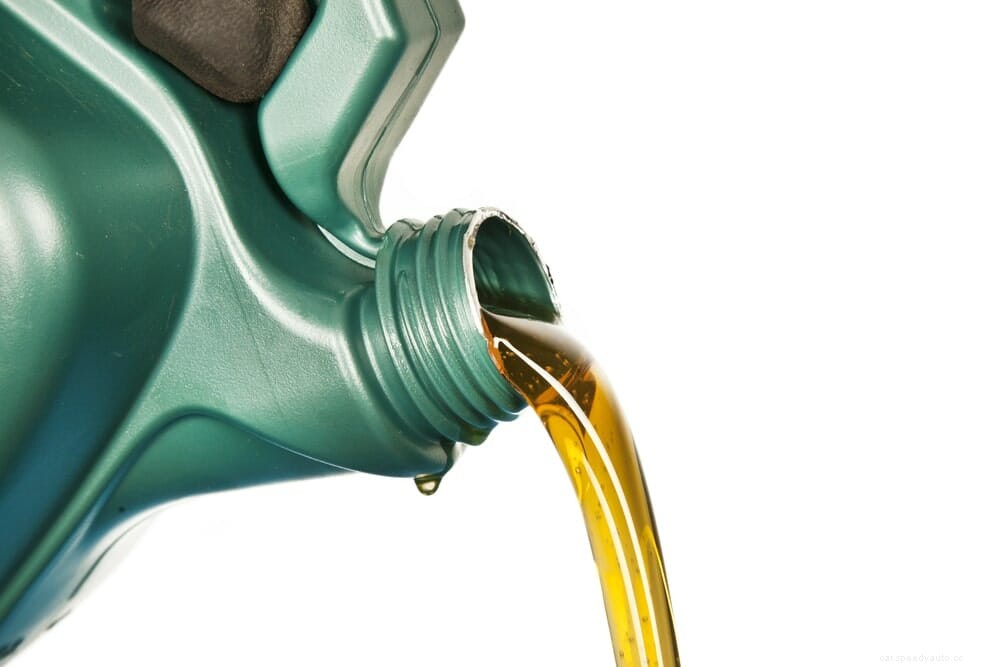
The flashpoint is the temperature that the liquid turns into a vapor that can auto-ignite. As Motor oil’s flashpoint is high (302-392 degrees) it is one of the least flammable fluids.
Yes, even though motor oil isn’t flammable it is definitely combustible. The oil helps control the overall temperature of the engine, which means if there is a leak the oil levels are going to be low.
So your engine’s normal temperature range, 190-220 degrees Fahrenheit, will increase, inevitably increasing the chances of burning.
If you notice you have a motor oil leak, make sure to look at the seals and rubber hoses as they start to deteriorate prematurely. If these seals and rubber hoses are damaged it may cause your car to break down and fail without warning.
When the exhaust is sitting idle, it can reach temperatures of 300 degrees Fahrenheit. When it is on high load, it can reach temperatures of 1400 degrees Fahrenheit, which certainly exceeds a motor oils’ flashpoint.
There is no way that motor oil can explode. To begin the process it would need to be converted into a fine particle mist and then ignited, this is all before it could even begin to burn.
Motor oil is an important factor in the maintenance and running of your vehicle and ensures that it runs smoothly. It is key in both lubrication and also as an acid buffer.
Both engine and motor oils are considered flammable liquids, but motor oil has a much lower flashpoint than synthetic oil. So it is still important to be careful with them around direct heat.
Standard motor oil and synthetic motor oil will burn but the latter has a much higher flash point of 440 degrees Fahrenheit compared to crude motor oil which has a flashpoint between 302-392 degrees Fahrenheit.
Oil whether it be standard motor oil or synthetic version needs to be handled with care, especially in the presence of heat. It also needs to be disposed of correctly in order to prevent pollution to the environment.
