
Looking to get the best shine on your car? Waxing and polishing your vehicle by hand is an extremely tiring process that you may even find doesn’t give the most optimal results!
Specially designed polishers designed for vehicle use can come with quite a high price tag, so if you are looking for a cheaper alternative then why not buff and polish a car with a drill – this may be the solution.
Buffing and polishing your car using your drill provides a highly customizable level of paint correction and a much better finish than if you were to buff and polish by hand as the drill can reach up to 2000RPM, which your hand obviously cannot match.
To polish your car using your drill you will simply need a drill bit and polishing pad as well as your chosen polish of course.
If you’re looking for a polisher to buff your car, we recommend the Goldkin 1400W 6-speed Polisher. It’s highly rated and comes with the basic polishing pads you need to get started.
With any shortcuts, there will be advantages and disadvantages. Polishing using a drill can be a great way to save your time and energy compared to polishing by hand, but it doesn’t mean it will be safer.
Before we get into the step-by-step process of how to safely polish your car with a drill, here are some pros and cons to the procedure so you know how to give your car the best finish possible without any negative impact.
The time-saving convenience of using a drill means you can quickly fix any small scratches if you are without the proper machine polishers that are designed for this task.
However, many argue that using a drill to polish your car is not the best option as you can easily press too hard against your paint and burn the protective clear coat on your vehicle.
This is largely due to the design of a drill, and holding it at the right angle without placing too much pressure is difficult to maintain unlike with a machine polisher which has 6-speed options and dual handles.
The cleaning and polishing pads that you would use on a drill will be much smaller in comparison to the large ones that come with a machine polisher which can create a time-consuming task.
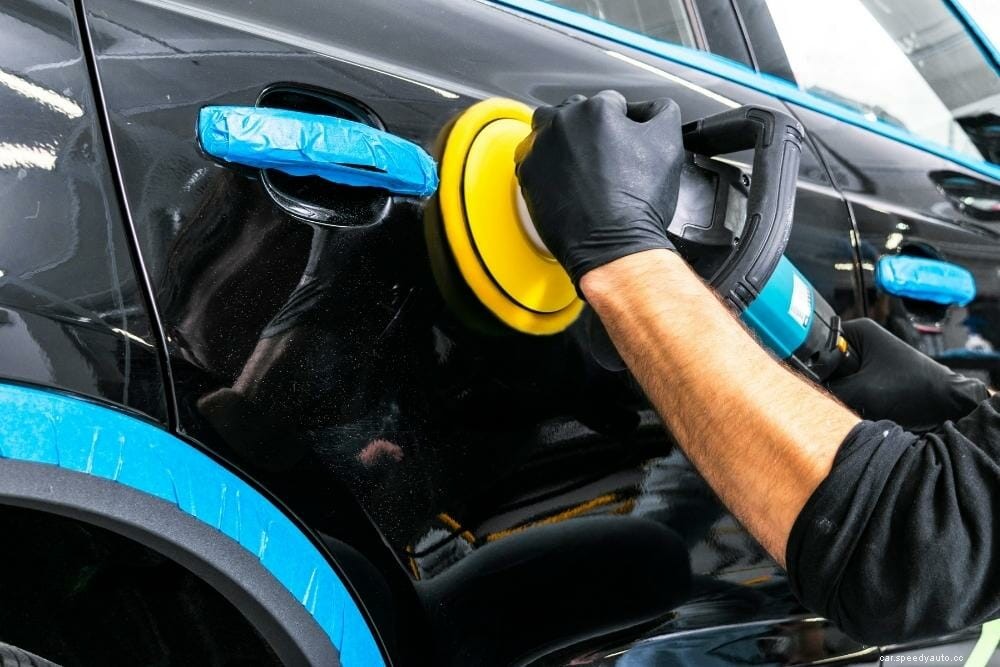
However, if your only other option is doing it by hand then this shouldn’t be an issue for you.
If you want to see for yourself how this method can speed up your polishing process without forking out on expensive machines then you’re in luck. If you already own a drill then this tool can be a great multipurpose way to clean all areas of your car.
Not only can you use attachments to clean the seats and interior of your vehicle, but you can also mount a polishing pad and get to work on your paint job.
You may find a cordless drill is the best for this as you can gain better access around your whole vehicle, but if you only have a corded drill this can work too with the use of an extension cord.
Use the polishing paste as you normally would, just using your drills polishing pad to do the hard work! We recommend using a high-quality mounted polishing pad like the one below to get the best results on your vehicle.
Although many professionals may not recommend using a drill to polish your car, if you have an annoying scratch you want to get rid of or just need your vehicle to be looking its best, here’s how to polish your car using a drill and polishing pad!
If you are still a little nervous, check out this video to show you how to buff and polish a car with a drill.
If you are new to the world of car detailing then chances are you don’t own a tool specifically designed to polish your car which is why using a drill and attachment is such a popular option with vehicle enthusiasts today.
If you are looking to invest in some equipment and avoid any damage from a dodgy DIY job then you may be wondering what other easy car polishing alternatives there are on the market.
The best option is a machine polisher which comes in a rotary and dual-action variety, with a rotary being used more by detailed and experienced detailers.
Although it is quicker and provides better results, using a dual-action, to begin with, means you won be able to burn the paint as easily and can learn the necessary steps to give your car the best finish.
Using a standard household drill with a car polishing and buffing pad is a quick, easy, and cost-effective way to get practical results when removing scratches from your paint job. All you need is a drill that can operate between 1500 and 2500 RPM and a standard 3/8″ drill bit.
If you didn’t want to use a drill to polish your vehicle then you can do it by hand but this will only work well for minor swirls and scratches on your clear coat.
A machine is designed to work on deeper paint defects but this also comes with its own warnings as this can burn through your paint in seconds if used incorrectly.
You can also use an angle grinder as a polisher if you don’t have a drill. You have to ensure you purchase a flap disc with non-abrasive padding on the outer layers to prevent grinding on the surfaces you want to polish.
Buffing pads are circular pads made of wool, foam, microfiber, or a combination of the three to apply wax, sealants, and other coatings to any painted surface that needs buffing.
Trying to find a cost-effective method to get a one-off shine on your vehicle may seem like an impossible task, but making a DIY car polisher using a drill that has a buffing pad attached can be a great way to remove scratches and damage from your paint job that you cannot shift by hand!
If you want to buy something that has everything you need, we recommend the Goldkin 1400W 6-speed Polisher. It’s got everything you need to get started.
Hand buffing and polishing will only work on the clear coat surface of your vehicle, so it may be worth investing in a dual-action machine polisher if you want to keep the exterior of your vehicle in the best condition possible.
This doesn’t mean that polishing using a drill is a bad option though!
As long as you are careful to maintain a steady and light pressure that won’t damage your paint job then you can have your vehicle looking better than ever with your very own DIY detailing tools!
