
VSC stands for ‘Vehicle Stability Control,’ which refers to Toyota’s vehicle stability control technology. By reducing—or totally cutting—power transmitted to your wheels, stability control helps your vehicle retain traction and control. It accomplishes this by providing braking pressure to up to three wheels automatically.
The system’s goal is to keep your car pointing in the direction you want it to go. It’s an important safety element that has been required by law since 2012 (at least in the United States). Naturally, VSC OFF indicates that your Toyota’s stability control is turned off.
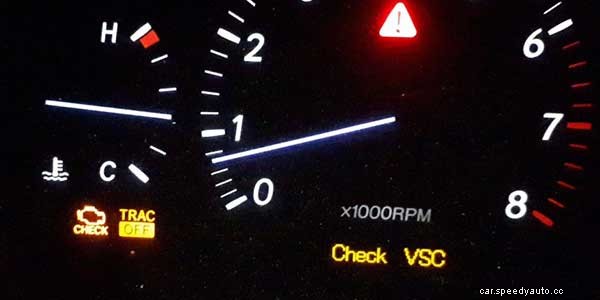
If the “check VSC system” light illuminates on your Toyota or Lexus’ dashboard display, you may have a major problem, but diagnosing it can be difficult. This is the type of warning that, like the “check engine” or “battery” light, might indicate that something is significantly wrong with the vehicle if it is not treated right away. There have been cases in the past with earlier Toyotas when this technology has failed in a very hazardous manner. Drivers of Toyotas from the 2007, 2008, 2009, and 2010 model years claimed that the “check VSC system” alert appeared while driving.
The car would then become difficult to handle and stopping proved even more difficult in some cases while in others moving at all was now an issue.
The VSC, like any other automobile system, can fail for a variety of causes and in a variety of ways. When the light comes on, it causes the brakes to go entirely mushy underfoot, according to drivers who have experienced it. The brakes apply quickly and strongly, similar to what you’d anticipate if you slammed your foot down in a hurry. The pedal itself has no effect, and your automobile has come to a complete stop.
In other circumstances, the brakes don’t engage strongly enough to force the car to drift until it comes to a complete stop on its own. Both, as you can expect, might be quite deadly. For these reasons, you should never disregard the VSC light when it appears.
Other instances of the light coming on might be perplexing because there are no visible indicators and the car appears to be in good working order. It could still be drivable, but if you hit a rough piece of road, you could end yourself in a risky situation. You have no way of knowing whether the system will
In general, a failed VSC system indicates that you may be losing road stability. Because you only utilize this system when you need it, you’re unlikely to discover anything is wrong until it’s too late. Your safety is jeopardized if you don’t have it.
It’s worth noting that the VSC system can be, in fact, manually shut off if you want to. This is something you should only do in certain situations, and it shouldn’t be left off at all times. Any Toyota or Lexus outfitted with the VSC system should have a VSC switch readily available to you as a driver that allows you to disengage the system as needed.
If the VSC light came on during snowy conditions, then your best and easiest option is to park somewhere warm enough to let that snowmelt and see if the warning light stays on.
You can use an OBD 2 scanner, often known as an “on-board diagnostic” scanner if you have one. A competent technician would use this to diagnose the VSC issue. It can assist you in determining why the light came on in the first place. If it is not convenient for you then do reset first if the issues still remain then Hard reset, if the problem still remains then you may need to go to a repair technician to fix the problem.
There will be a button either by your shifter or your steering wheel (depending on the model year of the Toyota) that has the same icon as the light in your gauges. Once you’ve located it:
The problem is still there, Check Vsc is Still on.
Then
That may clear the issue with the check VSC light. If it did not, then you need to take your car to a professional mechanic to fix this problem.
Another detailed topic specifically about how to fix check Vsc in Toyota Camry, for quick fix read that article.
Is it Possible to Drive with the VSC Light On?
This is a question you should ask yourself whenever a warning light flashes on your dashboard. Is it safe to drive any longer? Regrettably, there is no correct response to this question. Whatever the case may be, you must take a caution light on your dashboard carefully. The check VSC light may indicate a major problem. It might, however, be a glitch. To identify the appropriate course of action, you’ll need to consider what’s going on at the time the light turns on.
A defective O2 sensor or a loose gas cap indicates that your VSC system is in good working order and that driving is safe to continue. Nonetheless, such difficulties must be handled in case a subsequent problem occurs. If you think you have one problem and then another one arises, you won’t see it coming, which might be disastrous. Whether it’s safe to drive or not, the reason for the light going on must be addressed because that’s the only way to know for sure.
