
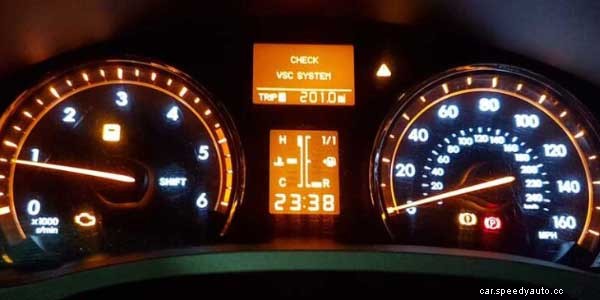
Any automobile is a precision vehicle that has to be taken care of in a variety of ways. While routine maintenance will keep it going smoothly for the most part, from time to time, unpredictable items can pop up. We’re fortunate enough that science will help us find out what’s going on and what we can do about it for a long time. For example, to suggest something is wrong, the dashboard will display a number of lights and warnings. One of them is a VSC system and how to fix check VSC system Toyota Camry for 2002 upper models.
VSC, or Vehicle Stability Control, is a Toyota-developed function that is found on a number of Toyota and Lexus cars. It was first released in 1995 as one of the most significant breakthroughs in road safety at the time.
This feature essentially assists you in keeping the automobile on the road, particularly if you live in a severe climate with unpredictable weather. This device will keep you safe at all times and assist you if you lose traction. It’s essentially the same as ESC (electronic stability control), but Toyota calls it VSC (Vehicle stability control).
This system works in a straightforward manner: your car’s computer is aware of the conditions you’re driving in and recognizes when you lose traction; the system then determines when to apply the brakes to the wheels to prevent further skids that could throw you off the road; we’ll go over this in more detail in the next chapter.
It literally saved your life a number of times, and you probably didn’t even realize it. However, because you came into this post by searching for “verify VSC system,” you are already aware of its existence.
However, if the check VSC system light appears frequently, there might be a different reason for it flashing in front of your eyes, which is worrying since it may not operate when you need it, so how does this system work in detail?
The VSC is the inner traction control system of the vehicle. The machine roars to life as you drive down slippery roads and lose control, giving you better steering power. Both of the car’s wheels would have electronic sensors that interface with the Powertrain Control Module (PCM) of the car.
The ECU computer that regulates the VSC system is directly connected to the VSC light. The computer, as we all know, is the car’s brain, and it chooses what to do in certain scenarios. When the VSC alerts the computer, it sends the proper signals to the brakes and other components.
The VSC keeps track of the steering and overall stability of the vehicle. It kicks in soon as the vehicle starts to lose traction. It takes care of everything on its own; first, it applies the brakes as needed and decreases engine power, ensuring that the automobile maintains its stability and the driver maintains control. The VSC works in tandem with the ABS system to preserve overall vehicle stability throughout this procedure.
But what exactly is ABS? We’ve previously discussed it. ABS, like VSC, is a safety function that prevents the wheels from locking up when the brakes are used in an emergency circumstance. And to aid with the driver’s ability to retain tractive touch with the road, preventing the automobile from colliding and averting a major incident.
It works by applying the brakes just when necessary to shorten the stopping distance; for example, if you don’t have ABS, stopping from 60 miles per hour will take significantly longer. ABS, on the other hand, will require significantly less stopping distance and will assist you in avoiding potentially dangerous circumstances.
Each wheel has an electrical sensor that connects with the Powertrain Control Module or PCM, sending data about the stability and steering performance in severe weather. The rotation speed of the wheels, as well as the vehicle’s horizontal and vertical motion, are among these parameters.
When there is a problem with traction, the sensors collect data and communicate it to the main computer or ECU. The ECU then begins evaluating the data to determine what actions are required to maintain the vehicle’s traction. The ABS and VSS systems are in charge of these tasks.
Any fault involving traction and steering stability will cause the computer to flash a red signal and the check VSC system to appear. When it comes to harsh turning, understeering, and sliding, the VSC system will assist the driver in maintaining control.
On a daily basis, many accidents occur as a result of drivers losing control of their vehicles due to adverse weather conditions such as rain, fog, snow, slick, or frozen roadways. This technique works for both the driver and the passengers, and it has saved hundreds of lives in the years since it was made public.
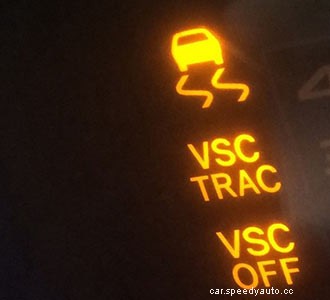
This is a sign that there is an issue with the system when the check VSC system light goes on, which may either be a problem with the sensors or even the steering rack.
But because the VSC works together with the ABS, when the check VSC light comes on, it can also indicate there is an issue with the latter, and so both may not be functioning properly.
Causes:
What Are the Symptoms of a Bad Alternator
For all these 4 errors, and how to fix it can be depended upon the identified issue, you have to go through simple steps one by one and see the problem is fixed.
If it is still on your dashboard then it could be a system malfunctioning problem, therefore advised to inspect with a specialist.
1st Approach
Rest can be done in Four Ways.
There will be a button either by your shifter or your steering wheel (depending on the model year of the Toyota) that has the same icon as the light in your gauges. Once you’ve located it:
If the VSC OFF light is still on, then follow the next approach.
2 Approach
3 Approach
Once you locate the air filter box, you should then examine all the small vacuum lines coming from it, and check whether any of them are loose or broken. If any of the lines are loose, you need to reconnect and retighten them.
4 Approach
The last step is always to take the vehicle for a test drive to check whether the light is gone or not.
