
A regular automotive transmission has several components including gears, hydraulic system, clutches, bands, seals and gaskets and torque converter. Transmission fluid ensures that everything is running smoothly without friction and wear. A timely fluid change ensures that it keeps doing its job efficiently. That is why it is crucial to understand when to change the transmission fluid.
In a way, the transmission fluid has a dual function. Not only does it act as a lubricant between the components, but also works as a hydraulic fluid. It regulates the speeds between tyre and engine, in addition to transferring engine power to the wheels. However, it is prone to burning and contamination – after which it fails to do its job efficiently. You need to change the fluid before that happens.
Vehicle owners must check the manual of their cars for better consultation. It usually states when to replace transmission fluid.

Several manufacturers recommend changing a car transmission fluid in their manual cars between 48,280 to 96,560 km. The problem occurs due to fluid contamination which happens over time due to factors such as heat and external impurities. Little bits of metal from the component may also contaminate the oil. If all these particles are not drained out, they will cause further wear and damage.
Some automatic cars come with the instruction that no replacement is necessary. If the owner wants to follow this guidance, that’s fine. However, it is always recommended to perform the vehicle transmission fluid check, just like in manual transmission cars.
Now, the question arises when to do the automatic transmission fluid change. Many automatic transmission doesn’t need fresh fluid until 160,000 km and in some Ford transmission, it crosses 240,000 km. However, many experts say that this duration is quite long and the fluid should change at least every 80,000 km.
The price of transmission fluid varies as per the brands. For instance:
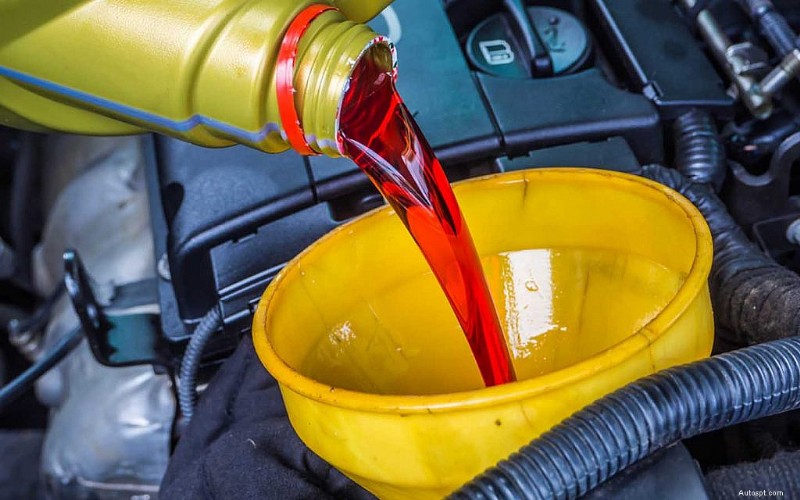
Several signs indicate that it is time to change the transmission fluid. Some signs are related to the fluid itself while others are related to the car’s performance.
You came across two choices while changing transmission fluid – either completely flush it or just change it.
The fluid change means you discard the old fluid from the transmission pan and refill it with the fresh one. The transmission oil flush means taking out the oil from cooler lines and crevices of the car transmission system.
While changing fluid, there will be some percentage of old fluid remaining in the gearbox; however, when you flush the fluid from the entire gearbox.
For automatic transmissions maintenance, experts suggest that if you suspect the fluid wasn’t well maintained in the past, then just change the fluid instead of flushing it. Flushing increases the chances of some gunk sticking in the narrow oil channel. It will worsen the performance and efficiency. It is better to let an expert decide what your transmission needs.
Many automakers put in their manuals that the automatic transmission fluid lasts its entire life. However, many people report that it is only good for around 160,000 km. Therefore, do not change the fluid while the vehicle warranty is in effect, as the dealership is responsible and must replace it free of charge.
You can check the transmission oil by its colour, smell and consistency. The colour of the oil becomes blackish and it will start smelling like a burnt fluid.
This concludes our guide about how to know when to change transmission fluid and what is the process of changing it. We hope it will help you in changing the oil of all car transmission types at home, right when you need to. If you aren’t sure what you’re doing is right, visit your nearest service centre. If your car needs an oil change frequently, then it is better to purchase another used car. You can find a variety of used cars in the UAE on dubizzle, popular cars on the portal include:
Stay tuned to the UAE’s leading car blogs for more information on car parts, market trends and automotive technology.
