
Quick Summary: Automotive air conditioning evolved from primitive “car coolers” in the early 1900s to a near-universal feature today. Key milestones include Packard’s first factory-installed unit in 1940, the shift to engine-compartment systems in the 1950s, and the environmental transition to R-134a refrigerant in the 1990s. Today, over 99% of new cars come equipped with advanced climate control. Last Updated: April 7, 2026.
Summer brings with it a host of delightful sensations – the sun’s warmth on your skin, the smell of the ocean air, and the sight of early-morning sunrises and late-evening sunsets. It also gives rise to that dreaded, uncomfortable feeling every motorist has experienced: opening your car door in the middle of a hot day only to be keeled over by the wave of heat emanating from the vehicle’s interior.
The truth is, cars get hot. Dangerously hot, actually. Fortunately, nearly every American car is equipped with standard air conditioning. But this wasn’t always the case. Modern air conditioning was invented in the early 1900s and it took several more decades to devise a way to incorporate it into an automobile.
So, how did we go from relying on open rooftops and rolled-down windows to being able to turn our car into an icebox with just the press of a button? The history of air conditioning in cars has seen quite the evolution.
Although air conditioning in cars was still years away, the earliest vehicles had a distinctive advantage to beating the heat: they were open air. The earliest Model T’s, for example, had no doors and a collapsible hood. Drivers were likely more concerned about cold weather.
But closed-body vehicles quickly followed. For drivers and passengers to cool down in these cars, windows were rolled down while vents under the dashboard circulated air. However, these ventilation systems were crude and didn’t keep dirt, dust, pollen or insects from getting inside the vehicle.
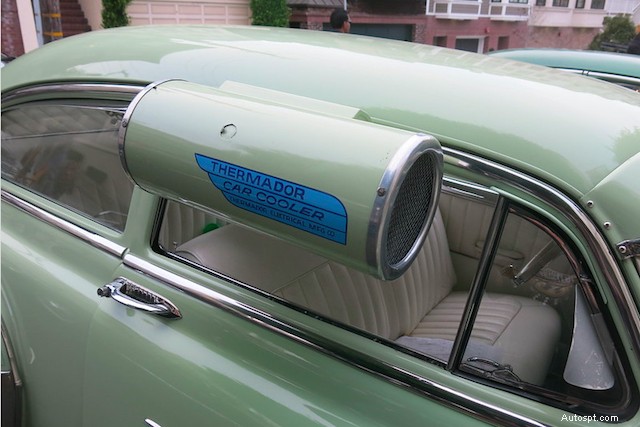
Other primitive cooling devices included the Knapp Limo-Sedan Fan, a small electric fan mounted to the interior of a car, and the car cooler. This latter device was attached to roof of the car and used water evaporation to deliver cool air through an open window. It was known as the first product to lower a car’s cabin temperature. A car cooler could “reduce the inside temperature of the car as much as 15 to 20 degrees,” according to a Popular Mechanics article published at the time.
The 1940s was a seminal time in the history of automotive air conditioning. To kick-start the decade, Packard became the first automaker to offer factory-installed air conditioning. It was followed closely by Cadillac, which introduced the feature in its 1941 models.
As one could imagine, these early cooling systems were far from perfect. The unit was located in the trunk of the vehicle, forcing the driver to get out of the car and manually install or remove the drive belt from the compressor to turn the air conditioning on and off. Secondly, the system could only recirculate air already in the cabin, not incorporate outside air. When a smoker was onboard, the air quickly become unbearable. Furthermore, the condensed water running overhead was known to drip down on passengers. If that wasn’t enough, these first systems had no control settings – they were either on or off.
Air conditioning, and auto manufacturing in general, took a back seat for much of the remaining decade as the country devoted its efforts to World War II.
Euphoria was not the only thing gripping the country after the war: Waves of cool air started circulating coast to coast as air conditioning in cars became an option for most motorists. In 1953, General Motors, Chrysler and Packard all introduced new air conditioning systems. Three years later, every major American carmaker offered air conditioning as an option. An estimated 3,000 cars were equipped with air conditioning before the onset of World War II, according to automotive company Hagerty. By the end of the 1950s, that number had skyrocketed to 1 million.
The technology of these cooling units continued to improve as well. In 1953, General Motor’s Harrison Radiator Division devised a revolutionary system that could fit into a car’s engine compartment. About a decade later, Cadillac made a breakthrough of its own with the invention of comfort control. The system, which kept the cabin at a temperature set by the driver, worked by channeling some of the cold air to the heater core, thus mixing hot and cold air to keep the temperature steady. These enhancements only further popularized the use of air conditioning in cars. At the culmination of the 1960s, more than half of all new automobiles were equipped with air conditioning units.
The 1970s brought with it a brand new problem for carmakers when it came to air conditioning units. Scientists had discovered that compounds known as chlorofluorocarbons (CFCs) were depleting the earth’s ozone layer. Automotive air conditioners used a CFC refrigerant called R12, better known as Freon. As the decade wore on, and the number of air conditioners in cars increased, it became increasingly clear that a new option needed to be developed.
After years of testing, a suitable replacement was found in the refrigerant R-134a. In 1987, the U.S. government signed the Montreal Compact, which, in part, required car manufacturers to make the switch in coolants by 1996.
Nowadays, you’ll be hard pressed to find a vehicle on the market without air conditioning: Only 1% of passenger cars don’t offer it, according to Car and Driver magazine.
As you’d expect, these modern systems are highly advanced, with features such as dual and rear climate control, which allow separate temperature controls for the driver and passengers.
Automotive air conditioning is not without its drawbacks, however. Most notably is its effect on fuel efficiency. Air conditioning can reduce a conventional vehicle’s fuel economy by more than 25%, according to the Environmental Protection Agency. That number could be even greater in hybrids, plug-in hybrids and electric vehicles.
Some simple tips to limit the reduction in fuel efficacy include using air conditioning only at highway speeds, not idling with the air conditioner running, and opening the windows before driving to let hot air out of the cabin before turning on the air conditioning.
Which car company was the first to offer air conditioning?
Packard was the first automaker to offer factory-installed air conditioning in 1940. Cadillac followed shortly after with its own system in 1941 models.
How did early car AC systems work?
The first systems were located in the trunk. Drivers had to manually exit the car and adjust the compressor’s drive belt to turn the AC on or off. These units only recirculated cabin air and lacked adjustable temperature controls.
Why did car manufacturers change AC refrigerants in the 1990s?
Original systems used R12 (Freon), which contained chlorofluorocarbons (CFCs) that depleted the ozone layer. Following the Montreal Compact, automakers transitioned to the more environmentally friendly R-134a by 1996.
Love learning about cars? Head to our auto history page.
Auto History Accuracy: This timeline of automotive innovation was last updated on April 7, 2026, to include the latest data on fuel efficiency and modern climate control systems.
Last updated on April 7, 2026 by AAA Staff
