
We’ll tell you all about charging a Rivian and provide tips and information so you can find out how to get yours ready for the road.
According to the EPA, the Rivian R1T truck offers 314 miles of range, while the R1S SUV brings a max of 316 miles. Your actual range will vary based on various factors, including driving conditions. You can charge yours in one of several ways. Read on to find out more.
There are three different ways to charge a Rivian at home. Whichever option you choose, Rivian says never to use a household extension cord, power strip, or any type of power adapter when connecting the cable to an outlet in the wall.
A portable charger comes standard with every Rivian purchase. With its 18-foot cord, this Level 1 adapter can connect to a standard 120V household outlet. It provides a slow charge — approximately 3 miles of range per hour. The Level 1 option is great for overnight charging or when the battery needs a small boost using a standard outlet. Rivian’s guides suggest using a dedicated household outlet for charging.
The Rivian Wall Charger is sold separately and comes with a cord that’s 25 feet long. It is the quickest way to charge at home. With an 11.5 kW charging speed, it can deliver up to 25 miles of range per hour. The unit is weatherproof and approved for both indoor and outdoor use. You can update it wirelessly via Wi-Fi, but you must contact a licensed electrician for professional installation. According to Rivian’s website and as of this writing, the Level 2 Wall Charger can be purchased at the time of purchase but the company’s website says it’s “coming soon.” Wall chargers come with a 5-year warranty.
Compatible with a 240V outlet like that of an electric clothes dryer, the Rivian portable charger will provide up to 16 miles of charge for every hour plugged in and connected to the vehicle.
The charger is compact and easy to store in a garage or utility space. But most drivers keep it in the front trunk for on-the-go moments. It comes with a carrying case, and the charger is approved for use in inclement weather, so there’s always a way to charge your Rivian.
According to Rivian, the portable charger only works with its vehicles. The portable charger must be plugged into an outlet that’s properly grounded.
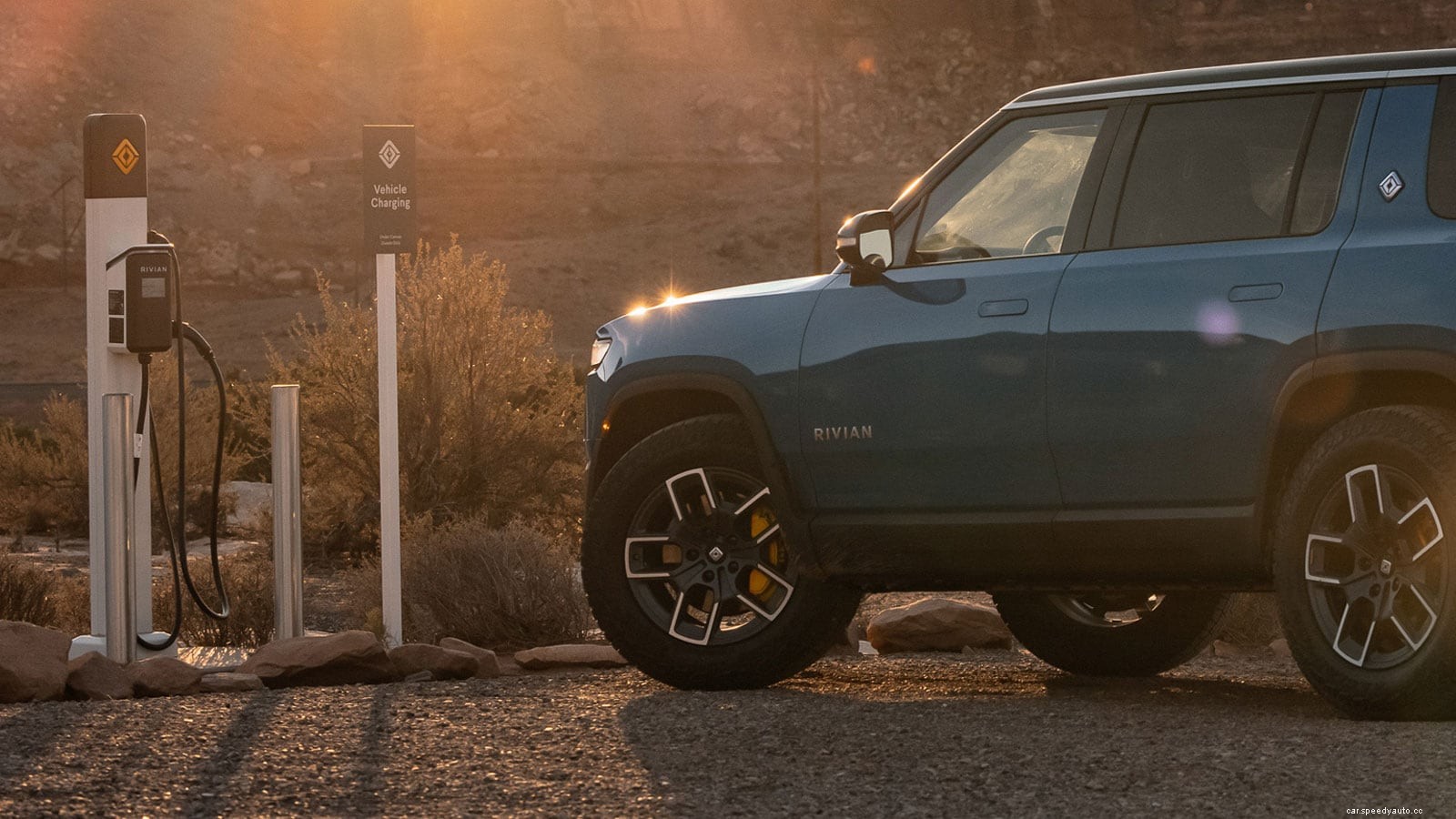 Most electric vehicle manufacturers use a J1772 charging plug. Rivian also accepts this common “J-plug” connector compatible with many charging networks. There are also a few other options for charging on the road.
Rivian plans to unveil charging stations near some popular areas like shopping centers, hotels, parks, and restaurants. The company wants to expand its new network and operate at least 10,000 across the United States and Canada. These stations would be open to the public. Pricing and charging speeds will vary by site.
In addition to the Rivian Charging Network, you can also use DC fast chargers with a J-plug connector. Rivian vehicles work with public networks that use a standard CCS charge port.
Rivian wants to install its own fast-charging Rivian Adventure Network charging stations. Plans call for more than 3,500 DC fast chargers planned at approximately 600 sites located along popular travel routes. If built, the charging sites could deliver up to 140 miles of range in as little as 20 minutes.
Rivian designed its app and in-vehicle navigation system to work seamlessly with your vehicle for access to charging status, rates, directions to nearest EV charging stations, and more. This makes locating stations simple and easy, and it automatically connects to the Rivian Adventure Network for contactless digital payments.
Cox Automotive, the parent company of Kelley Blue Book and Autotrader, is a minority investor in Rivian.
