
Cars require some kind of engine or motor, gas or electric, to get you to your fun destination. Those powertrains may get you to your local theme park for some roller coaster thrills. While the maintenance design is completely different, roller coasters also require some kind of motor to operate, and they produce horsepower. How do roller coasters work, and how much power is under those hoods?
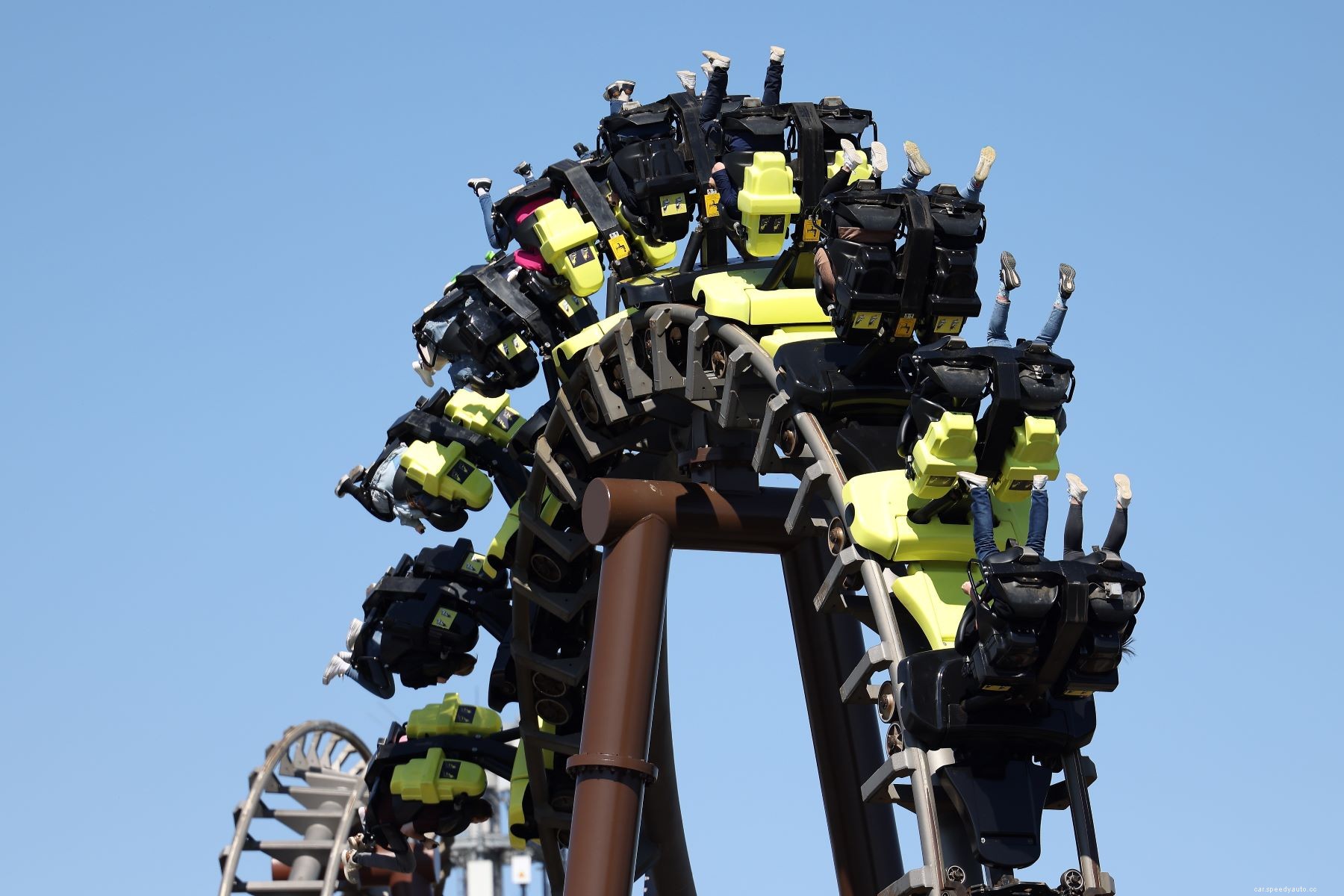
According to How Stuff Works, roller coasters are similar to passenger trains in how you ride in interconnected cars, but the difference is that most roller coasters do not need a motor or power source to operate. It is gravity and momentum that carries you most of the way.
To get you started, you need to build up that momentum by getting to the top of the hill. Most traditional coasters use a chain lift to get you to the top of the hill. One long chain or several chains under the track pulls the cars to the top of the hill. That chain is looped around a gear at the top and the bottom of the hill. The gear at the bottom is turned by a motor.
Going up the hill builds potential energy, the energy of position. This potential energy is then released as kinetic energy, the energy of motion, as you go down the hill. Once you round the corner of the first hill, gravity takes control of the car and applies a constant downward force. The track controls where the train will go as gravity forces it downward. Downhills speed the car up, and uphills slow it down. It really is a basic concept. Roller coasters use gravity and inertia to propel the car along the track. No motor is needed thanks to physics once the car is in motion.
You'll never experience the same ride twice with Sierra Sidewinder! Since its opening in 2007, this popular Camp Snoopy ride has been many young guests' first roller coaster at Knott's! Happy 15th Birthday Sierra Sidewinder! ?
— Knott's Berry Farm (@knotts) May 26, 2022
? IG: mog_amusements pic.twitter.com/cbZjXlmFX5
According to York Precision Machining & Hydraulics, There are three main launch systems used in more modern roller coasters:
These systems are very powerful. According to Idea Wiki, the hydraulic pumps can produce around 500 horsepower each. The newer pneumatic systems can launch the car from rest to 80 mph in 1.8 seconds.
Here's the view from Cedar Point a few minutes ago. All of the rides that you can see, including Top Thrill Dragster, are not running now, after a large-scale power outage at the park. pic.twitter.com/ChNATo1TQ9
— WTVG 13abc (@13abc) May 28, 2018
The following roller coasters in the U.S. use the more modern launch systems with great reviews:
