
If you want to learn how to drive a manual car read through our easy guide and find out how to do it in just a few steps.
(If you want to find out how to drive an automatic - check out our guide on how to drive an automatic car.)
Typically, manual cars will have three pedals: clutch, brake and accelerator (in that order, left to right).
The brake and accelerator pedals are pretty simple - press the brake to slow down (the firmer you press it, the quicker you’ll lose speed), while using the accelerator increases the engine’s revs and causes you to speed up (the firmer you press it, the quicker you will speed up).
The clutch pedal is the one that makes driving a manual car more difficult than an auto.
Without going into too much detail, the clutch is essentially two metal plates that connect the engine to the drive wheels.
So by pressing down on the clutch pedal, you’re disconnecting the engine from the wheels.
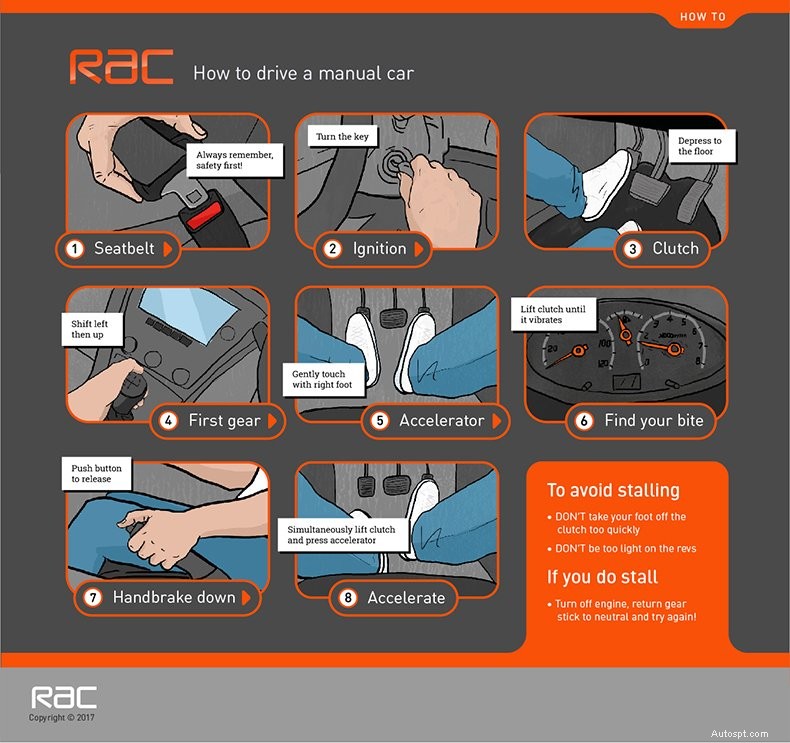
Remember - if you’re too quick lifting your foot off the clutch, or don’t give it enough revs, the car will stall: that’s where the engine cuts out and the red lights glow on the dashboard.
If you stall, apply the brakes, turn the engine off, return the gear stick to neutral and begin the process again.
To drive uphill in a manual car you'll often need to change to a lower gear otherwise you'll lose power. Depending on your speed, just change down a gear or two, and drive as normal.
You may find you need to put your foot down on the accelerator a little further than usual to acheive a normal level of speed when going uphill. Just be careful when you return to level ground, and be ready to ease off the accelerator and change to a higher gear.
To do a hill start, follow the instructions above, but you may want to engage the handbrake, rather than use the footbrake. This is so that you can use one foot for the clutch, and the other one for the accelerator as soon as possible, which will help you to avoid rolling backwards.
It's even more important to get the strongest bite possible when you're using the clutch on a hill start. Follow our full hill start guide here for more advice.
Over time, you’ll get used to a car’s clutch and have a good understanding of where its bite point is, as well as how many revs you need to give it to move off.
It sounds complicated but you’ll develop a natural feel for it with practice.
If you’re not careful, though, it can be easy to wear the clutch out prematurely – and that’s likely to cost at least £300, rising well into four figures for some cars. Follow these tips and your clutch should easily last for well over 100,000 miles:
Don’t use the clutch to hold the car on hills or creep forward at junction
If you’re waiting at a junction, in traffic or at a roundabout, it’s tempting to hold the car at the clutch’s bite point, allowing you a quick getaway when you can move. But this can cause unnecessary wear, especially if you do it often.
Stop, put the handbrake on, and only use the clutch when you’re ready to pull away.
Again, it’s tempting to leave your car in gear and keep your foot on the clutch when you’re stopped in traffic.
This puts a lot of pressure on the clutch release bearing, however, which could wear out quickly if you do it regularly.
To avoid stalling, especially during hilly manoeuvres, many drivers are too heavy with the accelerator.
This can cause unnecessary wear on the clutch plates.
You need a minimum amount of revs to get the car to move – and if you’re gentle enough, most cars can move without using the accelerator at all.
Put the key in the ignition and turn all the way until the engine starts. Put the clutch pedal down with your left foot. Move the gear stick into first gear. Use your right foot to press down on the accelerator gently to increase the engine’s revs very slightly. Slowly lift the clutch pedal until the engine starts to vibrate gently. Release the handbrake to start moving slowly. Increase the revs while slowly raising your foot off the clutch until you are moving forward with only the use of the accelerator pedal.
No, you must pass your test in a manual car to be allowed to legally drive one. If you have a manual drivers licence, you are allowed to drive an automatic car though.
Driving a manual car on a roundabout can sometimes feel like you need an extra hand because you often need to steer, use your indicator, and change gears all at once. Take it slow, and make sure you shift up to at least 2nd gear once you’ve joined the roundabout. Once there, use your indicator before you start turning off at your exit, but not early enough for it to be mistaken for the previous exit. Then you can check your left mirror, make your exit, then shift up a gear to drive onwards if necessary.
