
Not only are they easier (and more relaxing) to drive than a manual, in some cases they can be better on fuel and can cost less to maintain.
If you haven’t driven an automatic car before, however, it can be all too easy to get behind the wheel and be totally perplexed by the lack of a clutch pedal and the array of options provided by the shifter.
If you're looking to learn how to drive a manual car - check out our quick and easy guide with pictures here.
Most automatic gearboxes will let you select between ‘P’ (for park), ‘R’ (reverse), ‘N’ (neutral) and ‘D’ (drive).
Some automatic gearboxes will also give you the option to select first or second gear.
This will help in situations where you want to use the gearbox to keep your speed down - such as driving down a steep hill.
Having this option also helps to keep the revs down and stop the wheels from spinning when pulling away in certain situations.
For instance when moving off in snowy or icy conditions it is sometimes advisable to pull away in second gear to stop the wheels from slipping if it is particularly snowy - some automatics also have a dedicated 'winter mode' that takes care of this.
You can read more about driving in adverse conditions on our driving in snow page.
The fact that a lever or selector takes the place of a gearstick in an automatic means that there are only 2 pedals: the accelerator and the brake. No clutch pedal to be found here.
Be careful not to instinctively press down on the brake pedal the way you would the clutch pedal in a manual! This will lead to an improptu emergency stop.
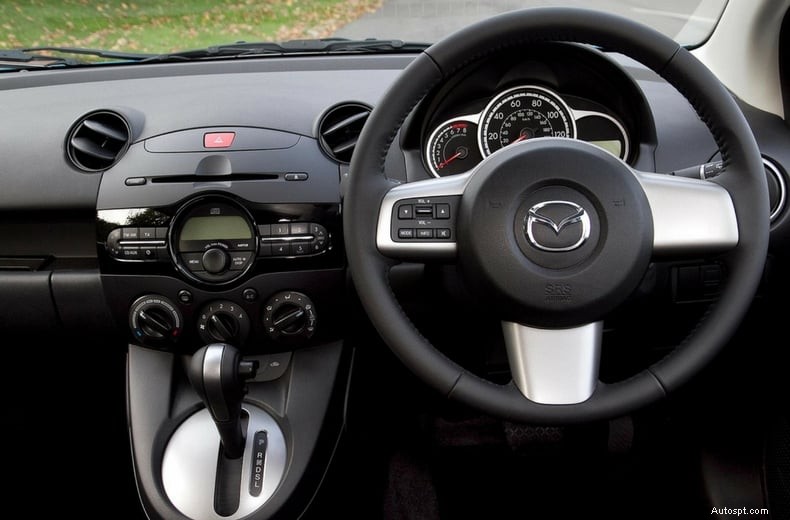
Although automatic gearboxes are generally very easy to use, the confusion comes when starting and stopping.
When you get into a car with an automatic gearbox, it should have been left in ‘park’.
In the image above, you will notice two other letters on the gear shifter.
The ‘S’ stands for Sports Mode. This will often lower a car’s suspension, increase the level of sensitivity to the throttle, and increase the speed of the vehicle’s acceleration. The car will often stay in a gear longer to maximise the level of speed.
The ‘L’ refers to Low Mode. This will tell the car to remain in a lower gear for more power and less speed. This will help with towing and steep slopes.
Although any car which changes gears itself without the driver having to use a clutch pedal is generally considered to be an automatic, there are in fact a number of different types of automatic gearboxes.
These use a ‘torque-converter’ to do the job of the clutch, and are more refined than other automatic ’boxes, but will use more fuel than manuals.
Luxury cars such as the Range Rover and Volvo XC90 stick with a conventional automatic transmission - using as many as nine gears.
CVTs are popular in hybrid cars such as the Toyota Prius, as they do away with cogs in favour of a belt which acts as a single gear ratio.
As well as being more efficient and more reliable, they also make for a smoother drive as the car doesn’t have to skip between gears.
A downside is slower acceleration than other automatic gearboxes, and a loud, strained engine sound can occur if you attempt to make rapid progress.
These types of gearboxes are similar to a conventional automatic gearbox, but two clutches (operated automatically) replace the torque converter.
They line up alternating gears, meaning the next ratio is prepared and allowing rapid gear changes.
They’re popular in VW Group cars - ranging from the DSG gearbox found in the Volkswagen Golf to the PDK used in Porsches.
These aren’t as popular as they used to be, but are still used in cheaper cars such as the Skoda Citigo.
These act like a normal manual, but select gears automatically and operat the clutch by computer rather than using a pedal.
The downside of this is they can be a little jerky - just like a manual, there’s a small pause as the system works through gears.
Although automatic gearboxes traditionally have a reputation for being high maintenance, they are more reliable than they used to be.
They also reduce the chance of parts going wrong - for example, if your clutch control isn’t perfect, you won’t wear out the clutch in an automatic car.
As well as being easier to drive, in some cases automatic versions of cars can actually be more efficient than their manual counterparts.
They can be faster, too - many dual-clutch transmissions in particular can change gears quicker than humans can, shaving crucial tenths of a second off the 0-62mph time.
Ideal for sporting a track day - you can read our beginner's guide to track days here.
Automatic cars are, however, usually more expensive to buy, which will not help your cause if you're a new driver already facing high insurance premiums.
If you are looking to save money on car insurance as a new driver, you might want to look into black box car insurance. Or you might want to consider temporary car insurance to cover you for borrowing a car.
 How to pass your driving test – a full guide from novice to pro
  How to drive a manual car - a quick and easy guide with pictures
  How to drive an automatic car - step by step guide
  15 Driving test tips to help you pass first time
  How to get a provisional driving licence
  How to teach a learner driver - a guide to supervising a friend or family member
  The Highway Code - Common UK road signs and what they mean
  17 things your driving instructor never taught you
  Stopping distances made simple
  How to do a hill start - our complete guide for manual and automatic
  How to guide - bay parking for your driving test
  How to parallel park - our video guide to mastering the manoeuvre
  How to do a three-point turn - driving guide
  Roundabouts - how to deal with them and pass your test
  Learner drivers on motorways - everything you need to know
  What is a driving test fail? Majors and minors explained
  Should I take an intensive driving course?
  Scared of driving - how to overcome driving fear