
Engine misfires in your vehicle are frustrating on a number of levels. First off, your car or truck isn’t going to run right and it will likely sound awful when at idle or cruising. But misfires can cause more than just an annoying exhaust note. If gone unfixed, engine misfires can damage other parts of your car’s engine and exhaust systems. That can result in costly repairs. In this article, we’ll discuss exactly what a misfire is, as well as the car misfire symptoms, causes, and how to fix them.
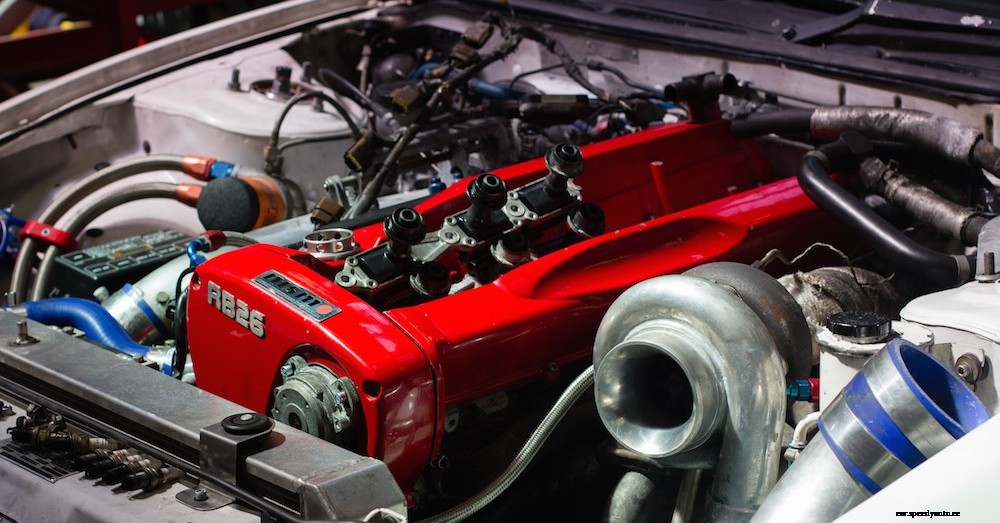
A misfire has to do with the combustion process in your vehicle’s engine. In a typical 4-stroke engine, a number of finely tuned processes must occur, in order, for the engine to function properly. Here’s a simplified look at that process:
The first step of the process occurs when an engine piston moves downward. This allows that respective cylinder to fill up with a mixture of fuel and air from your engine’s intake manifold. That fuel/air mixture can be created by way of a carburetor or fuel injection system. Additional parts like turbos and superchargers can affect the ratio of this mixture.
Next, the piston goes back up and compresses the air/fuel mixture until the pressure is highly combustible.
The third step in the process occurs when your engine’s spark plug ignites that pressurized air/fuel mixture in the cylinder. That causes the piston to be pushed downward again. This time, when the piston moves downward, it rotates your engine’s crankshaft. Ultimately, that crankshaft rotation is what’s going to transfer to your car’s transmission and move your vehicle forward or backward.
The final step in the “4-stroke” process occurs when the piston moves back up again. This time, the upward movement is dumping all of the burned air/fuel mixture into your engine’s exhaust manifold and out your tailpipe.
A misfire occurs when any of the chemistry is off during one or more of those steps. For example, if your air/fuel mix is too lean or too rich, it could result in a misfire (i.e. too much or too little fuel entering the cylinder compared to air). Misfires can also occur if you have a bad spark from a faulty plug or if your timing is off. If your piston rings aren’t sealing, it could result in some of your mixture leaking out—hello misfire!
The first step in fixing a misfire is understanding what is. Now that you have a solid grasp on misfires, here’s how to go about diagnosing and fixing them.
Before we move into fixing misfires, you’ll need to know if your car actually has a misfire. Here’s a look at some of the common symptoms you could experience when your engine misfires.
If your car develops a misfire in one of the cylinders, it may trigger your check engine light. Your car’s first line of defense when it comes to problems is the check engine light.
Most modern vehicles have some sort of electronic control module (AKA “the computer”). If one of your vehicle’s systems starts to function abnormally, a signal is sent to this control module.
The computer then assesses just how bad the problem is, and if it feels the issue warrants immediate attention, it will trigger the check engine light on your instrument cluster. That’s your sign to get to a repair shop and see what’s going on.
Keep in mind that most auto parts stores can also pull the trouble code from your car’s computer. What’s more, they usually don’t charge you for it.
You won’t always be able to sense a misfire, even when your check engine light is triggered. However, one symptom that you will likely notice is a rough idle.
When your vehicle misfires, it can throw your air/fuel mixture way off. This will cause your engine to “sag” or “lurch” unevenly when you’re sitting still. If the misfire and the resulting mixture is bad enough, it might even cause your engine to die.
Remember, a misfire is going to affect your engine’s air/fuel mixture. When that mixture is out of whack, it will send faulty information to all sorts of other components.
One of those components is the set of O₂ sensors in your exhaust. If those O₂ sensors read faulty information because of the bad air/fuel mixture, it will cause your car’s control module to reduce the acceleration.
This symptom can be even more obvious in cars equipped with turbochargers. Your engine won’t get as much air or boost, and you’ll have nowhere near the “pickup” you’re used to.
In addition to slower acceleration, a misfire can also cause your vehicle to accelerate roughly. As your engine reaches higher RPMs while accelerating, a misfire can cause your car to jerk and surge while you’re moving forward. This is one of the more common symptoms of a misfire.
If you’re not a “gearhead,” this symptom might be a bit more difficult to spot. The bottom line is that different engines make different sounds.
Specifically, a 4-cylinder engine is going to sound different than a 6- or 8-cylinder engine. In a misfire, one or more of your engine’s cylinders may go entirely dead, and suddenly your V8 is a V7. To a trained ear, that loss of a cylinder will produce a different engine note, and it can be a sign of a severe misfire.
This can also be traced back to the slow acceleration symptom. In a V8, a loss of a cylinder still results in your engine being able to produce 87% of its capacity. However, in a 4 cylinder, a loss of a cylinder knocks your power down to 75%. So, if a misfire causes a dead cylinder, it will likely be much easier to spot in a 4-cylinder than a V8.
Carmakers go through extensive procedures to ensure your engine is “balanced” inside your engine bay. When one or more of your cylinders have a misfire, that balance is off. You may find that your car is suddenly vibrating more when you’re idling or accelerating.
If you’re parked, you might even be able to open your hood and see your engine “twisting” toward one side or the other as it idles. That’s usually a sign that you have a misfire.
The next step in effectively fixing engine misfires is to understand what causes them in the first place. Just like there are six obvious symptoms of an engine misfire, there are also six common causes. Here’s a closer look at each of them.
If you suspect your engine is misfiring, one of the first places you should look is the distributor, ignition coil, or both. Older vehicles use a distributor to ignite the spark plugs. A distributor has sensitive contact “points” inside, and if any of those points become worn, damaged, or corroded, it could result in a misfire.
In addition to distributors, some older vehicles also had ignition coils, which powered the distributor itself. Most newer vehicles only come with ignition coils. If the coil is damaged, it might not be supplying the appropriate voltage to your distributor and/or spark plugs, and you’ll get a misfire. If you determine that your distributor or ignition coil(s) are bad, replace them as soon as you can.
A faulty spark plug is one of the most common causes of engine misfires. Remember, the spark plug is what provides the spark that results in the little explosion that moves your pistons up and down in the cylinder.
If one or more plugs aren’t functioning properly, that ignition could result in excess fuel being left in the cylinder. That, in turn, causes a misfire.
Spark plugs can become fouled or damaged over time, so if you’re having misfires, they should be one of the first things you check. The good news is that they’re very cheap and easy to replace.
A less common cause of engine misfires is a faulty fuel injector, but that doesn’t mean they don’t go bad. We’ll discuss how to check for bad fuel injectors in a moment.
Low fuel pressure is caused when your cylinders aren’t getting enough fuel, resulting in a mixture that is too lean. That lean mix will cause a misfire. If your engine isn’t getting enough fuel, there are several other parts that could be the culprit.
If your car is equipped with a fuel pressure regulator, that’s a good place to start. A faulty or misadjusted regulator could be preventing adequate fuel pressure from building.
The next place to look is your fuel filter. Most vehicles will have at least one fuel filter between the fuel pump and the carburetor or injectors. Some cars also have another filter between the tank and the pump. If those filters get clogged with debris (from a rusty fuel tank, for example), it will result in low fuel pressure.
Finally, a bad fuel pump will certainly result in low fuel pressure and engine misfires. If your trouble codes turn up that you’re having misfires in all of your cylinders, there’s a very likely chance that you’ve got a fuel pressure issue.
Low engine compression is another common culprit for engine misfires. Several things can cause low compression, but one of the most common (and easiest) to check is your engine’s timing.
A faulty timing belt is often to blame for timing and compression issues, so start there. You’ll need to learn to use a timing light and find the timing indicator on your engine’s main pulley.
If your car has a distributor, timing can be adjusted by simply rotating the distributor to change the ignition points. We’ll discuss checking for other compression issues in a bit.
Vacuum leaks could certainly result in engine misfires, and a leaking intake manifold could be the culprit. Older vehicles were prone to leaking manifolds, so if you’re driving a classic, it’s a good place to start.
Often times, a leaking gasket will have black carbon buildup around the seams. There’s also a pretty easy and inexpensive way to check for vacuum leaks while your car is running. More on that in a bit.
Now that we’ve discussed symptoms and causes of misfires, we’ll look at how to specifically diagnose each of those causes and fix the issue. If you’re not 100% sure what is causing your misfire, we recommend following these steps in order.
If you’re having misfires and your check engine light is on, you should be able to pull the trouble codes. Most auto parts stores and mechanics have code readers and they’ll usually pull your codes for free.
There are also some code readers you can purchase for a reasonable price, but you might have to do a little additional research online to find out exactly what your code means. We’ll share some common codes shortly.
Most of the high-end code readers used by parts stores and mechanics will actually show you what the code means. If you use one of the cheaper readers, you might only get a numerical code that you’ll have to plug into Google to know what you’re dealing with. Some of the common codes related to engine misfires are:
The code will usually point you to your next area of focus (e.g. air/fuel mix, ignition, vacuum leak, etc.). In the case of a “random misfire” code, you’ll likely need to check each of the possible causes. We’ll take a look at each of them now.
Remember, most engine misfires are caused by an ignition issue, so even if your codes don’t specifically point to ignition sources it’s a good place to start. If your car is old enough to have a distributor, check it first.
Pop off the distributor cap and look for worn out or corroded points and connections inside. In many cases, you can simply replace the distributor cap for very little money. You’ll obviously spend a bit more to replace the entire distributor, but it’s still a relatively inexpensive fix.
If you have a newer vehicle with multiple ignition coils, you can track down the misfiring cylinder(s) pretty easily. Start your engine and listen closely to how it sounds. Then, turn it off and unplug one of the coils.
Restart your engine.
You should hear a distinct difference in the sound. If you don’t, you’ve found your misfiring cylinder. Obviously, you might need to repeat this process until you track down the dead cylinder.
This method can also be done while the engine is still running, but we don’t recommend it because there’s a good chance you’ll give yourself a pretty healthy jolt of electricity.
Once you’ve found a dead cylinder, swap the ignition cable with another cylinder and repeat the test. If you get the same result with the new cylinder, it means that it’s your ignition coil or cable that is causing your misfire. Replace them.
However, if you discover that the problem only occurs on one cylinder, you should check your spark plugs. The process is identical to checking the coil and wires. Simply swap out spark plugs between two cylinders and see if the problem travels with the plug or if it’s isolated to the same cylinder. If the problem travels, simply replace the spark plugs and you’ve probably solved your issue.
If you’re getting a good spark but you still have a misfire in a cylinder(s), it’s time to move on to checking your intake manifold for leaks.
Checking for vacuum leaks around your intake manifold is very easy. However, there is an element of danger so it’s important to take the proper precautions. Before you dive into this step, make sure you have a fire extinguisher on hand, just in case of a fire.
Start by turning on your engine and letting it idle for a minute. Then, grab a can of starter fluid (available in aerosol cans at any parts store) and spray around the intake manifold gasket while your engine is still running. If you have a leak, you’ll hear your engine rev. You may also see some black marks around this area if the leak is bad enough.
If you’re getting a distinct revving while performing this step, the solution is likely as simple as replacing the intake manifold gasket. You can do this yourself, but if you’re not comfortable tearing down the top end of your engine to get to the gasket, take it to a certified mechanic.
However, if you’ve discovered that a vacuum leak is not the culprit, it’s time to move on to a compression test.
To check the compression of your cylinders, you’re going to need a special tool. Our preferred compression testing tool is the Innova 3612. There are more expensive and robust tools on the market, but unless you’re doing a lot of engine work, there’s just no sense in spending that kind of money. The Innova 3612 is relatively inexpensive and it will work with just about any vehicle, regardless of the age. It comes with several different fittings so it will fit multiple-sized spark plug holes.
Start by removing the spark plug(s) in the suspected dead cylinder(s). Next, insert the hose from the compression tester into the spark plug hole. Hook up the pressure gauge to the other side of the hose.
Next, unplug your ignition source so that your motor won’t actually fire while you’re performing the test. You can do this by unplugging the power source to your distributor or ignition coil.
At this point, have a friend turn the key in the ignition for about 5 seconds while you observe the pressure gauge. Record the pressure reading. Now, put a few squirts of motor oil into the spark plug hole (just enough to coat the top of the piston), reinsert the compression tool, and crank the ignition again. Record this reading as well. The test with the oil should read higher.
Now, repeat these steps with a couple of other cylinders that you believe are firing effectively. If you notice that one or more cylinders are substantially lower in compression, there’s a good chance that low compression is the cause of your misfire.
If compression is the root of your misfires, it can be caused by damaged pistons or rings, or worn out cylinder walls. Unfortunately, these fixes aren’t cheap. You’re likely looking at an engine rebuild or purchasing a brand-new crate motor if you want to keep the same car.
If the compression looks good on all of your cylinders, there’s one final test you can perform to track down your misfire.
When it comes to fuel-related misfires, remember that if you’re having issues in all of your cylinders, it’s likely a fuel pressure issue. If that’s the case, check that your fuel regulator is set properly, then make sure you don’t have anything clogging up your fuel filter(s). Finally, make sure your fuel pump is working properly and replace any of these parts that aren’t functioning properly.
However, if you’re only having issues in one of your cylinders (and you’ve followed the other steps we’ve listed first), you likely have a bad injector. First, make sure you have power to the injector in question. Do this by using a voltmeter and turning on your ignition. If you have no power, your issue is likely in the wiring and you should have it replaced by a professional.
If you do have power to the injector, test it just like you did the ignition coils and spark plugs. Switch the injector with another cylinder and see if you get a misfire in the new cylinder. If you do, you have a bad injector. Simply replace it and you should be good to go.
As you’ve seen, there are several issues that could lead to engine misfires, but most of the time it’s an ignition issue.
There are several steps to performing a thorough diagnosis of your engine, but none of them are overly complicated. The key is to take your time and stay organized as you’re swapping spark plugs, wires, coils, and injectors.
As always, if you feel like you’re in over your head, your best bet is to take your car to a mechanic so you don’t cause further damage.
