
A flat tire is one of the most common issues you’re going to come across as a car owner. If not properly fixed, a flat tire can also be one of the most dangerous issues. The good news is that in addition to being one of the most dangerous and most common issues, a flat tire is also one of the easiest vehicle issues to diagnose and fix. In this article, we’ll discuss how to find a leak on your tire (if it’s not obvious), how to temporarily stop the leak so you can get back home, and how to permanently fix a flat tire once you’ve gotten there. Along the way, we’ll offer up some product recommendations to make the process a little easier.
The first step in fixing a flat tire is to find the leak in the first place.
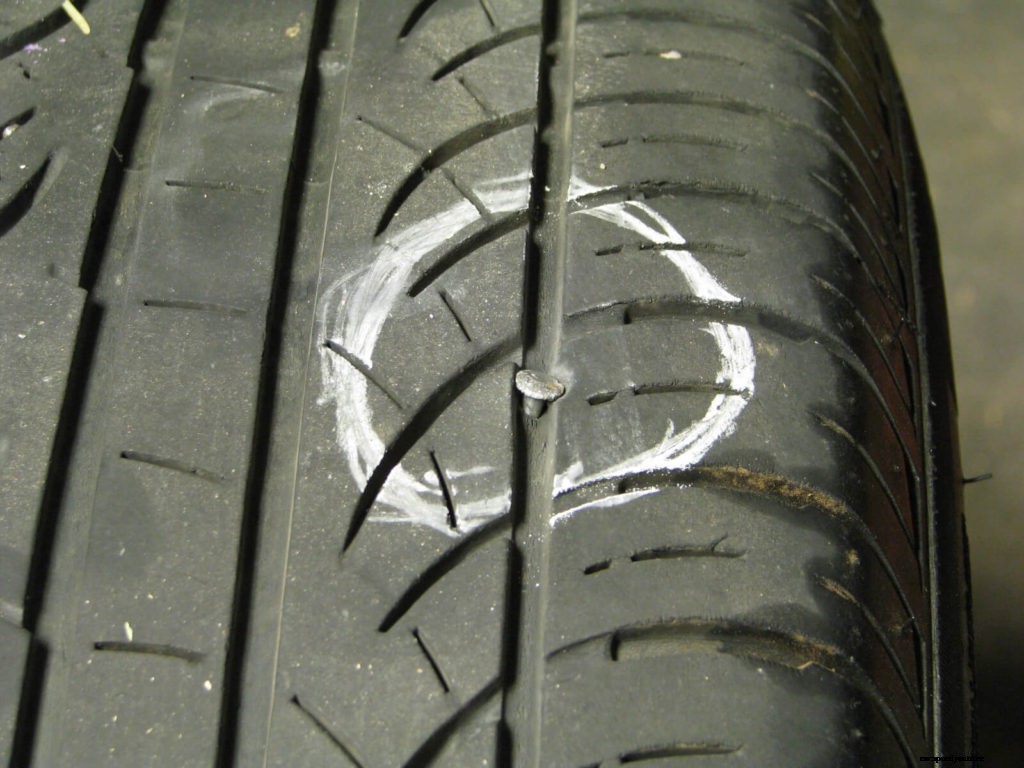
Sometimes, this first step is pretty easy. You’ll walk out to your vehicle after you get off work and your tire will be flat. A quick inspection could reveal an obvious source for the leak like a nail or screw sticking out of your tire (I once pulled a 9-inch gutter spike out of a trailer tire that had gone flat on me).
If you’re lucky enough to have one of these obvious markers, you know where your leak is. The best fix in this situation is to remove the damaged tire and put on your spare, but for the sake of the rest of this article, we’ll assume that you don’t have a spare.
Your first reaction might be to pull out the nail, bolt, or screw that’s so rudely embedded itself in your tread, but you should fight the urge.
That foreign object is likely the only thing keeping your issue from graduating from a slow leak (but still manageable) to a gaping hole that no amount of fix-a-flat will plug up.
So, for now, just leave the culprit in place.
If you don’t have something obvious like a nail or screw staring you in the face, finding the leak will require a bit more effort. Inspect your tire for anything that looks like a cut or a tear.
Now, it’s time to get creative. I always keep a spare bottle of Armor All or Windex in my trunk, and it’s not just for keeping things clean. If I suspect I might have a leak in one of my tires, I’ll spray the suspected area with a bit of cleaner. If the liquid starts to bubble up, you’ve got a leak! (Some might consider it gross, but I’ve even used spit in a pinch for this step).
If you don’t see anything that looks like an obvious puncture or tear, just start spaying your entire tire a section at a time and watch for bubbles. If you’re home when you notice your flat, swap out the Armor All for some actual dish soap and water and you’ll get much better results.
I also like to keep a silver-colored Sharpie on hand so that when I find the leak, I can circle it—it just makes it easier to find as you walk back and forth from the toolbox in the garage.
If you don’t have to travel far to get back home, you should try to get air back into your tire. That same nail or screw that did the damage can also act as a plug, keeping just enough air in and slowing the leak until you can get home and apply a more permanent fix.
Keeping a portable air pump in your vehicle can be the difference between getting home on your own and paying a hefty towing bill.
Our favorite portable air pump is the Audew Auto Digital Tire Inflator. This pump plugs directly into your cigarette lighter and the cord is long enough to reach all four tires on even the biggest vehicles. The pump will quickly inflate tires on any passenger vehicle, including bigger SUVs and trucks.
Our favorite feature is that the process is nearly completely automated. You simply attach the fitting to your tire stem, input the desired air pressure on the digital display, and press the start button. The pump will automatically inflate and shut off when the desired pressure is reached.
As we mentioned, if you leave a screw or nail in your tire, it will likely prevent air escaping long enough so you can get back home. Just keep your speed to a minimum and take it easy.
If you don’t have an obvious nail or screw to keep the air in, it’s time to break out the temporary tire sealant. Tire sealants are incredibly easy to use, they’re relatively affordable, and they’re a great piece of emergency gear to keep in your trunk.
To use them, you simply attach a supplied hose to your tire stem and add the contents of the bottle to the inside of your tire. The contents will find and plug up any leaks.
Here’s the thing, though, tire sealants are strictly temporary! They should be used as an emergency step to get you back home or to a garage so you can permanently fix your flat. Most sealants are only good for about 100 miles of travel and aren’t meant to be driven over 65 mph (check individual products for specific safety guidelines).
When it comes to tire sealants, our favorite product is Slime Tubeless Tire Sealant. It’s a thick, durable sealant that has a good track record of saving stranded motorists. It’s affordable, non-flammable, and contains no toxic chemicals. Our favorite feature, though, is that Slime will work on punctures up to a quarter-inch thick. That provides a lot of peace of mind when it comes to getting home on a flat.
The key to a tire sealant working effectively is that you must get the tire rolling soon after applying the product. So, add the sealant to your tire, then start heading for home. Just remember to take it easy. Once you’ve made it back to the relative safety of your own driveway, it’s time to move on to the final step.
Once you’ve found your leak and managed to get your car back home safe and sound, it’s time to take care of the pesky issue once and for all. The final step for permanently fixing your flat tire is to use an appropriate plug kit.
But first, you’ll need to get your tire safely off your vehicle.
Start by ensuring your car is in park, then block whatever tires you won’t be fixing.
Then, while the damaged tire is still on the ground, use a lug wrench to loosen all of your lug nuts. You don’t want to completely remove them here, just break them free.
Next, use an appropriate car jack and jack up your vehicle until the damaged tire is free. Finish removing all of the lug nuts and then remove your tire and wheel from the vehicle completely.
If you haven’t obviously marked it, now’s the time to find the leak again and draw a circle around it with that silver Sharpie. If a nail or screw is still in your tire, now’s the time to grab some pliers and finally pull that sucker out!
Next, grab your plug kit. One of our favorites is the Tooluxe Universal Tire Repair Kit. The kit isn’t overly complicated to use and comes with the bare essentials needed to quickly and effectively fix your flat tire.
While the functionality and contents of the kit are pretty much identical to dozens of others on the market, what we love most about Tooluxe kit is that the tools are built from stainless steel, whereas most other kits are plastic.
That means the Tooluxe kit will hold up better and allow you to put some serious torque on the T-handles as you’re conducting your repair job.
To use a plug kit, start by grabbing your reaming tool and use it to bore out the puncture in your damaged tire.
Essentially, what you’re doing here is creating a nice, smooth hole in which you’re about to shove the string plug.
Next, grab your insert tool and one of the string plugs that should come with whatever kit you’ve selected. Thread the string plug through the eyelet at the end of the insert tool and dab a little rubber cement (usually supplied with the kit) on the plug.
For good measure, add some of the cement directly over the puncture hole you just reamed out. Use the tool to shove the plug into the puncture hole.
It’s going to take some serious leverage, so just be careful you don’t shove too hard or you’ll end up going too far and losing the entire plug inside your tire (trust me, I’ve done this on plenty of occasions).
The key is to insert the plug until it folds over on itself and you only have about an inch at the ends protruding from the puncture.
Using a sharp pair of side cutters or razor blade, carefully trim the plug ends down until they’re flush with your tire’s tread.
After a couple of minutes, inflate your tire back to the appropriate pressure and spray some soapy water (or Armor All, Windex, Etc.) around your plug and check for bubbles. If you plugged it correctly, everything should be sealed and you won’t see any.
Finish up by mounting your wheel and tire back onto your vehicle, tighten up all the lug nuts and lower your car back down to the ground using the jack. Make sure to snug up all your lug nuts to the appropriate torque once you’ve got the tire back on the ground.
That’s it! Now grab a beer and pat yourself on the back for repairing your own tire.
One final word of caution here. These steps are meant for repairing a puncture that’s in your actual tire tread (the part that rides on the road). If you have a puncture in your sidewall, most plug kits won’t work and you really need to take the damaged tire into a dealer to get fixed or replaced.
Flat tires are no fun, but with some very simple tools and a little know-how, they’re also very easily repaired. Following the steps above can not only get you safely back on the road, but you’ll also save some cash and boost your confidence with the knowledge that you performed some vehicle maintenance on your own instead of taking your car to the local garage.
