
While these cars are not only good for the environment and prevent needing to spend money on gas, a new question arises for electric car owners: what kind of charger should I use for my car?
The main difference between the Juicebox 40 and the Tesla Wall Charger is that the former is slightly more expensive. However, it’s also more versatile, as it can be used with numerous different electric cars from different motor companies. Teslas, on the other hand, work better with Tesla products.
In this article, we’ll go over the differences between the two chargers, look at the pros and cons of each, and figure out why, depending on your car, the ideal charger may be different.
When it comes to getting an electric car, there are a lot of factors that go into the decision-making process. If you’re new to the electric car buying and charging process, it can be very confusing.
What is important to know, first, is the differences between level 1 and level 2 chargers:
| Level 1 Chargers | Level 2 Chargers |
| Charging rate of 3 to 5 miles (4.8 to 8 km) per hour | Charging rate of 12 to 80 miles (19 to 129 km) per hour |
| 120 volts needed | Needs between 208 and 240 volts |
| Works great for hybrid cars with small batteries | Works better for cars with larger batteries |
As is seen in the above table, the differences between the two levels of chargers are very different and very important. Depending on the type of electric car you’re getting and the frequency of use, you will need a different type of charger.
However, in general, if you have a fully electric car, a level 2 charger is best.
Check out this video for more information on which level charger you should choose:
It is also essential to consider the types of different ports that plug into the wall.
For most level 1 chargers, your average three-prong plugin, the same one you would plug your phone in with, will work.
For level 2 chargers, you may need to use a plugin that would be used for a dryer, whether it be old or new, or you may need to hardwire the charger in.
Either way, these chargers are just a little more complex to use.
We wrote a related and helpful article about the 15 most important questions to ask when charging your Tesla. Feel free to give it a read and let us know what you think.
When it comes to these two ports, some things are very similar between the two:
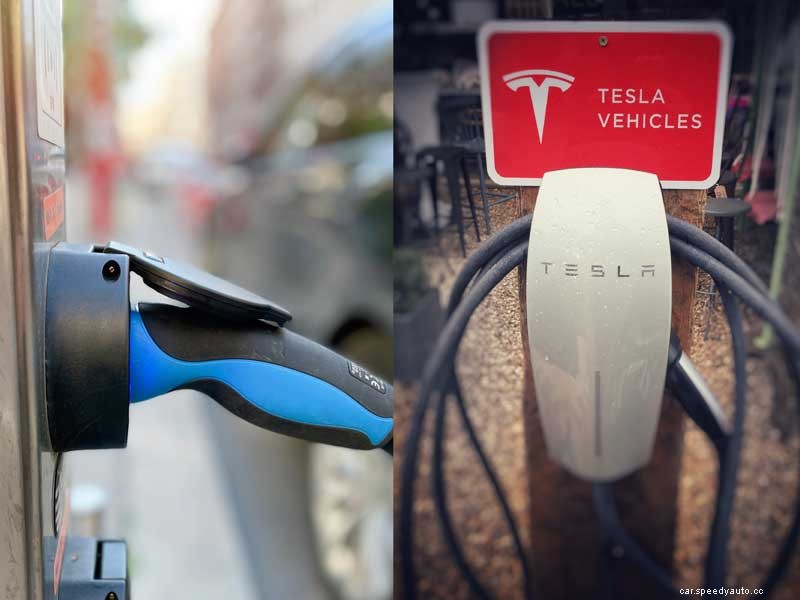
While there are some similarities between the Juicebox 40 Charger and the Tesla Wall Charger, there are some key differences too.
The biggest of these differences include:
Below is a quick breakdown of the pros and cons of each charger:
| Juicebox 40 Pros | Juicebox 40 Cons |
| Has an easy to use interface | Is slightly more expensive |
| Is more adaptable to all kinds of electric cars, regardless of the brand | Does not come with a pedestal mount |
| Is relatively easy to order and get installed | Charges slower than a Tesla Wall Charger |
| Can reliably charge all-electric cars overnight | Has a much longer cable |
Electric cars are quickly becoming the newest and most popular innovation when it comes to the modern-day auto industry.
As listed above, there are definitely some pros and cons to the Juicebox 40 Charger. Perhaps the biggest benefit is that it is more versatile for use among electric cars.
While the Tesla Wall Charger is designed for a Tesla, the Juicebox 40 is intended for any electric car to use. With an easy user interface and simple design, the Juicebox 40 can be used by almost any electric car owner with relative ease.
A big downside, however, is that the charger itself is more expensive and charges slower. The Juicebox 40 charges at a rate, depending on the car, of about 30 miles (48.3 km) per hour, which is about 14 miles (22.5 km) per hour slower than the Tesla wall charger. It is also more expensive by about $100 to purchase.
| Tesla Wall Charger Pros | Tesla Wall Charger Cons |
| Charges faster than the Juicebox 40 charger | Less versatile with the cars it can charge |
| Cheaper to purchase than the Juicebox 40 charger | Harder to get than the Juicebox 40 charger |
| Has a pedestal mount making it easier to install in more locations | Is more likely to need to be hardwired |
| Has a smaller charger cord | The user interface is less intuitive |
Ultimately, the biggest issue you will run into with the Tesla Wall Charger is that it is designed for Teslas. This isn’t so much of a problem if you drive a Tesla, making it the best on the market for a Tesla driver.
But if you drive an electric vehicle that isn’t a Tesla, the charger is much harder to adapt to your needs.
The Tesla Wall Charger is perfect for those who drive a Tesla, while the Juicebox 40 may be preferable for those who don’t.
Both are high-quality and highly reviewed electric car chargers, but the best charger for your car changes depending on the type of car you intend to drive.
