
The Hyundai Motor Company, usually referred to simply as Hyundai, is a leading South Korean automotive manufacturer headquartered in Seoul. The company was founded in 1967, with its first model, the Cortina (in collaboration with Ford Motor Company), launched in 1968. The Cortina was assembled in the Ulsan plant in South Korea. Hyundai has come a long way since then, and currently owns a 33.88% stake in Kia Corporation, and also wholly owns the luxury automotive brand, Genesis, among others.
Hyundai has an annual production capacity of over 1.6 million units, making the automotive manufacturer the third-largest in terms of production behind the Japanese automotive manufacturer, Toyota and the German automotive group, Volkswagen. Hyundai has production facilities across a number of global locations. Some of these include: North America, India, Russia, Turkey, China and the Czech republic. Hyundai vehicles are sold in nearly 200 countries globally.
Hyundai commenced developing alternative fuel vehicles in 1988. The first pure electric car was developed by the company in 1991 (Sonata EV). The automotive manufacturer commenced producing hybrid electric vehicles in 2008. The company has also been involved with hydrogen powered vehicles. In 2018, Hyundai launched the Nexo, a hydrogen powered crossover SUV. The company also launched the first the Xcient Fuel Cell, the world’s first production hydrogen fuel cell truck.
In 2022, the company announced a new production facility in South Korea, with a sole focus on the manufacturer of electric vehicles (EVs). The facility is expected to commence operations in 2025. The company currently has the following battery-electric vehicles (BEVs) and plug-in hybrid electric vehicles (PHEVs):
For those of you new to zero-emission electric driving, we recommend a read of the following articles:
The Hyundai IONIQ, is the first model to be offered as a hybrid (HEV), a plug-in hybrid (PHEV) and a battery-electric vehicle (BEV). All three powertrains are offered within one body type. The variants made their debut at the Geneva Motor Show in 2016. However, the IONIQ Hybrid made its debut in South Korea in January 2016.
The pure electric Hyundai IONIQ is now only available as a used electric car, and offers much value to those keen to families keen to migrate to zero-emission electric driving, but keen on an affordable first step. The past 24 months has witnessed the growth of the used EV market, with a number of relatively good options to consider, to include the IONIQ electric.
The IONIQ EV is not going to make a bold statement and nor is it going to set the heart racing when driven. But that is not the reason to buy this family electric hatchback. The electric vehicle (EV) offers practicality and decent pure electric range.
The EV is available in one EV battery size (38.3 kWh), with a WLTP range up to 193 miles. Even adjusting for real-world driving conditions, the electric car should be able to deliver over 165 miles emission-free. Not bad at all and a very useful range to meet day-to-day driving needs: school runs, family outings, weekend trips, grocery shopping and a lot more!
The Hyundai electric vehicle (EV) has a 7.2 kW AC (single-phase) onboard charger. Given that most homes in the UK are powered by a single-phase power supply, the 7.2 kW onboard charger fits perfectly. The EV can be fully charged in 6 hours via a dedicated single-phase residential EV charger like zappi. For faster charging, the EV offers DC charging up to 50 kW (10%-80%: 57 mins).
We at e-zoomed encourage a topping up approach to charging an electric car. This way charging times are shorter and regular charging is good for the maintenance of the EV battery. The automotive manufacturer offers a 8 years or 100,000 miles warranty.
The front-wheel drive IONIQ electric hatchback can achieve 0-62 mph in 10.2 seconds. The EV offers a maximum power up to 100 PS and 295 Nm torque. The top speed is 103 mph. The electric car benefits from both, instant torque and regenerative braking.
Steering-mounted paddles adjust the regenerative braking strength. The EV offer a number of driving modes: Eco, Normal, Sport and Eco+. The Eco+ drive mode maximises vehicle range by setting a 56 mph speed limit, switching off the air conditioning, heating, fans, and optimising regenerative braking level.
The EV also offers a number of safety features, to include: Hyundai SmartSense, forward collision-avoidance assist, lane keeping assist, blind-spot collision warning, high beam assist, lane following assist, rear cross-traffic collision warning, driver attention warning and smart cruise control. Also as standard is a 10.25″ touchscreen display. The EV offers 357 L boot space.
Bottom-line, electric driving is good for the environment and the wallet. You can lease electric vehicles (EVs) via e-zoomed at very competitive prices! To enquire about a used electric car, email us at shop@ezoomed.com.
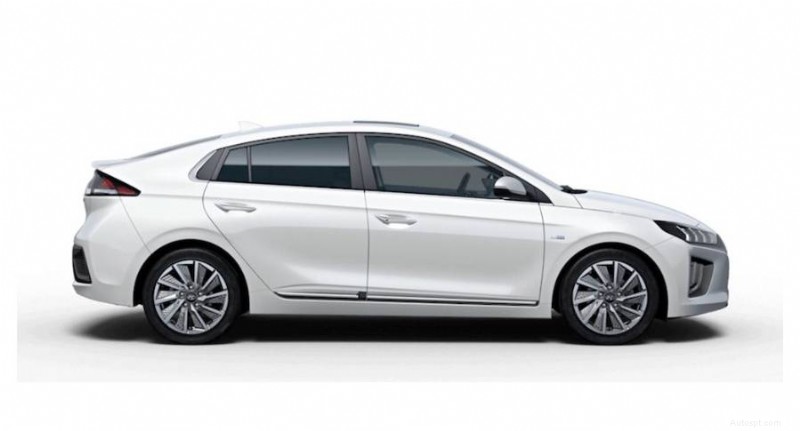
The Hyundai IONIQ Electric Hatchback (credit: Hyundai)
While e-zoomed uses reasonable efforts to provide accurate and up-to-date information, some of the information provided is gathered from third parties and has not been independently verified by e-zoomed. While the information from the third party sources is believed to be reliable, no warranty, express or implied, is made by e-zoomed regarding the accuracy, adequacy, completeness, legality, reliability or usefulness of any information. This disclaimer applies to both isolated and aggregate uses of this information.
