
ŠKODA, the Czech automaker of the Volkswagen Automotive Group finally unveiled its electric car that will enter into production later this year.
Most specifications were already known, but there are some good and bad surprises.
Let’s see the press release.
› ŠKODA’s first all‑electric production vehicle in its 124‑year history
› The zero‑emission city speedster is fitted with an electric motor with a power output of 61 kW
› 36.8‑kWh lithium-ion battery enables a range of up to 265 km in the WLTP cycleBy launching the ŠKODA CITIGOe iV, the Czech car manufacturer is embarking on a new era – 124 years after it was founded. As the first ŠKODA production vehicle, the four-seater city car is powered exclusively by a 61‑kW electric motor. This means the CITIGOe iV is powered not only purely by a battery, but also without generating any emissions. The 36.8‑kWh lithium‑ion battery allows for a range of up to 265 km in the WLTP cycle – meaning the CITIGOe iV is perfectly equipped for traffic in modern cities. Series production of the environmentally friendly city speedster will begin in the second half of 2019.
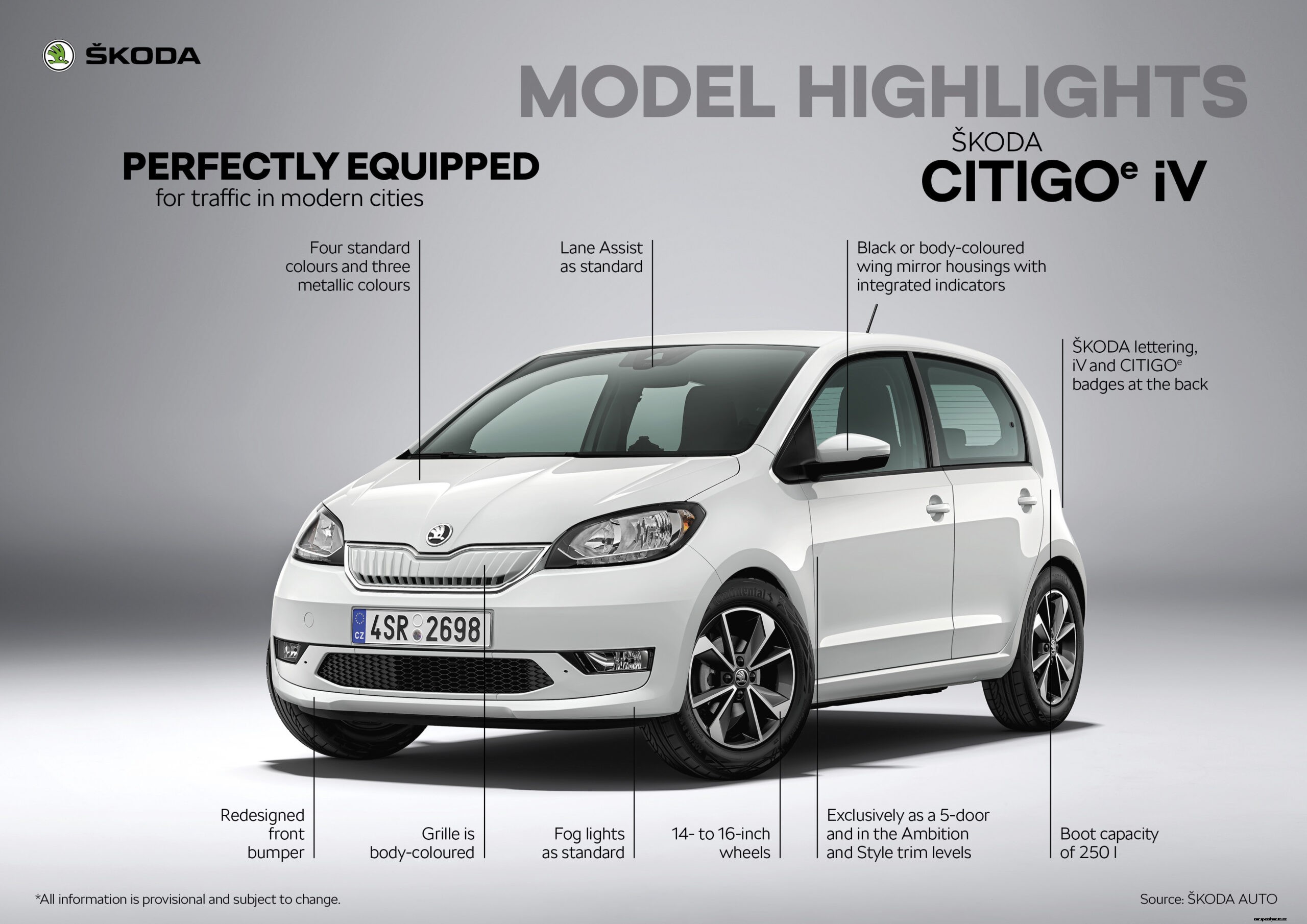
ŠKODA CITIGOe iV highlights
Lane Assist as standard is a nice surprise, I hope that AEB (Autonomous Emergency Braking) is also present, since it’s very important to avoid collisions.
Zero‑emission, nimble and spacious despite compact dimensions, the ŠKODA CITIGOe iV is a perfect vehicle for modern cities. Despite being just 3,597 mm long and 1,645 mm wide, the smallest ŠKODA also offers a spacious interior for four passengers and a boot capacity of 250 l. The boot can easily be increased to 923 l by folding down the rear seats. The front‑wheel‑drive CITIGOe iV is ŠKODA’s first all‑electric production vehicle and features an electric motor with a power output of 61 kW. The maximum torque of 210 Nm – which is relatively high due to the drive concept – is available straight away, as is typical for electric motors. The short burst from 60 to 100 km/h therefore takes 7.6 seconds, while the CITIGOe iV can accelerate from 0 to 100 km/h in 12.5 seconds. Its top speed is 130 km/h.
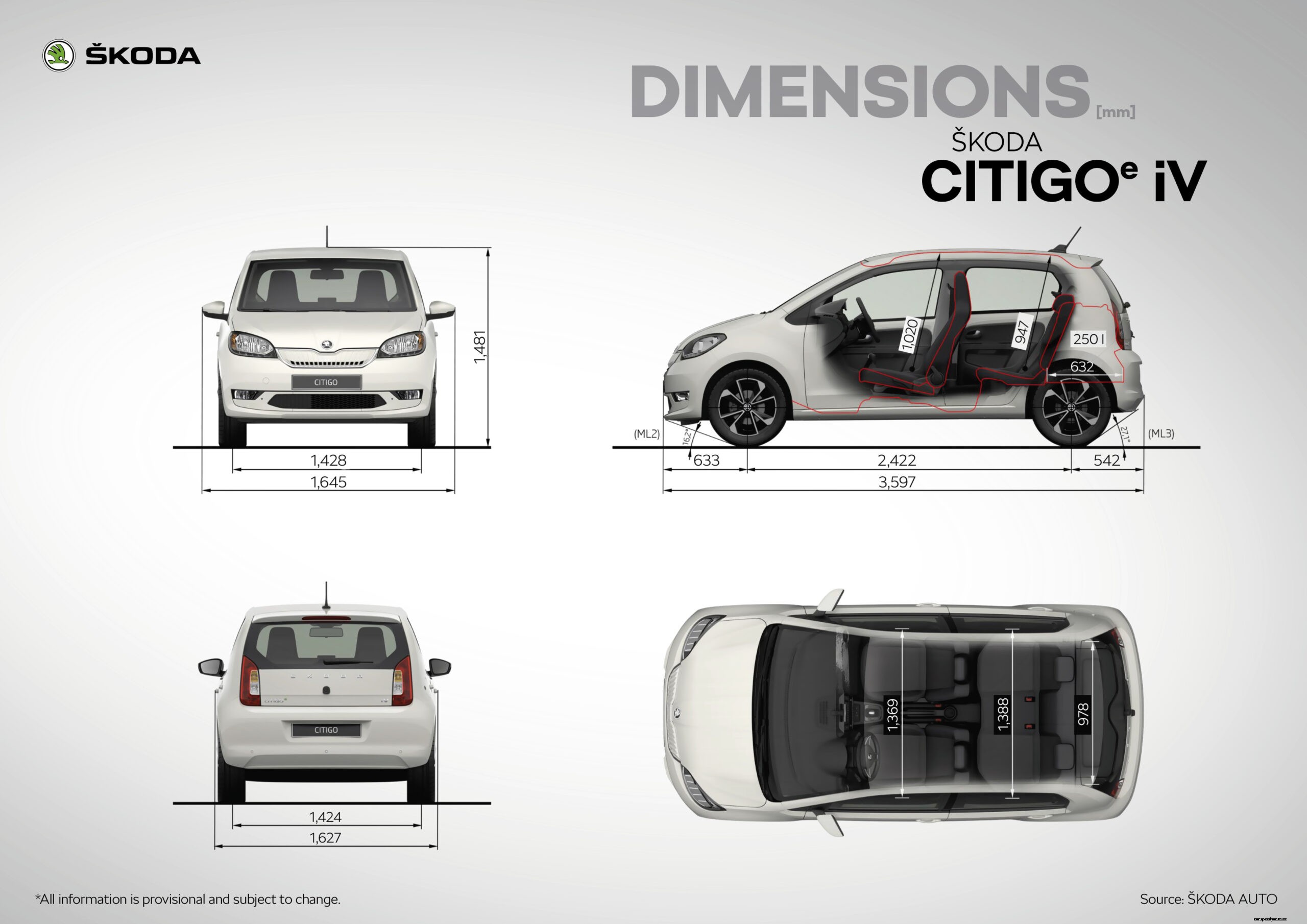
ŠKODA CITIGOe iV technical overview
The ŠKODA CITIGOe iV is powered by a 60-Ah lithium-ion battery with a capacity of 36.8 kWh.
The battery in the chassis floor measures 1.1×1.7 m and is just 0.3 m high. It consists of a total of 168 cells and allows for a range of 265 km in the WLTP cycle. When the power runs out, the battery can be recharged to 80 per cent in 1 hour using a CCS (Combined Charging System) charging cable connected to a 40-kW DC fast charger. Using a 7.2-kW AC wall box, the battery is charged to 80 per cent in 4 hours 8 minutes, or 12 hours 37 minutes using a 2.3-kW home-charging station. Both the Combined Charging System and the cable required for AC charging come as standard in the Style trim variant and are optional for the ŠKODA CITIGOe iV Ambition. Should this charging option not be available, the ŠKODA CITIGOe iV’s battery can also be recharged using a standard household plug socket.
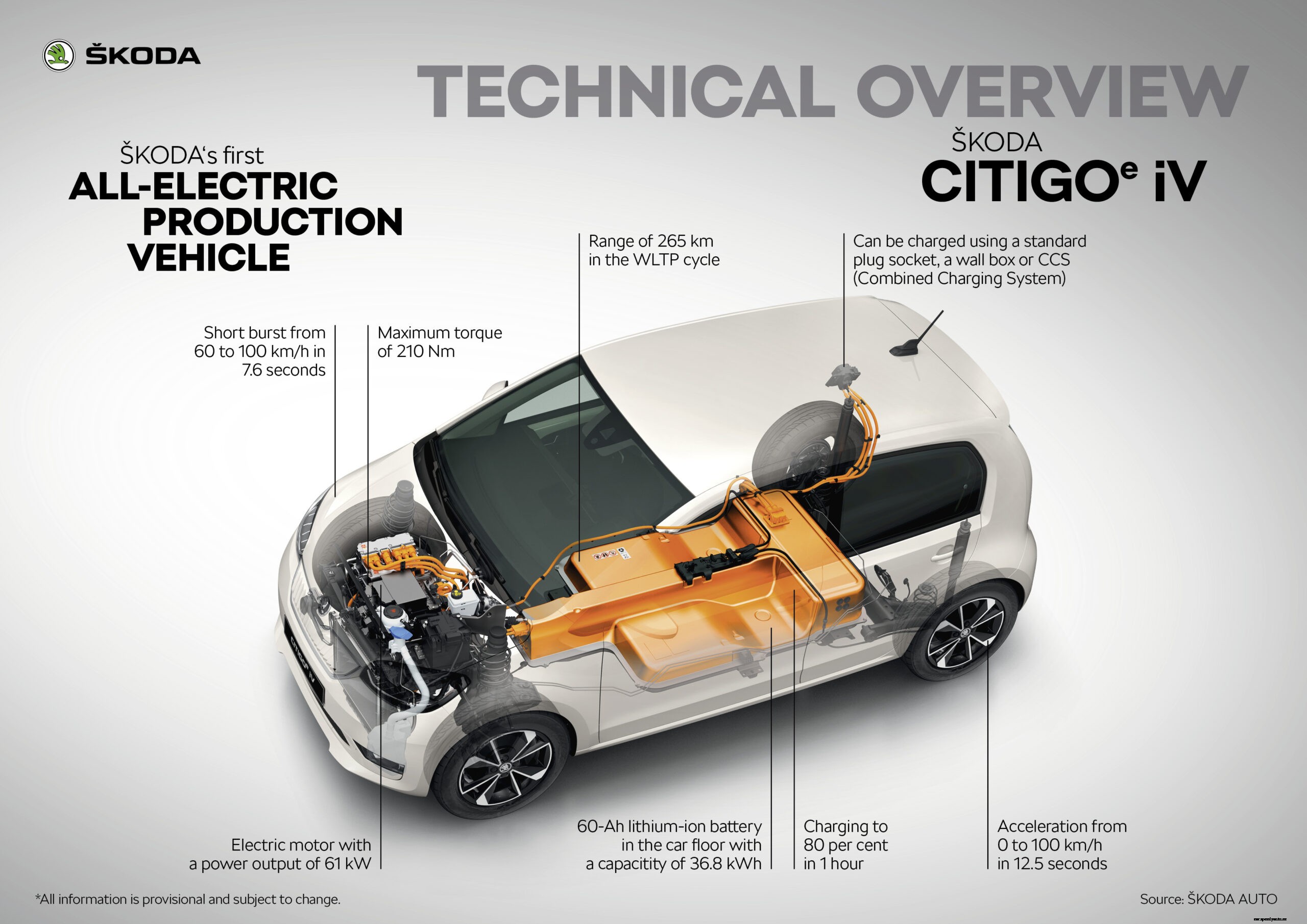
ŠKODA CITIGOe iV technical overview
While the range and battery capacity is no surprise, there is something that I wasn’t expecting.
The firstborn Volkswagen e-up had a battery pack made with 25 Ah prismatic cells from Sanyo/Panasonic, with a total of 204 cells in a 102s2p configuration, which gave it a capacity of 18,7 kWh (204 x 25 Ah x 3,667 V). I thought that the ŠKODA sibling would use the same configuration but with 50 Ah battery cells from Samsung SDI – or even CATL – to double the capacity. I was wrong.
While it’s clear that this electric car is still on the NSF platform, Volkswagen probably no longer uses PHEV2 prismatic cells, instead it seems to use the same 60 Ah pouch cells of the Audi e-tron. Using the same battery cells would make sense considering that ŠKODA and Audi belong to the same Volkswagen Automotive Group.
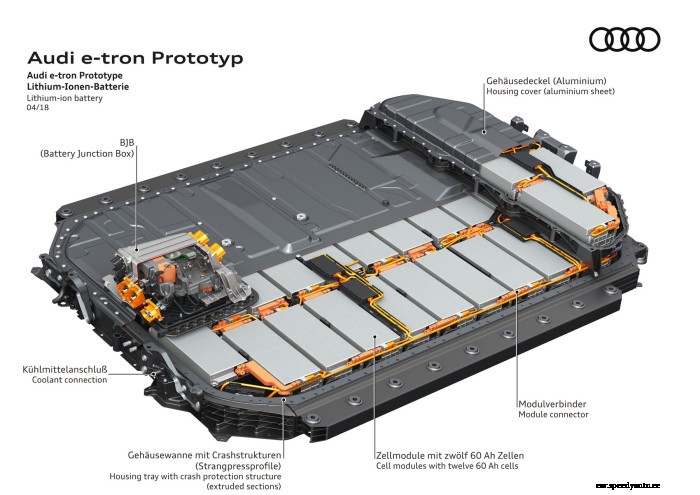
Audi e-tron battery
The adoption of more energy dense cells is good news, however the battery configuration with less cells in series is a bit disappointing, since it reduces DC fast charging rate. Instead of the 102s2p configuration of the original Volkswagen e-up, now the configuration is 84s2p, this explains why it takes one hour to recharge 80 % of the battery at a DC fast charger.
The 60 Ah cells seem to be from LG Chem, but I’m not sure. I’ll leave it to Jeff Nisewanger to find out 🙂
If they are from LG Chem, it’s almost certain that the battery pack has some kind of TMS (Thermal Management System) – required by LG Chem for warranty purposes.
Update
Ralf K. mentioned another valid possibility, which is the use of 60 Ah PHEV2 battery cells from Samsung SDI – we can see them on the roadmap below.
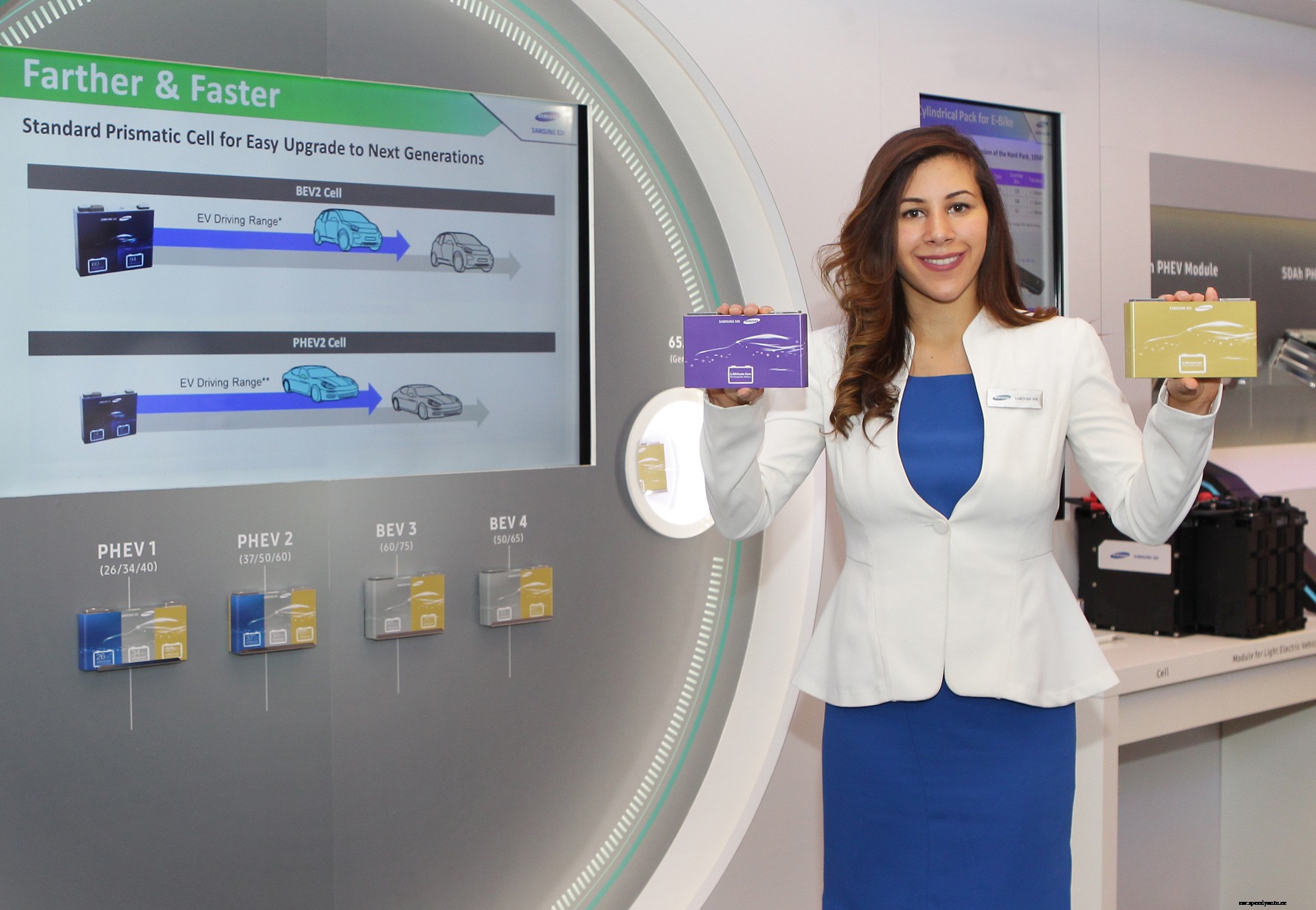
Samsung SDI at the North American International Auto Show (NAIAS) 2017
Anyway, the most important factors to determine this electric car’s success are price and availability. The price we already know to be around 19.000 €, but availability is still unknown. Volkswagen will likely prioritize production of the electric triplets (Volkswagen e-up, SEAT e-Mii and ŠKODA CITIGOe iV) to its own carsharing projects that are expanding in Europe, at least at first. Having this said, with its WLTP range of 265 km, I think that this will be the best city car in Europe for a while, electric or not. What do you think?
Here you have the full presentation where it’s mentioned that the price will be “well below under 20.000 euros”.
Thanks Pajda for the heads up.
