
The new all-electric SUV Mercedes-Benz EQC was officially unveiled today and will be on sale next year.
Here is part of the press release.
“The EQC (combined power consumption: 22.2 kWh/100 km; combined CO2 emissions: 0 g/km, provisional data)1, the first Mercedes-Benz representative of the new product and technology brand EQ, features an all-new drive system development. The interplay between performance and dynamism in combination with a high level of efficiency and comfort was a particular focus of the developers. The EQC has a compact electric drivetrain at each axle, giving the vehicle the driving characteristics of an all-wheel drive. Over a wide operating range, the intelligent control allows dynamic torque distribution between the two driven axles, creating the conditions for high vehicle dynamics. The asynchronous motors have a combined maximum output of 300 kW. The centrepiece of the Mercedes‑Benz EQC is the lithium-ion battery from in-house production housed in the vehicle floor. With an energy content of 80 kWh (NEDC), it employs a sophisticated operating strategy to supply the vehicle with power, enabling an electric range of more than 450 (according to NEDC, provisional figure)1.”
I don’t understand why the unreliable NEDC was mentioned, since WLTP already replaced it as the official test cycle in Europe. NEDC is outdated and Mercedes knows it very well. I sincerely hope it was a mistake, since the figures look terrible. With a range of just 450 km and an efficiency of 22,2 kWh/100 km in the fairy tale NEDC test cycle, it looks even worse than the Jaguar I-PACE – which is already a very inefficient electric car. In the more demanding WLTP cycle the Hyundai Kona Electric – with a 64 kWh battery – gets 482 km of range.
Anyway, let’s take a look at the powertrain.
Maximum variability for more efficiency and stability
In both their drive and recuperation functions, the electric motors operate and function irrespective of the direction of rotation. On the overrun or when braking, the mechanical rotation is converted into electrical energy and used to charge the high-voltage battery (recuperation). In the interests of maximum driving stability and efficiency, the power requirement between the front and rear axle is regulated according to the driving situation. Torque shifting allows the torque to be distributed dynamically between the front and rear axles, ensuring that there is always a satisfying balance between power and efficiency. This gives the EQC the superior driving characteristics of an all-wheel drive.
Under low to medium load conditions, only the front electric motor is operated for efficiency reasons. Maximum recuperative deceleration is achieved by using both electric motors as alternators.
Powertrain specs:
| CO2 emissions | 0 g/km |
| Power consumption (NEDC) | 22.2* kWh/100 km |
| Range (NEDC) | more than 450* km |
| Drive system | 2 asynchronous motors, all-wheel drive |
| Output | 300 kW (408 hp) |
| Peak torque | 765 Nm |
| Top speed | 180 km/h (governed) |
| Acceleration 0-100 km/h | 5.1 s |
| Battery | Lithium-ion |
| Battery energy content (NEDC) | 80 kWh |
| Battery weight | 650 kg |
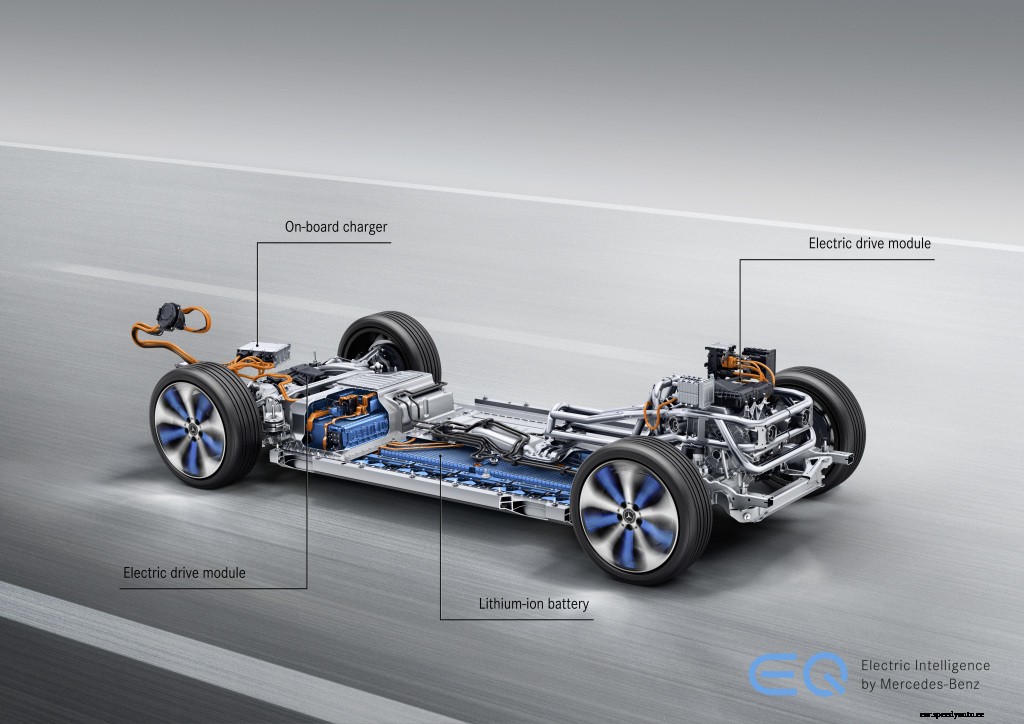
Equipped with a 7,4 kW on-board charger, the Mercedes-Benz EQC can also be fast charged from 10 to 80 percent in around 40 minutes – at a maximum rate of 110 kW.
Charging options: Flexible and fast charging
Whether at home via a wallbox, while shopping, at work or ultra-fast on the motorway: there are various ways to supply electric vehicles with power. Intelligently networked charging solutions focussed on the mobility needs and convenience of customers are an integral part of the new product and technology brand EQ.
As standard the EQC is equipped with a water-cooled onboard charger (OBC) with a capacity of 7.4 kW, making it suitable for AC charging at home or at public charging stations. The charging time required for a full charge depends on the available infrastructure and the country-specific vehicle equipment. Charging at a Mercedes-Benz Wallbox is much faster than at a domestic power socket (see section “The intelligent services for the EQC).
It is faster still with DC charging – which is standard for the EQC – for example via CCS (Combined Charging Systems) in Europe and the USA, CHAdeMO in Japan or GB/T in China. This usually public quick-charging system expands the existing technical standard for AC charging of electric vehicles with the capacity for DC fast charging. Depending on the SoC (status of charge), the EQC can be charged with a maximum output of up to 110 kW at an appropriate charging station. In around 40 minutes, the battery can be charged from 10 – 80 percent SoC (provisional data).
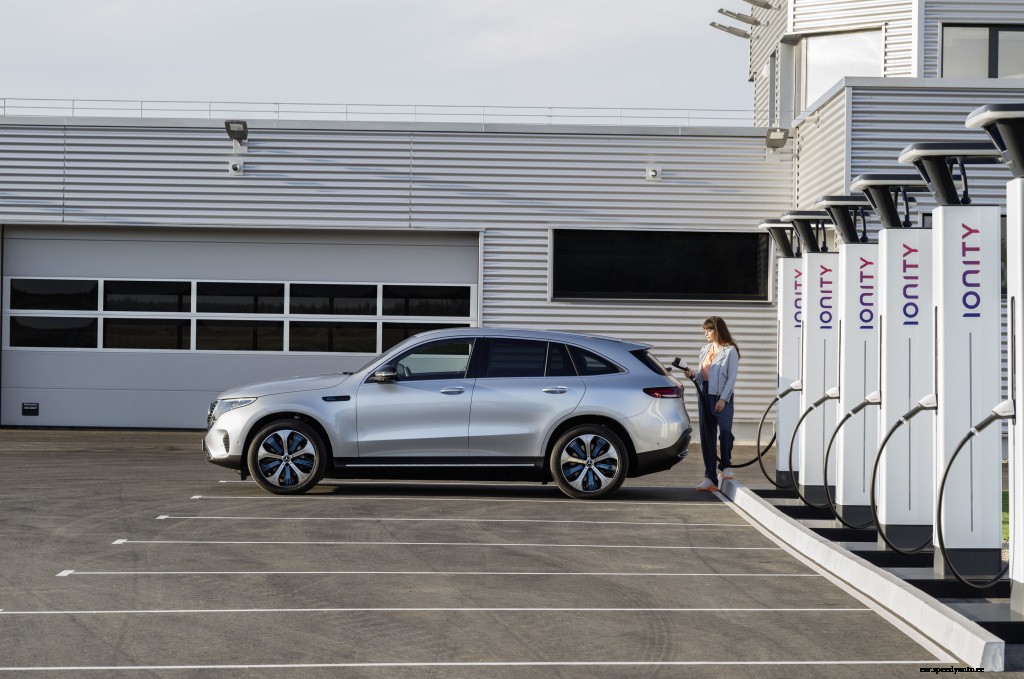
Mercedes-Benz EQC at IONITY fast charging network
The 80 kWh battery is assembled by Daimler subsidiary Deutsche ACCUMOTIVE with SK Innovation battery cells. The battery pack has in total 383 cells and is configured in 96s4p (96 series connections of 4 cells in parallel).
At 650 kg the battery pack is massive and definitely uses NCM 622 cells. With NCM 811 cells it would be at least 100 kg lighter. For example, the 75 kWh battery of the Tesla Model 3 weighs 478 kg. With its low-cobalt content NCA battery cells, Tesla has a great advantage over its competitors. Less raw material equals to less weight, less costs, more efficiency, performance and range.
When Tesla finally upgrades the Model X and S (currently on 18650 standard) with the 21700 cells currently used by the Model 3, these upcoming premium electric cars from legacy automakers will be even far behind. Nonetheless more advanced battery technology isn’t Tesla’s only big advantage when compared to upcoming premium electric cars from legacy automakers, good aerodynamics is also another one. Lower weight combined with better aerodynamics give Tesla a huge head start.
Luxury automakers accustomed to produce ICE (Internal Combustion Engine) cars don’t care about efficiency, but this comes at a much higher cost (less range, less performance and higher price) when applied to electric cars. This mindset has to change if premium legacy automakers want to catch up with Tesla.
The battery: a “heart” from Saxony/Germany
The EQC is equipped with the latest generation of a lithium-ion (Li-Ion) battery serving as the energy source for both electric motors. The battery consists of 384 cells and is located in the vehicle floor, between the two axles. The battery system is modular in design, consisting of two modules with 48 cells each and four with 72 cells each. The powerful high-voltage battery has a maximum voltage of 408 V and a nominal capacity of 210 Ah, for an energy content of 80 kWh (according to NEDC).
The integral overall cooling concept of the EQC, consisting of a heat pump function and two electric PTC heater boosters, not only includes the power electronics, the electric motor and the rotor, but also the battery. The entire battery system is liquid-cooled. At low temperatures a battery heater ensures outstanding performance and efficiency (see Climate control section).
The battery is an integral part of the crash concept for the vehicle as a whole. Its low, central location also has a positive effect on the handling characteristics of the EQC (see Safety section).
The battery is produced in Germany, by the wholly-owned Daimler subsidiary Deutsche Accumotive in Kamenz/Saxony (see Production section).
As for all other high-voltage batteries, Mercedes-Benz issues a battery certificate as a commitment to the battery performance.
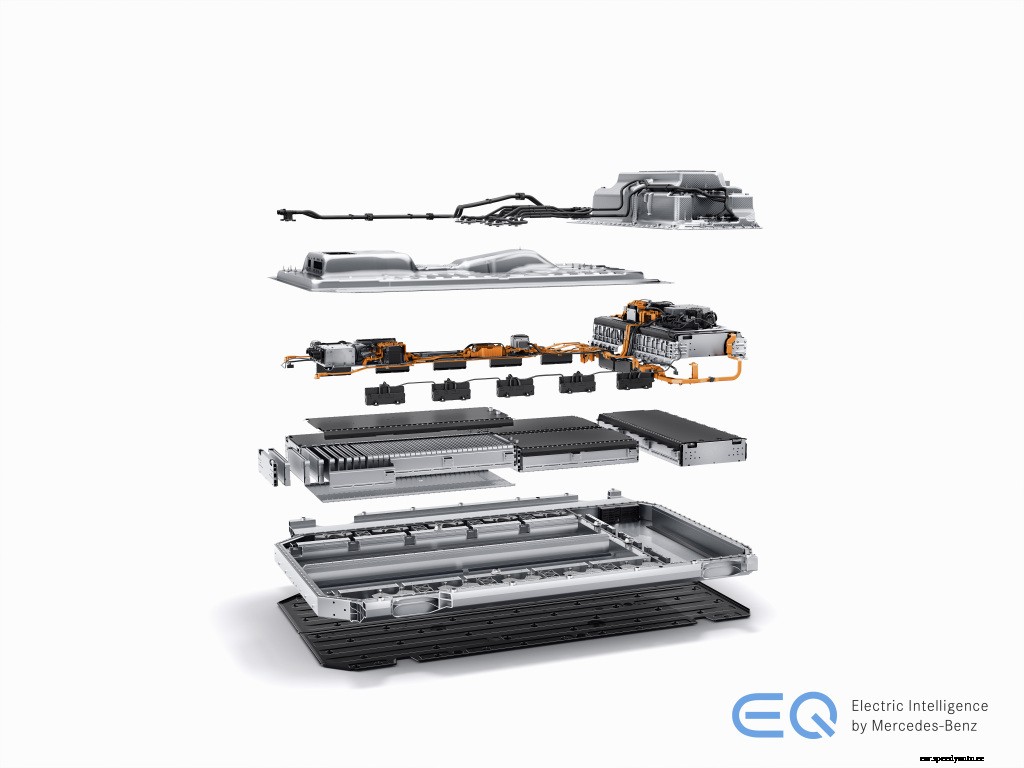
Mercedes-Benz EQC battery pack
The new Mercedes-Benz EQC seems to be a very appealing all-electric SUV, I just wished it was more efficient. Unfortunately, for legacy premium automakers efficiency isn’t very important.
What about you? What do you like and dislike the most about this electric car?
