
The Nissan LEAF is no longer the front-runner of electric cars and Nissan knows it. However, instead of introducing major changes to the LEAF, Nissan is pushing for a cheaper price to remain relevant.
Now Nissan introduced a cheaper entry-level trim with a slower 3,6 kW on-board charger and without dual USB ports for the rear seats. Nonetheless, the price difference between the two cheapest trim levels can vary a lot from country to country.
Let’s see the advertised prices (before government incentives) in some countries that already got the new entry-level trim.
Portugal
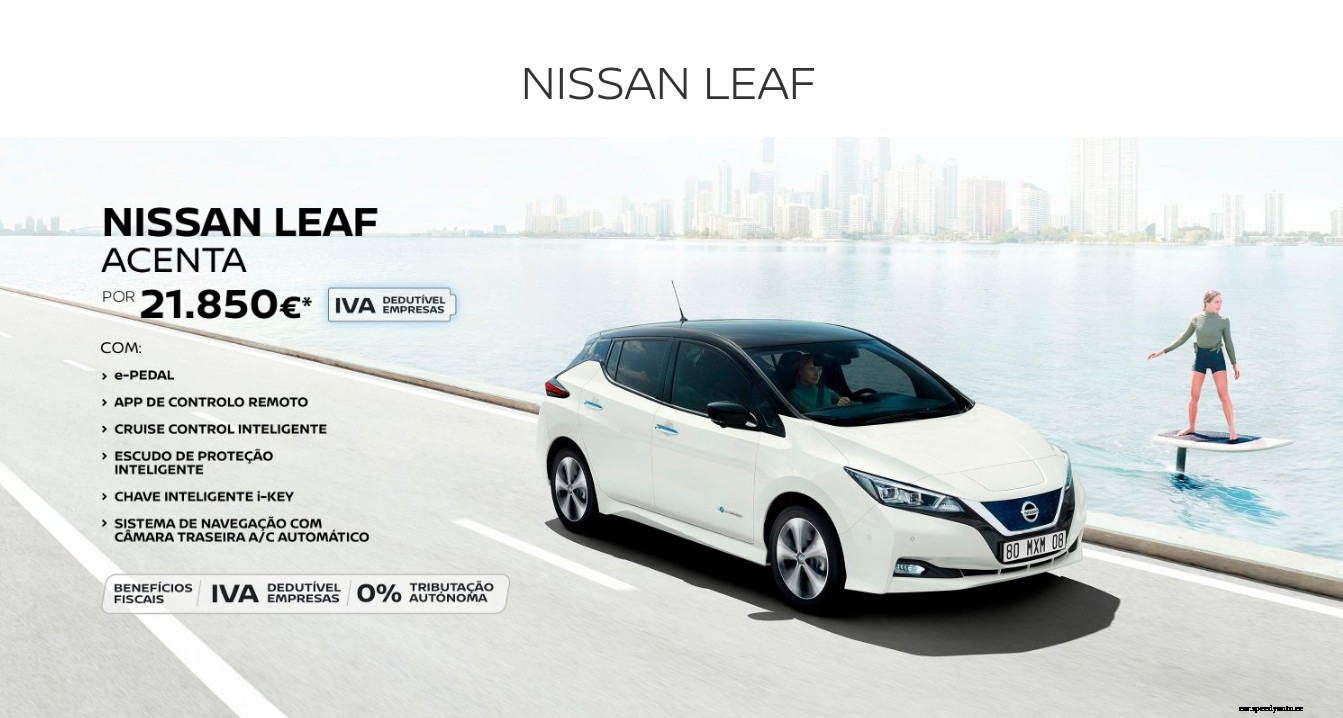
Nissan LEAF promo for companies in Portugal
In Portugal companies can benefit from VAT deduction on the purchase of electric and plug-in hybrid vehicles. Considering that VAT in Portugal is 23 %, it represents a huge saving and that’s why electric cars like the Nissan LEAF and the Renault ZOE are extremely popular with companies. A tourist in Lisbon easily notice that most new Uber cars are electric.
Spain
The ACENTA ACCESS represents a 4.000 euros saving when compared to the next cheapest trim level. With this amount of discount losing the 6,6 kW on-board charger and the dual USB ports in the rear seats doesn’t sound so bad.
France
Italy
The new entry-level trim only seems tempting in Spain where it starts at 25.900 euros, which is 4.000 euros cheaper than the second cheapest trim level available. In other countries the difference between the two cheapest trim levels is a lot smaller and might not be worth it.
Anyway, while a price cut is always welcome, Nissan should stop delaying the inevitable by introducing to the LEAF the long awaited TMS (Thermal Management System) to prolong the lifespan of the battery packs and increase DC fast charging speed. Moreover, in Europe the fast charging standard CHAdeMO is dead, Nissan should embrace the Combined Charging System (CCS) as soon as possible.
But what’s next?
Looking at the history of Nissan LEAF’s upgrades I wouldn’t be surprised if the next step is to ditch the 40 kWh battery and make the 62 kWh variant standard. The 270 km WLTP range from the 40 kWh battery is now looking ridiculous for a family electric car like the Nissan LEAF. Especially now that smaller electric cars such as the Renault ZOE or PEUGEOT e-208 have better range.
However, the NCM 811 battery cells from AESC arrive this year. With 32 % more volumetric energy density than the current NCM 523 battery cells, Nissan could make a new 82 kWh battery pack with the same size. Considering that a good TMS takes some space in the battery pack, a 75 kWh NCM 811 battery with liquid cooling would be reasonable…
I hope that the Nissan LEAF is going to get a completely new battery pack this year with NCM 811 battery cells and liquid cooling. Electric cars without long-lasting battery packs aren’t environmentally friendly products.
Having this said, I do think that Nissan needs to have a smaller and cheaper electric car available for less than 20.000 euros in Europe. Something to be an alternative to the VW electric triplets that will be very tempting to young buyers and car sharing fleets.
What do you think Nissan should do next regarding electric cars?
