
SVOLT will start producing its cobalt-free NMX battery cells in June that are now available to order.
Let’s see the press release (translated from German), it has interesting details.
High-tech company brings new battery cell technology onto the market especially for the automotive sector
For the first time, SVOLT Energy Technology Co., Ltd. (SVOLT), a global high-tech company headquartered in China, presented its battery cells with cobalt-free cell chemistry at the International Motor Show (IAA) in September 2019. The first cell variants can now be ordered. This was announced by SVOLT President & General Manager Hongxin Yang at the first “SVOLT Battery Day”, which took place in Wuxi in mid-December 2020.
The systemic provider is initially offering two sizes of the new nickel-manganese battery cells (NMX) worldwide. These come completely without the heavy metal cobalt, which is otherwise used for the thermal stabilization of high nickel battery cells (NCM). Series production of the new products is scheduled to start in June 2021 at the plant in Jintan, China. At the end of 2023, the new batteries can also be produced in the planned plant in Saarland.
Cobalt-free battery cell in two sizes
As of now, cobalt-free NMX battery cells with 115 Ah and an energy density of 245 Wh / kg in an MEB format (33.4 x 220 x 102.5 mm) can be ordered. Its voltage is 3.74 V and the capacity is 430 Wh. This means that the 115 Ah version of the NMX battery from SVOLT has an effective usable capacity of 396 Wh.
A cobalt-free cell variant with 226 Ah and an energy density of 240 Wh / kg, which is expected to be available from the fourth quarter of 2021, can also be ordered. The 226 Ah version is SVOLT’s own cell format L6 (21.5 x 574 x 118 mm). L-cells are long battery cells in a thin prismatic design with laterally positioned electrodes and degassing valves.
Dispensing with cobalt makes battery cells more sustainable and cheaper
Thanks to the complete absence of the heavy metal cobalt, one of the most expensive and controversial cathode elements, as well as a reduced nickel content, the cobalt-free NMX cells from SVOLT are not only much more sustainable, but also around 5 percent cheaper than classic high-nickel battery cells and are therefore particularly suitable for the broad middle class market. At the same time, the products from SVOLT achieve an energy density that is barely 5 percent below that of comparable NCM battery cells.
SVOLT’s NMX battery cells consist of 75 percent nickel and 25 percent manganese and are stabilized using specially developed doping and coating processes. In this way, NMX cells achieve greater thermal stability and overall safety than NCM cells.
Long life and high performance thanks to a new type of cathode material
With the help of the new technology, SVOLT has also succeeded in significantly improving the cycle aging as well as the calendar aging of the NMX cells compared to conventional NCM battery cells. Among other things, more than 2,500 charging cycles can be achieved in this way. SVOLT achieves the long service life of NMX battery cells through a specially developed cathode material. A single crystal with a wafer-thin surface coating (“nano-coating”), which consists of just a few hundred molecules, is used.
Within the battery cell, the single crystal reduces one of the main causes for the aging of e-vehicle batteries: the formation of micro-cracks and breaks in the active cathode material and thus the wear and tear of the cell. At the same time, the coating, which is only a few nanometers thick, protects the surface of the cathode material used from side reactions with the electrolyte. SVOLT significantly slows down the cell aging of its NMX battery cells.
In addition, SVOLT uses a supplementary doping process, in which foreign atoms, the so-called doping material, are introduced into the cathode material and positioned there. In this way, SVOLT not only succeeds in stabilizing the NMX cells without cobalt, but also in increasing the mobility of the lithium ions in the cathode and the conductivity – and thus the performance of the battery.
The two NMX cell sizes from SVOLT can now be ordered worldwide. Further NMX cell variants are being planned.
Statements
Kai-Uwe Wollenhaupt , President SVOLT Europe & Vice President SVOLT Energy Technology: “As a systemic provider, SVOLT not only produces lithium-ion batteries that are specially optimized for the automotive sector and its requirements, but also works on their further development. This is the only way to promote the acceptance and widespread use of electromobility. Our high-performance, inexpensive and sustainable battery cells without cobalt are an important milestone that, in addition to our goal of offering the most sustainable products possible, also underlines our profound expertise in research and development. SVOLT is the first company that has succeeded in bringing a cobalt-free, high-nickel cell chemistry to mass-produced industrial series production. ”
Maxim Hantsch-Kramskoj , Vice President Sales & Marketing, SVOLT Europe: “Our cobalt-free battery cells are to be used, among other things, in an electric vehicle from Great Wall Motors that will be available on the Chinese market from July 2021. But there is also great interest in the new battery technology beyond the borders of China.
This press release has some interesting data, the cathode of SVOLT’s NMX battery cells consists of 75 percent nickel and 25 percent manganese. These batteries are at least 5 % cheaper than standard NCM cells and will be available in two sizes.
Previously I made some early estimations about the NXM battery cells from SVOLT, but now we have more details to make more accurate estimations.
I was expecting a higher content of manganese, it would give the battery cells a higher voltage and lower cost. However, the higher voltage cathode would require a non-standard electrolyte. A higher voltage battery cell will probably come later with a new improved electrolyte…
NMX 115 Ah battery cell (compatible with Volkswagen’s MEB platform)
NMX 226 Ah battery cell
SVOLT doesn’t mention the voltage of the 226 Ah battery cell, I’ll assume it’s also 3,74 V.
However, it’s very possible that this battery cell has a higher manganese content and higher voltage. The data below previously gathered by Moneyball suggests that this 226 Ah cell has a kWh cost lower than the 115 Ah cell. That lower cost could be explained by a lower nickel content and an equivalent higher manganese content.
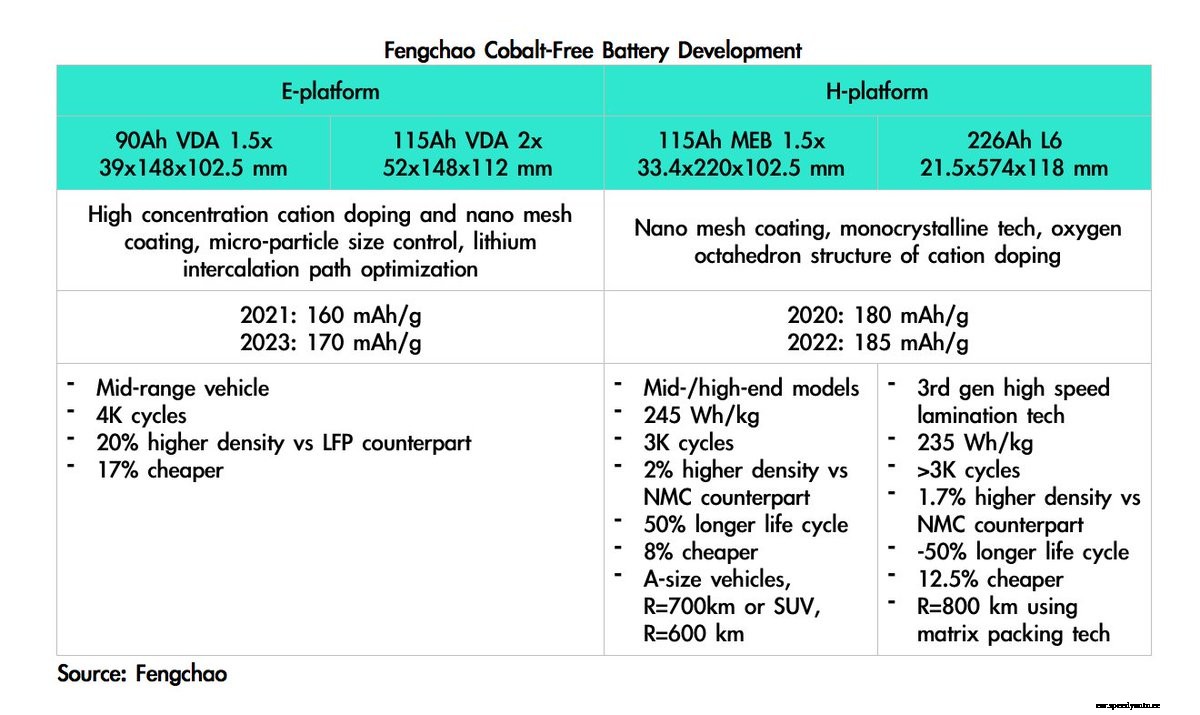
Tweet by Moneyball with information on SVOLT battery cells
The 115 Ah battery cell arrives first and the 226 Ah battery cell will be available just a few months later (fourth quarter).
Anyway, production is scheduled to start in June 2021 at the plant in Jintan (China) and by the end of 2023, the new battery cells can also be produced in the planned plant in Saarland (Germany, close to the border with France).
PSA is an European legacy automaker that already signed battery supply contracts with SVOLT. However, the central location of the planned battery plant in Europe suggests that SVOLT wants to supply multiple French and German automakers with its cobalt-free batteries.
More info:
https://svolt-eu.com/vollstaendig-kobaltfreie-batteriezellen-von-svolt-ab-sofort-bestellbar/
https://forococheselectricos.com/2021/01/svolt-abre-los-pedidos-de-sus-baterias-de-niquel-manganeso.html
