
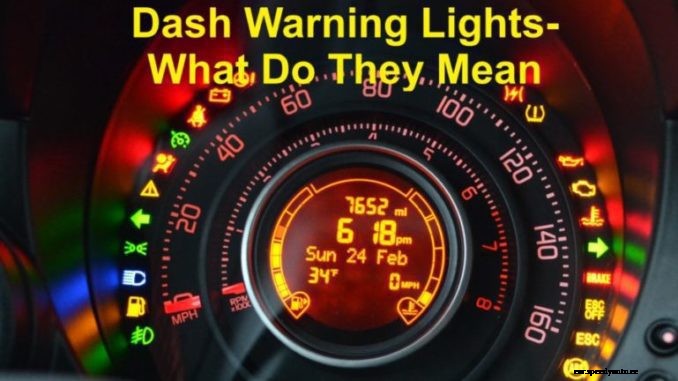
Also, dash warning lights are only the messenger to something going on. And, does not pinpoint the item or system that has failed.
Consequently, some dash warning lights point to relatively, small issues. But, some of the issues, are major. Unfortunately, there is no way to distinguish between them; by just looking at the malfunction indicator light (MIL). So, the only way to find out what’s wrong with the vehicle; is to plug in a (OBD) scan tool.
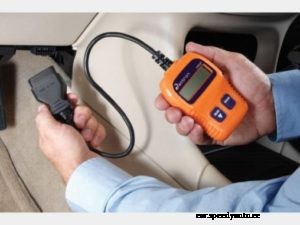
Firstly, the scan tool and accompanied software; can read the diagnostic trouble code (DTC) from the system. So, every time the (OBD) system turns on the malfunction indicator light (MIL) light; it will also store a diagnostic trouble code (DTC) in the electronic control unit. The diagnostic trouble code (DTC) will give more information about the detected issue. NOTE: Many parts stores will read the code for free.
Dash warning lights are nothing new, but the messages are. Consequently, there are hundreds of different dash warning lights. The following list of dash warning lights are the most common:
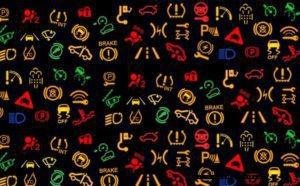
Not all dash warning lights are universal. So, always refer to your owner’s manual, when you’re not 100% sure, what the light indicates.
A check engine light coming on indicates the engine computer has set a; diagnostic trouble code (DTC). And, usually requires diagnosis, with a professional scan tool.

The Malfunction Indicator Light Can Signal, Three Different Types Of Problems:
Most vehicles have an alternator, along with a voltage regulator, that keeps the battery charged. And, also provides electricity to the vehicle when the engine is running. A simple circuit looks at the voltage that the alternator is producing; and turns the battery light on, if it is low.
Consequently, indicates voltage level is below normal level; and the vehicle’s charging system is not functioning properly. Finally, check battery terminals, alternator belt, and battery condition.
If you see the engine coolant light show up on your dashboard; it could mean coolant levels are running low. So, check the gauge on the side of the coolant tank under the hood and top up if necessary. In conjunction with a temperature gauge reading well into the red; it could mean your engine is overheating.
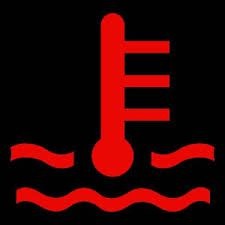
Indicates the temperature has exceeded normal limits and you need to check:
Transmission is operating at higher than optimum temperature, as transmission fluid is hotter than normal. Check transmission fluid level and engine coolant level.
STOP driving immediately and turn the engine off.
Possible Causes Of Low Oil Pressure Warning Light:
If this light stays lit, it indicates loss of oil pressure. Immediately check oil level and pressure.
This Is Monitored By The (ECM), And Indicates That The Oil Life Has Expired.
So, the interval can be mileage or a combination of readings taken by the (ECM). The owner’s manual lists the reset procedure. Some vehicles require the use of special tools, to reset the light.
When you first start the engine, the “oil change due” light should come on; for 1 to 2 seconds and then go out. If the light stays on, the vehicle is due for an oil and filter change.
Typically indicates a lighting or other electrical problem, that is controlled by the (BCM) (body control module). Check all lights (headlights, turn signals, brake lights, and hazard lights).
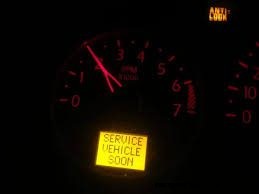
The light comes on when; there is a fault condition in an area of, the vehicle chassis systems.
These systems may include:
As a result, the tire pressure monitoring system, has found a tire with low air pressure; or there may be a sensor malfunction. Check tire pressure. Also, some vehicles will allow manual reset of (TPMS) warning light and others will require; professional diagnosis. Refer to owner’s manual.
Indicates one of three possible conditions:
But, If the problem is in the (ABS) system, it may need professional diagnosis.
Indicates engine computer has, limited engine power output.
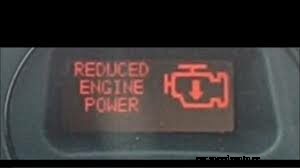
Consequently, the (ECM) has many levels of reduced power; depending on what component has failed in its control system. Usually requires diagnosis, with a professional scan tool.
Indicates that the Anti-lock Brake computer, has set a code and needs professional diagnosis.
So, the (ABS) system uses sensors at each wheel to monitor their rotational speed. Furthermore, a computer monitors the signals, from all four wheels and the position of the brake pedal; to make sure that the vehicle is stable and under control.
If the computer notices any abnormal signals; or the lack of a signal from any of the sensors; it will turn the (ABS) light on, to alert the driver of an issue. In addition to monitoring the wheel speed sensors; the computer can turn the (ABS) light on for other reasons; like low brake fluid levels or a blown fuse.
Consequently, if your fuel cap light is on; it means that the computer has detected a leak in the system; typically from a loose gas cap. A leak present somewhere else in the system; can also trick the computer into thinking the gas cap is leaking.
If not addressed, quite often the check engine light (CEL), will also illuminate.
Indicates that cruise control is set during driving.
Indicates that there is a problem, with the vehicle’s traction control/anti-skid or electronic stability system.
So, if the symbol lights momentarily, it may mean that the ignition switch is locked. And, will need the proper transponder-equipped key to restart.
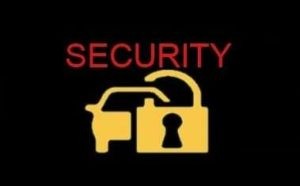
If the symbol is visible, when the vehicle is on; then it typically indicates, a malfunction in the security system.
Indicates that there is an exterior light on the vehicle, that is not functioning properly.
This light Illuminates when, the vehicle’s traction control/anti-skid or electronic stability system is in use. Usually, an indicator that conditions are slippery.
Indicates that a door (including hood and trunk) is not closed. Open and close all doors, including hood and trunk. Because, if vehicle is left in this condition overnight, it can drain the battery.
This symbol indicates, that the vehicle’s overdrive system has been, manually turned off. Typically the overdrive system is controlled by an, on/off switch.
So, if this light stays illuminated after starting; it indicates that the vehicle has found a fault in the airbag system. As a result, the computer has set a code.
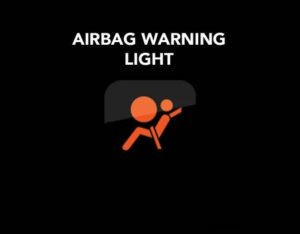
Above all, professional repair of the supplemental restraint system, is highly recommended.
Indicates washer fluid is low. Fill washer fluid reservoir. The cap has a symbol that looks like a windshield. Some vehicles have separate reservoirs, for front and rear window washers.
Indicates, that the vehicle’s front fog lamps, are illuminated.
So, it could be something as minor as a faulty sensor or a broken wire. But, it could also be something more serious than that. Therefore, if left unchecked, the faulty issue will cause; lasting and expensive damage to your vehicle. And, in certain cases, it can result in total breakdown of your vehicle.
However, dash warning lights are not going to warn you that:
Finally, if your vehicle drives, sounds, or smells funny; either fix it or take it to someone who can.
