
With modern vehicles, there are so many warning lights that can come on – it’s hard to keep track of them all. New cars can flash an ABS light, traction control, airbag, collision warning, check engine, or myriad other lights.
Modern vehicles can be very confusing as to what you’re supposed to do when one of these lights comes on your dash, also.
We will walk you through some of the common lights, why they illuminate, and what you should do when it happens.
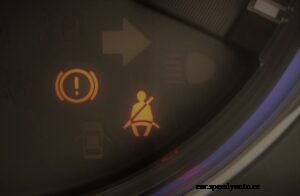 It is important to note, that many car manufacturers classify their warning lights by color. Amber typically means you should note the issue, and do something about it as soon as possible. Red usually indicates that a system has failed, or is completely inoperative.
If you have a red-colored light come on the dash -that is an indication that a serious fault is present that needs immediate repair.
You might think it’s drastic to say ‘immediate repair,’ but often, a red warning light means that the system has shut itself down to try and protect itself from further damage.
A great example of when a warning light shows a disabled system, would be a red ‘BRAKE’ light and a red ‘ABS’ light. This means there is a problem with the physical brakes on the vehicle, and it is severe enough that the Anti-lock Braking System has shut down to prevent damage to electronic or hydraulic components. If you keep operating the vehicle in this scenario – you’re likely to hurt other parts of the system, and make your repair bill go up!
The other factor to remember, is that the red warning indicator might be telling you that important safety features of your car have been disabled, putting you and others at risk.
For instance, if the red Airbag/SRS (Supplemental Restraint System) light comes on your dashboard – this means that the safety systems that protect you in a crash, aren’t functioning. If you have an accident with this light on, your airbags likely won’t deploy, and your safety restraints probably won’t work like they should to keep you from moving around in an impact situation.
In this case, the red indicator is trying to tell you that continued operation of the vehicle significantly lowers your safety in the event of a crash.
The best advice when a red-colored dash light comes on – is to stop the vehicle, call a tow provider, and have the vehicle towed to your repair shop of choice (provided they are equipped to diagnose, and repair the problem).
When the vehicle arrives, be sure the shop is capable of performing actual diagnostics on the system that is being affected. In most cases, reading a code will NOT tell you what is wrong. It may help you understand what part of the system is being affected, but doesn’t tell you (or your mechanic) why.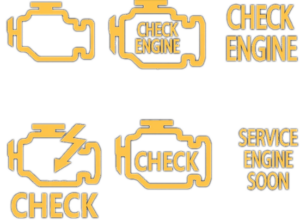
If your shop isn’t able to perform a diagnostic test on the parts of the system that turned on the light, you should find a mechanic who can.
Another very common dash light that can come on, is the ‘Check Engine’ warning light. This light can also be one of the most confusing.
Often, it is unclear why the Check-Engine light came on in the first place. You might be driving, and notice absolutely nothing wrong, yet the CEL (Check Engine Light) is on.
You might also notice that it comes on, and goes off periodically, with no warning, or seemingly no reason why.
Another puzzling thing that can happen, is having your Check engine light flash. Often this occurs when a problem is at serious risk of creating engine or catalytic converter damage.
Some vehicles even have just a small engine emblem, with no description of what the light is. Other vehicles might say Service Engine Soon instead of ‘Check Engine’.
Overall, this light is a catch-all for errors that involve the heart of your car or truck. It is basically a warning light to represent the thousands of possible issues that your engine computer can watch for. This may include things like, wrong air fuel mixture, bad spark plugs, low fluid levels, problems with the emission control system, etc.
A common myth is that you can buy a ‘code reader’ and somehow know what is wrong with the car, based on the code that turned on this Service Engine light. However, these ‘onboard diagnostics’ are not capable of pinpointing the problem; they can point at where the problem is happening, though.
A perfect example is the common ’02 sensor code’ – many times people will have a Check Engine light that comes on, and goes off after a while of driving. They’ll use a free code scan, or code-reader at a parts store, and find a code with a description like ‘System Too Lean – Bank 1.’
After a quick Google search, they’ll find stories of people replacing their Oxygen Sensors. However, after buying a new Oxygen Sensor, or maybe even all four… they find that the Check Engine Light still comes back on after a few days, for the same code!
This happens because the computer system in your car works to find problems, by monitoring the effects it can see. It then makes assumptions about what the cause is. Often times, these assumptions involve assuming that 10-15 different parts in the system are working just fine.
The reality may be, that one of those parts may have failed, causing the ‘bad data’ that made the computer trigger the Check Engine Light. But it is just as likely, that an engine problem exists, or something is affecting the data before it comes to the computer, or perhaps multiple parts failed at once!
These are the reasons why the Check Engine light can be tricky. When you have a Check Engine, or Service Engine light come on – whether it’s red, yellow, flashing, coming, or going… you should contact your repair center of choice, and ask what to do.
A knowledgeable repair shop will ask you plenty of questions about when the light
came on, what you were doing, how the car felt, etc. They will gather some data from you, and help you determine if you can wait to have your vehicle brought in
– or if the cause of the Check Engine light sounds like something to bring in right away.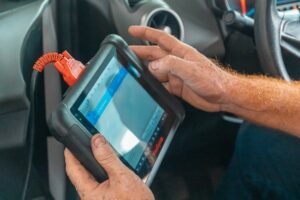
It is important thing to remember, is that when a warning light pops up on your dash; it occurs for a reason. These indicators lights don’t light up unless something is wrong with your vehicle. It is important to pay attention to the signs your car gives you, so that you can have problems fixed before they grow bigger, and cost you more money!
