
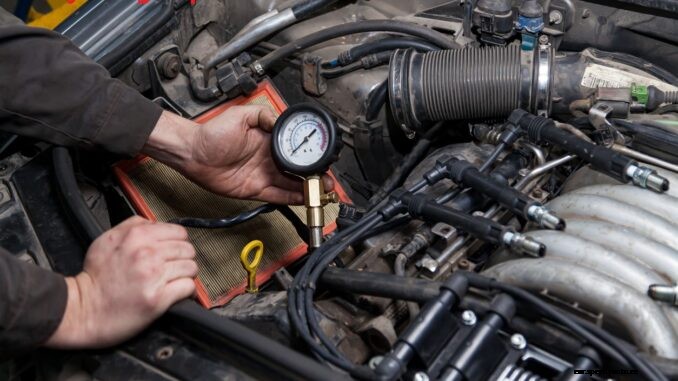
Also, it is important to perform a compression test every time a tune-up is done, as part of preventative maintenance.
You really don’t need special skills, to do a compression test. But, you do need to know, how to interpret your results correctly.
By performing a compression test, internal engine malfunctions; such as bad valves, piston rings or excessive carbon buildup can be detected, before they cause irreparable damage.
Be aware, that late model engines, are mostly made of aluminum and therefore, are prone to spark plug thread damage.
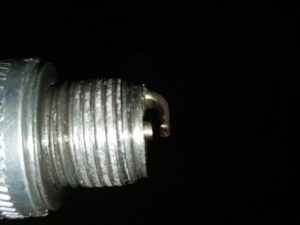
This is very common, when you remove a spark plug, on a hot engine.
So, before warming up the engine, remove the spark plugs and add a dab of, anti-seize compound to the threads. Install and tighten the spark plugs, to the torque listed, in your vehicle repair manual, using a torque wrench. Because, this will make it easier, to remove the plugs next time around.
There is more than one school of thought on, what the compression, of the average engine should be. So, as a general rule a compression of 135 PSI or better, is excellent. On the other hand, a compression of 85 PSI or lower, is extremely bad. Firstly, the most desirable situation is that all cylinders, give the same or close to the same reading.
In addition, that reading should be, above 135 PSI. Uneven readings are not uncommon on high mileage or worn engines. Also, the difference between, the highest and lowest readings, should be no more than 20%. So, as long as the lowest reading is, 100 PSI or better, then the engine is acceptable.
Consequently, greater differences between cylinders, indicate worn or broken rings, leaky or sticky valves or a combination of all.
While observing the gauge, during the cranking of the engine, you should have noticed, the way each cylinder pumped up. Usually, a cylinder will produce, about 40 PSI on the first stroke and about 35 PSI, on each additional stroke.
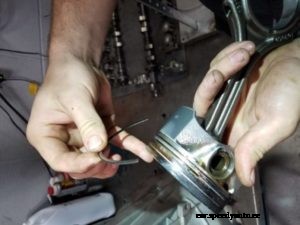
Problem cylinders, may have trouble pumping up and may increase, by only something like, 10 PSI per stroke.
It may be possible to crank these cylinders enough times, to come close to, the other cylinder’s total PSI. This is why we try to crank, all cylinders the same amount. As a result, poor rings, usually cause this condition. Be aware that a cylinder suffering from excessive oiling, even from bad rings; can yield high compression test results. Other symptoms, may give you a clue to the problem (a smoking engine).
There are some variables that affect the readings, obtained from compression testing:
Many automotive books describe, a dry and a wet compression test together. Usually these tests, must be interpreted together to isolate the trouble, in cylinders or valves. To perform the wet test, a tablespoon of engine oil, is poured into the cylinder, through the spark plug hole.
So, you squirt the tablespoon of engine oil, into a cylinder, that is reading low. Crank the engine, two revolutions or so to spread the oil, then retest the cylinder. If the compression comes up markedly, 40 PSI or more, the trouble is, poor ring to bore sealing.
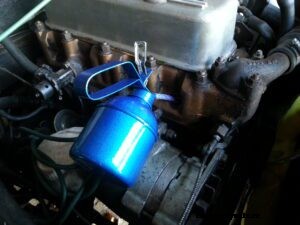
If compression, doesn’t increase much, about 5 PSI, then the problem, is probably with the valves. Furthermore, it could also be, pulled head studs or a, warped cylinder head.
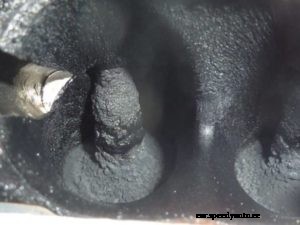
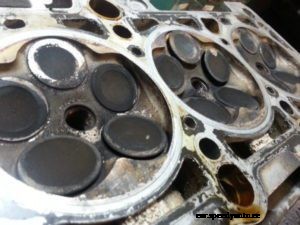
Your compression, is low on the first stroke. And, compression usually does not build up, on the following strokes. Furthermore, your compression does not improve much, when you add oil.
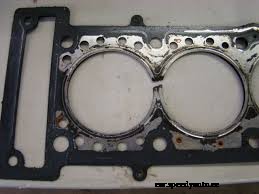
Two adjacent cylinders, have lower than normal compression and injecting oil into the cylinders, does not increase the compression. Most often, the cause may be, the head gasket leaking between the cylinders.
Testing compression is really nothing more than, a way to figure out, which cylinder has a problem. If you do find any issues, the next step would be doing a cylinder leak down test. A cylinder leak down test, is similar to a compression test. It also tells you, how well your engine’s cylinders are sealing. But, instead of measuring pressure, it measures pressure loss.
TIP: You can also do a, A running (dynamic) compression test.
