
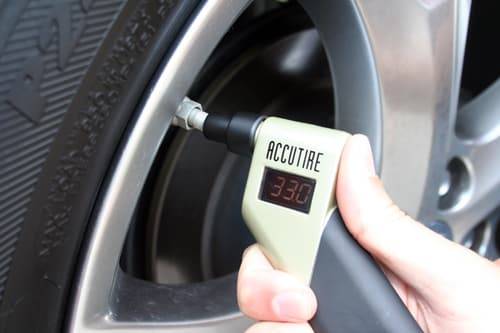

CARS.COM — While it may seem like a mundane task, inflating tires is much more crucial to your car than you may think, and it results in a safer and more economical experience on the road. Proper tire inflation can significantly improve the fuel economy of your vehicle. Your vehicle’s handling also will be greatly improved as the larger a tire’s inflated footprint, the more responsive and comfier the ride balance will be.
Related: How to Remove A Sticker From Your Car
To find your tires’ proper inflation level, look for a sticker on the driver-side doorjamb. It displays the vehicle weight restriction and tire information including the recommended tire pressure. The info is also found in the maintenance or car-care section of your vehicle’s owner’s manual.
Don’t refer to the sidewall markings on your tires, which in part specify the maximum tire pressure — not the recommended pressure for your car.
Unless your tire is visibly flat, don’t judge tire inflation just by looking at it; you have to use a tire pressure gauge to get the correct pounds per square inch (PSI) reading. There are three types of tire-pressure gauges: digital, internal slide and dial. Prices range from $5 for a basic gauge to more than $30 for one that is digital, has an air-release button — or even talks. All will do the job, but you may want to consider the conditions in which you’ll be using your gauge. “We’ve found that low-cost digital pressure gauges are very accurate and maintain the accuracy longer, but in extremely cold temperatures the gauge may not show up properly,” said John Rastetter, Tire Rack’s director of tire information services.
Tire manufacturers suggest checking tires when they’re cold for the most accurate reading. Outside temperatures can cause tire pressure to vary by as much as 1 psi per 10 degrees; higher temperatures mean higher psi readings. “Tires are black; what does black do? Attract heat,” Rastetter said, noting the importance of finding a shady place to check and fill all four tires.
Temperature plays a huge part in tire psi, Rastetter said, adding that the most crucial time of year to check pressure is in fall and winter when days are shorter and average temperatures plummet.
Check your tires in the morning before going anywhere, because as soon as you get behind the wheel for an extended amount of time, psi will rise. Rastetter said that if you’ve been on the road a long time and notice higher psi in your tires, don’t let the air out, as the increase in pressure has built up due to the warm, constantly-in-motion tires.
Rastetter emphasized the importance of keeping dust caps on during winter driving because if water gets into the valve stem and freezes inside the tire, it could cause a flat.
While you’re at it, check your spare tire’s pressure. You don’t want to have a flat tire and then find out your replacement is flat, too.
Make these steps part of your routine. It will benefit your vehicle and your wallet. Check out the video below for more.
Cars.com’s Editorial department is your source for automotive news and reviews. In line with Cars.com’s long-standing ethics policy, editors and reviewers don’t accept gifts or free trips from automakers. The Editorial department is independent of Cars.com’s advertising, sales and sponsored content departments.