
You take care of your car. You want it to last, so you make sure it gets all the routine maintenance recommended by the manufacturer. You have the tires rotated regularly, the air filter swapped out before it clogs, and the timing belt replaced long before it has a chance to break. Maybe you even go the extra mile, substituting Mobil1 Synthetic for conventional motor oil because you appreciate the finer things. Of course, you also make sure the rest of the fluids are changed on schedule. But did you know that simply changing the fluids might not give your car, truck, or SUV the level of protection you are looking for?
When it comes to servicing the fluids in a car, vehicle manufacturers usually advise draining the old fluid, replacing the filter (where applicable), and refilling with fresh fluid. When done according to schedule, this traditional method for replacing fluids can provide years of service for the systems in your car. But the “drain and fill” method is not as thorough as you might hope. It does not remove contaminants from the system. And, in many cases, simply allowing the fluid to drain out does not replace all of the fluid.
For example, inside an automatic transmission is a component called a torque converter. Contained inside the torque converter is as much as half of the ATF in the transmission. When the transmission is drained, the fluid inside the torque converter remains. So, when the transmission is refilled, only about half of the fluid is actually being replaced.
The only way to replace all of the fluid and thoroughly clean the system at the same time is to have a fluid flush service performed.
BG Fluid Service is your solution to complete fluid replacement. A technician will attach a specialized machine that forces fluid through the whole system, replacing all of the fluid. BG Fluid Service also gently cleans out foreign matter — varnish, gum, metal debris — far more effectively than can be done through draining. The results? Peak performance and longer life. Fuel mileage is increased, emissions are decreased, and internal components remain free from wear. BG Products are your key to protecting your vehicle.
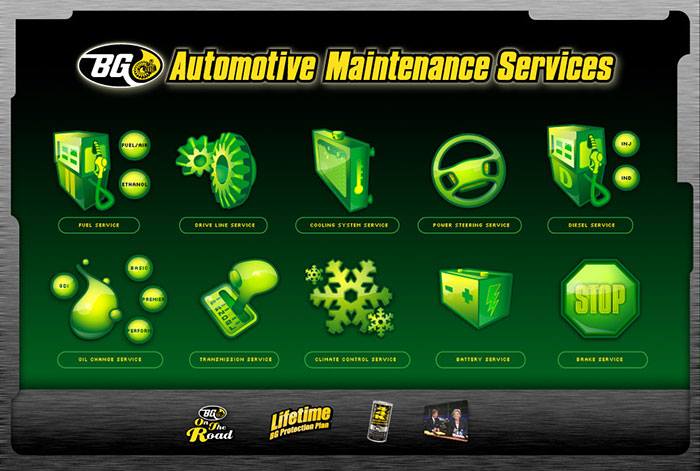
In addition to the engine oil, several other fluids should be replaced periodically. The service interval is different for each fluid — the automatic transmission fluid (ATF), power steering fluid, brake fluid, driveline component fluids, and engine coolant — and may range from changing the oil at 5k mile, to (in some cases) the differential fluid at 150k miles. Consider these BG Services for the fluids in your vehicle.
Over time, ATF can break down, causing transmission performance to decrease. Metal debris caused by friction between moving parts is deposited inside the fluid and can cause damage. A BG Transmission Flush will:
Power steering pumps can get noisy because of degraded fluid, and steering can feel difficult or erratic. This service can eliminate the noise and smooth out steering performance. This service will:
Brake fluid absorbs moisture over time. This moisture can cause corrosion in the system, degrade the fluid, and lead to a loss of brake function. To make sure your brakes are quiet, responsive, and safe, this service will:
Driveline components generally have a longer service life than many other vehicle systems, unless they are subjected to heavy use, as is often the case with trucks and SUVs. The fluids in each of the driveline components will break down over time and metal debris will collect, causing damage to the gears. This service will:
Today’s engines are designed with extremely tight internal tolerances to balance performance, fuel economy, and emissions. An undesirable outcome of close tolerance engines is that they are susceptible to carbon deposits on valves, ports, fuel injectors, throttle body, and combustion chambers. To smooth out a rough idle, increase fuel economy, reduce emissions, and more, this service will:
The coolant (antifreeze) inside the cooling system becomes contaminated with scale and corrosion, especially when subjected to extreme temperatures. The ability of the coolant to regulate engine temperature is reduced. To decrease the chance of overheating, this service will:
Diesel engines are subject to some of the same problems as gasoline engines — and a few of their own. Carbon deposits can clog the EGR valve, and diesel fuel deposits can disrupt the fuel system and lead to a rough idle, poor fuel economy, excessive smoke, and a sluggish throttle. To improve power and fuel economy, these services will:
