
Imagine cruising down the road when suddenly your car hesitates and lunges. It can feel like you don’t have enough power when accelerating, or feel like the power is fluctuating. What just happened? It can really throw you off when your car starts jerking around while driving.. While it could mean a more serious car repair is necessary, it can also be a simple fix, especially if taken care of right away. Let’s take a look at what could be causing your car to hesitate and jerk while driving.
Your car uses spark plugs to ignite the air-fuel mixture in your engine’s cylinders. If one or more of your spark plugs is older and wearing out, they’ll have trouble igniting that mixture. Because that ignition is necessary to power your car, you’ll notice hesitation when trying to accelerate, which can feel like your car is jerking you around.
In this case, what you’re really feeling is an engine misfire. When one of your spark plugs has trouble igniting like it should, that causes a delay that throws off timing to power your engine. In other words, it causes an engine misfire. This will also trigger your Check Engine light if it goes on long enough.
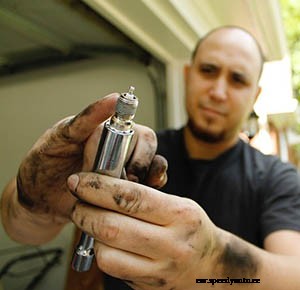
Your car’s engine uses fuel injectors, whose job is pretty straightforward – inject the proper amount of fuel into the engine to keep it running. Over time, the fuel injectors will naturally become dirty and can become clogged if left alone too long. If this happens, your engine won’t be able to get the fuel it needs to keep running.
Without the fuel it needs, your engine will misfire, causing the jerk you’re noticing while trying to accelerate. While this can go a short while, the longer you wait to have it checked by a mechanic, the more you risk causing further damage to your engine.
Between your gas pedal and the throttle plate is an accelerator cable. When you press down on your gas pedal, the accelerator cable opens the throttle so that your car can increase in speed. Over time, this cable wears out and can even break if left too long. A worn cable will make it difficult to accelerate.
As your accelerator cable wears out, you’ll increasingly notice jerking when trying to accelerate. The longer you let this go, the more frequently you’ll notice jerking and the more you risk the cable breaking. Once the accelerator cable breaks, you won’t have any acceleration power, so it poses a real safety issue.
The catalytic converter is an essential part of your car’s emissions system. In short, it converts toxic carbon monoxide into carbon dioxide, which is much less hazardous. This exhaust can now be pushed out through the tail pipe and away from your car. However, if you notice your car jerking from time to time, it could be because your catalytic converter is clogged.
If your catalytic converter becomes clogged, it’s likely an indicator of a larger problem with parts in your engine. That’s because the clog is the result of incorrect air-fuel mixture, causing fuel to pass through the catalytic converter. This can cause your car to jerk for a few moments and can ultimately lead to catalytic converter failure. It’s important to have your engine and emissions system inspected if you suspect your catalytic converter is to blame.
